
Welcome to this fascinating exploration of a rich and little-known heritage. The Karen people represent a Tibeto-Burman ethnic community numbering between 4 and 5 million individuals. About 90% of them reside in Myanmar, while the others mainly live in Thailand.
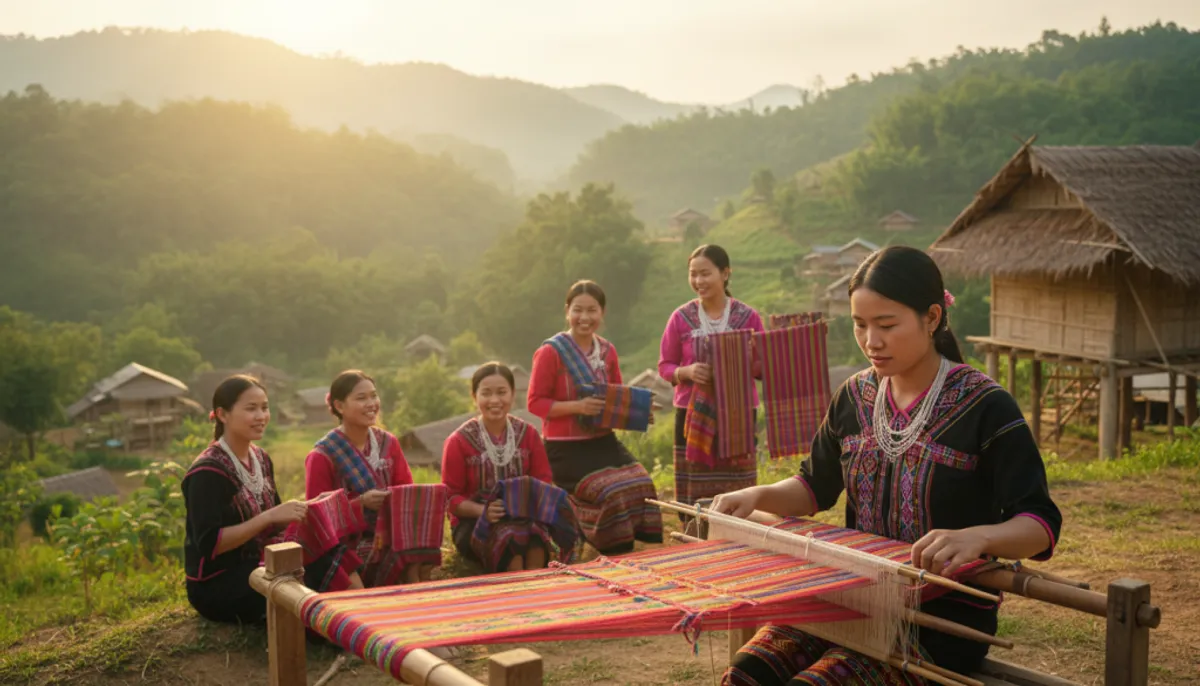
This group constitutes the second largest ethnic minority in Myanmar after the Shans. The term “Karen” comes from the anglicization of the Burmese word “Kayin,” but these populations refer to themselves as “Pwa Ka Nyaw Po,” which literally means “the Men.”
Their cultural heritage dates back to mysterious origins in the heights of Central Asia. Despite historical and contemporary challenges, this community has managed to preserve its unique identity with remarkable resilience.
We will discover how their traditions manifest in daily life, spiritual rituals, and craftsmanship, including the intricate art of iban craftsmanship. This ancient Karen culture continues to adapt to the modern world while maintaining a deep connection to its ancestral roots.
Key Points to Remember
- The Karens form an ethnic group of 4 to 5 million people
- 90% live in Myanmar, 10% in Thailand
- Second ethnic minority in Myanmar after the Shans
- The term “Karen” comes from the Burmese “Kayin”
- They refer to themselves as “Pwa Ka Nyaw Po” (the Men)
- Rich culture preserved despite historical challenges
- Traditions that adapt to the modern world
Introduction to Karen Culture
Let’s explore the significant presence of a major ethnic group in two countries of Asia. This community represents an important demographic force in the region.
Overview and Context
The Karens constitute the largest tribal minority in Myanmar. They also represent the most significant tribe in northern Thailand.
The estimated population exceeds one million people in Thailand alone. Their documented presence dates back to the 8th century BC.
The first explicit mention of the term “Karen” appears in the mid-18th century. This people has therefore occupied these territories for millennia.
| Aspect | Myanmar | Thailand |
|---|---|---|
| Demographic Status | Largest tribal minority | Main tribe in the north |
| Regional Importance | Second ethnic group | Significant presence |
| Documented History | Since the 8th century BC | Established population |
Objectives of the Article
Our approach aims to offer a respectful and in-depth understanding. We will avoid stereotypes to present the complex reality of this identity.
The article will clarify the different historical names. It will also examine contemporary challenges and highlight unique contributions.
This introduction establishes the necessary framework for the following sections. They will explore each aspect of life and traditions in detail.
The Origins and Migrations of the Karen People
The migratory journey of this ethnic group reveals a fascinating millennial history. This community traversed vast territories before settling in its current regions.
The Earliest Historical Traces
The earliest written mentions date back to the 12th century. They appear on a Mon commemorative stele.
This ancient documentation confirms an established presence for many years. Oral tradition evokes even older accounts.
The Great Migrations from Central Asia
According to legend, the first members crossed a “river of sand.” Some researchers see this as a reference to the Gobi Desert.
Their probable origin lies in Yunnan and the Tibetan highlands. They migrated southward, following the great river valleys.
The hero Tumeipa is said to have led this great migration from the “great river of sand.” The arrival in Myanmar occurred in three successive waves.
These movements around 700 BC definitively marked their settlement. The distant origin still influences the traditions of this community today.
The History of the Karens Through the Centuries
Spanning the ages, the history of this ethnic group reflects a constant adaptation. Their journey reveals a saga of resilience in the face of centuries of challenges.
From Ancient Origins to the Middle Ages
This community first settled in the plains. They were later driven out by Mon, Pyu, and Bamar colonizations. Unlike the Shans or Kachins, they never created proto-states.
The kingdoms of Bagan organized massive deportations in the 11th-13th centuries. These events profoundly marked their geographical dispersion.
The Influence of Neighboring Empires
In the 13th century, the Sgaw took refuge in the Yoma mountains. The weakening of the Toungoo dynasty around 1740 led to tragic uprisings.
“Resistance through the ages forges the identity of a people”
Periods of Conflict and Alliances
The Burmese-Thai wars of the 17th-18th centuries caused significant migrations. During World War II, many pogroms were committed.
In 1948, after the independence of Myanmar, this community demanded autonomy. They then founded the Karen National Union.
| Period | Major Event | Consequence |
|---|---|---|
| 11th-13th centuries | Deportations by Bagan | Geographical dispersion |
| 17th-18th centuries | Burmese-Thai wars | Migration to Thailand |
| 1942-1945 | Japanese invasion | Pogroms and resistance |
These years of struggle have shaped a unique identity. Time has strengthened their determination to preserve their traditions.
The Diversity Within the Karen People
The internal composition of this ethnic community reveals a fascinating complexity. Unlike a homogeneous entity, this Karen people forms a mosaic of distinct sub-groups.
The Sub-Groups and Their Specificities
Ethnologists identify four main constitutive groups. Each entity has its own demographic and cultural characteristics.
The term “Karen” thus encompasses about fifteen related communities. Their exact classification remains debated among specialists.
| Sub-group | Estimated Population | Distinctive Characteristics | Geographical Distribution |
|---|---|---|---|
| Sgaw | 1.5 to 2 million | Majority group | Myanmar, Thailand |
| Pwo | ~1 million + 50,000 | Significant minority | Myanmar, Thailand |
| Kayah (Karenni) | ~500,000 | Women with leg rings | Kayah State (Myanmar) |
| Pa-O | ~550,000 | Mountain community | Shan State (Myanmar) |
The Cultural and Linguistic Mosaic
This diversity is also expressed in linguistic practices. Each group uses variants of the same original language.
The Padaung, for example, are famous for their unique clothing traditions. Their specific name illustrates the richness of this internal fragmentation.
The general term thus masks a multi-layered reality. This complexity represents both a richness and a challenge for collective unity.
Karen Culture in Myanmar and Thailand
The existence of the Karens on both sides of the Burmese-Thai border presents striking contrasts. Their geographical distribution reflects radically different political and social realities.
The Geographical and Political Differences
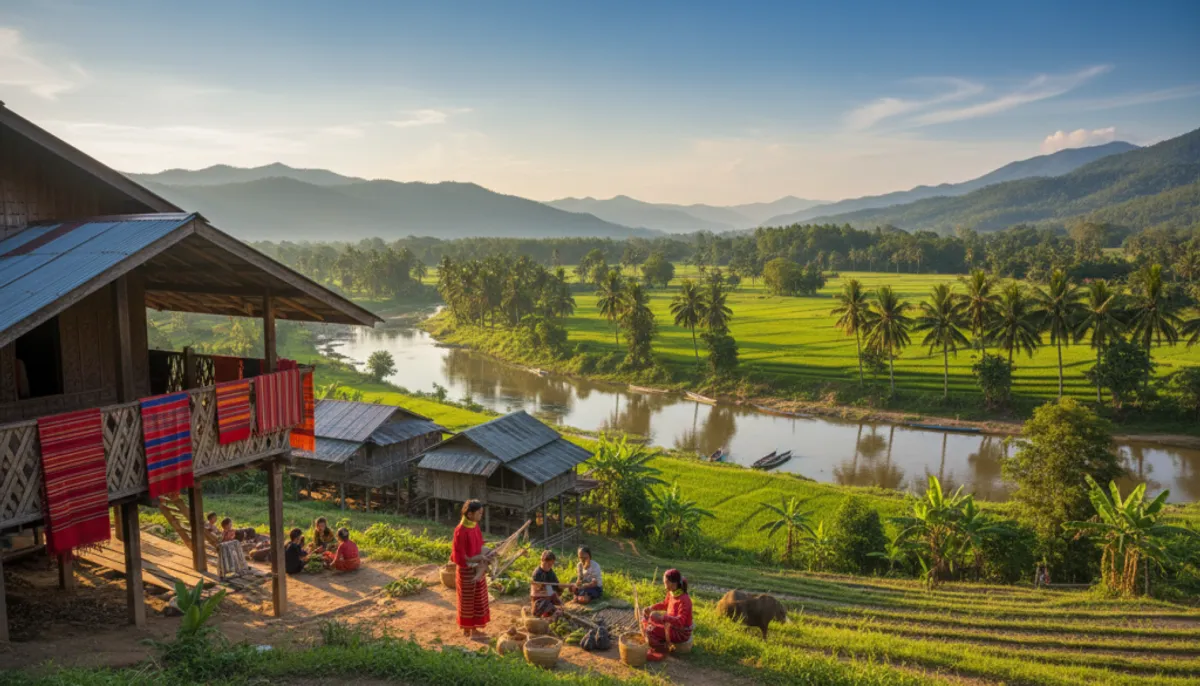
In Myanmar, this community occupies three main regions. The Irrawaddy delta, the Pegu Yoma mountains, and the eastern hills near the Thai border constitute their traditional territories.
The Karen and Kayah States gather the majority of the population. The political situation remains marked by a prolonged armed conflict since 1948.
In Thailand, their presence extends along the border area. The province of Tak, in the north of the country, represents an important demographic center.
The integration processes vary significantly. Some groups, particularly the Buddhist Pwo, have adopted local language and customs.
This geopolitical divergence profoundly influences living conditions. The specific challenges in each country shape distinct community experiences.
Daily Traditions and Customs
The rhythm of daily life among this people reveals a harmony between traditions and community needs. Each day is organized around specific activities that strengthen social bonds.
Family and Community Rituals
The family is the heart of social organization. Shared meals between neighboring villages create regular opportunities for gatherings.
This natural sociability manifests during collective ceremonies. It unites communities beyond geographical boundaries.
Craft and Culinary Practices
Men dedicate their days to farming, hunting, and construction. Women excel in traditional weaving and gathering.
This complementarity ensures the balance of community life. Tobacco and betel nuts are part of social habits from childhood.
The matrilineal organization influences inheritance and family decisions. This egalitarian structure promotes an equitable distribution of tasks.
Each meal prepared and each woven textile carries a deep cultural significance. These daily gestures preserve identity across generations.
Ancestral Rituals and Beliefs
At the heart of religious practices lies a remarkable syncretism blending animism and Christianity. This unique fusion reflects a fascinating spiritual adaptation.
Animist Spirituality
Even after conversion, members maintain traditional rites. They venerate the Ancients and the “God of Earth and Water.” This deity embodies the sacred link with the environment.
Shamans play a crucial role in the community. They are consulted to prevent illnesses and protect souls. They help navigate difficult spiritual trials.
| Spiritual Element | Function | Manifestation |
|---|---|---|
| God of Earth and Water | Environmental protection | Preservation rituals |
| Ancestral Spirits | Morale guidance | Honor ceremonies |
| Shamans | Spiritual healing | Regular consultations |
Traditional Ceremonies
Several times a year, the community gathers for important celebrations. Every member actively participates in these events.
Nature occupies a central place in all rituals. The preservation of large trees is an integral part of practices. This environmental sanctification ensures collective harmony.
The ceremonies strengthen the ties between the visible and invisible worlds. They honor natural cycles and deceased ancestors.
The Impact of Christianity and Missionaries
The arrival of missionaries marked a decisive turning point in the history of java this people. The 19th century brought major religious changes that permanently transformed society.Evangelization and Its Consequences
In 1813, Adoniram and Ann Judson settled near Moulmein. Their work paved the way for the evangelization of ethnic minorities.
The conversion of Ko Tha Byu in 1822 was a founding event. This historical fact triggered a movement of massive conversion during these crucial years.
Missionary schools formed an educated elite. This education became the breeding ground for emerging nationalism.
| Period | Key Event | Lasting Impact |
|---|---|---|
| 1813 | Judson's settlement | Beginning of evangelization |
| 1822 | Conversion of Ko Tha Byu | Conversion movement |
| 1826 | British annexation | Mass arrival of missionaries |
| 20th century | Formation of educated elite | Emergence of nationalism |
Over time, this community developed a unique religious syncretism. They retained some traditional beliefs while adopting Christianity.
This adaptation demonstrates a remarkable capacity for integration. The role of missionaries remains a fascinating subject of study for historians.
The Role of Women in Karen Culture
Women hold a fundamental position in the social organization of this community. Their influence extends well beyond the traditional domestic sphere.
Traditional and Symbolic Roles
The matrilineal system grants women significant authority in family decisions. They manage inheritance and pass down heritage to future generations.
Their economic contribution is essential for subsistence. They actively participate in agriculture, weaving, and food gathering.
| Traditional Aspect | Female Responsibility | Community Impact |
|---|---|---|
| Family Organization | Matrilineal transmission | Social stability |
| Economic Activities | Weaving and agriculture | Collective subsistence |
| Protection Rituals | Amulets and diets | Maternal health |
Protective practices around pregnancy reveal their resilience. In the face of maternal mortality, they have developed complex strategies.
“The knowledge of the ancients protects new mothers”
Contemporary Evolutions
Today, these women negotiate between preserving traditions and modern adaptation. Access to education is gradually transforming their place in society.
However, they still maintain ancestral rituals such as the three days by the fire after childbirth. This fidelity to customs ensures identity continuity.
Craftsmanship and Agricultural Practices
Artisanal and agricultural skills represent a fundamental pillar of the traditional economy. These know-hows, including balinese arts, demonstrate remarkable adaptation to the mountainous environment.Traditional Weaving
Practiced mainly by women, the art of weaving produces functional clothing and decorative pieces. Each textile carries a unique cultural identity.
The patterns and colors follow ancestral traditions. This activity constitutes an essential part of female artistic expression.
Slash-and-Burn Agriculture and Rice Terraces
Unlike other groups, this community uses an eco-responsible crop rotation system. Their approach minimizes environmental impact.
They build elaborate terraces to cultivate rice during the rainy season. This technique highlights their technical ingenuity.
Forestry expertise includes teak logging and elephant handling. These historical skills have played a central economic role.
Cattle and elephants represent the main signs of traditional wealth. These markers of prestige integrate into the community's economic system.
The Language and Cultural Expression
The diversity of dialects and languages beautifully illustrates the plurality within this ethnic group. Each linguistic variation carries a unique story.
Linguistic Particularities
The name “Karen” comes from missionary Francis Mason in 1866. This term Burmese “kayin” has no direct equivalent in their own languages.
Members use distinct self-designations according to their sub-groups. These names all mean “the Men” in their respective dialects.
| Sub-group | Self-Designation | Meaning | External Name |
|---|---|---|---|
| Sgaw | Pra/Pwa K’gnaw | The Men | Kareang (Mons) |
| Pwo | Hploun Hpou | The Men | Kariang (Thai) |
| Kayah | Keyè Li Hpou | The Men | Yang (Shan) |
The various neighboring peoples use different terms to refer to this community. This plurality reflects complex historical relationships.
Oral transmission remains essential for preserving this linguistic richness. Contemporary challenges threaten certain dialectal variations.
Verbal expression constitutes a fundamental pillar of collective identity. It conveys precious myths, songs, and ancestral knowledge.
Karen Culture in the Contemporary Context
In the era of globalization, this ethnic community faces profound transformations. Its ancestral way of life now encounters modern economic realities.
The Challenges of Modernization
Formal education is now a priority for families. Children attend government or missionary institutions.
This school integration, however, poses a major difficulty. It sometimes distances younger generations from traditional knowledge.
Some members have found new economic opportunities. They export rare products to international markets.
| Traditional Aspect | Modern Transformation | Community Impact |
|---|---|---|
| Oral Transmission | Formal Education | Generational gap |
| Village Economy | International Trade | New wealth |
| Community Life | Global Diaspora | Transnational links |
The Importance of Tradition Transmission
A significant diaspora has established itself in several Western countries. Communities can be found in Australia, North America, and Europe.
Despite geographical distance, these groups maintain a regular return to ancestral practices. They organize cultural events to preserve their heritage.
“Our challenge is to balance modernity with fidelity to our roots”
Transmission strategies evolve in the face of these changes. They now combine traditional methods with digital tools.
The Preservation of Nature and Eco-Responsibility
In the heart of the Thai mountains, ancient environmental wisdom continues to guide daily practices. This community demonstrates a remarkable balance between human needs and respect for ecosystems.
Rituals of Respect for the Environment
Their ecological approach finds its roots in profound spirituality. The veneration of the “God of Earth and Water” inspires every act of protection.
Large trees are considered sacred and preserved with care. This belief that all natural elements possess a divine essence guides their actions.
The agricultural system uses intelligent crop rotation. This method minimizes soil impact and maintains land fertility.
Specific rituals honor the jungle and hills surrounding them. Each crossing of territory is accompanied by gestures of respect towards nature.
This traditional environmental ethic gains relevance today. In the face of the global ecological crisis, their model offers sustainable solutions.
The ecological knowledge of this people is now recognized internationally. Their role as guardians of biodiversity inspires modern conservation policies.
Community Life and Karen Villages
Each village constitutes an autonomous social unit where collective identity is expressed. These communities generally consist of about twenty stilt houses, perfectly adapted to the mountainous hills.
Social Organization and Village Structure
The village society is based on egalitarian principles. The priest holds the supreme spiritual authority in each community.
The fundamental social unit remains the nuclear family. It then expands to the lineage and finally to the entire village.
| Social Level | Main Function | Responsibilities |
|---|---|---|
| Nuclear Family | Basic unit | Daily life |
| Lineage | Family solidarity | Heritage transmission |
| Village | Local community | Collective decisions |
| Village Complex | Expanded network | Regional exchanges |
Community Gatherings and Shared Meals
The inhabitants of different villages meet regularly. These gatherings strengthen social ties beyond local boundaries.
Shared meals constitute privileged moments of exchange. Each participant contributes to the collective preparation.
Construction and Village Lifestyle
Stilt houses protect against humidity and animals. This traditional architecture reflects ingenious adaptation.
The village lifestyle creates natural solidarity among all inhabitants. Men and women work together for common prosperity.
In-Depth Exploration of Karen Culture
For curious travelers, an authentic immersion in Karen territories offers a unique understanding of their traditions. This approach allows for the discovery of their way of life beyond mere tourist observations.
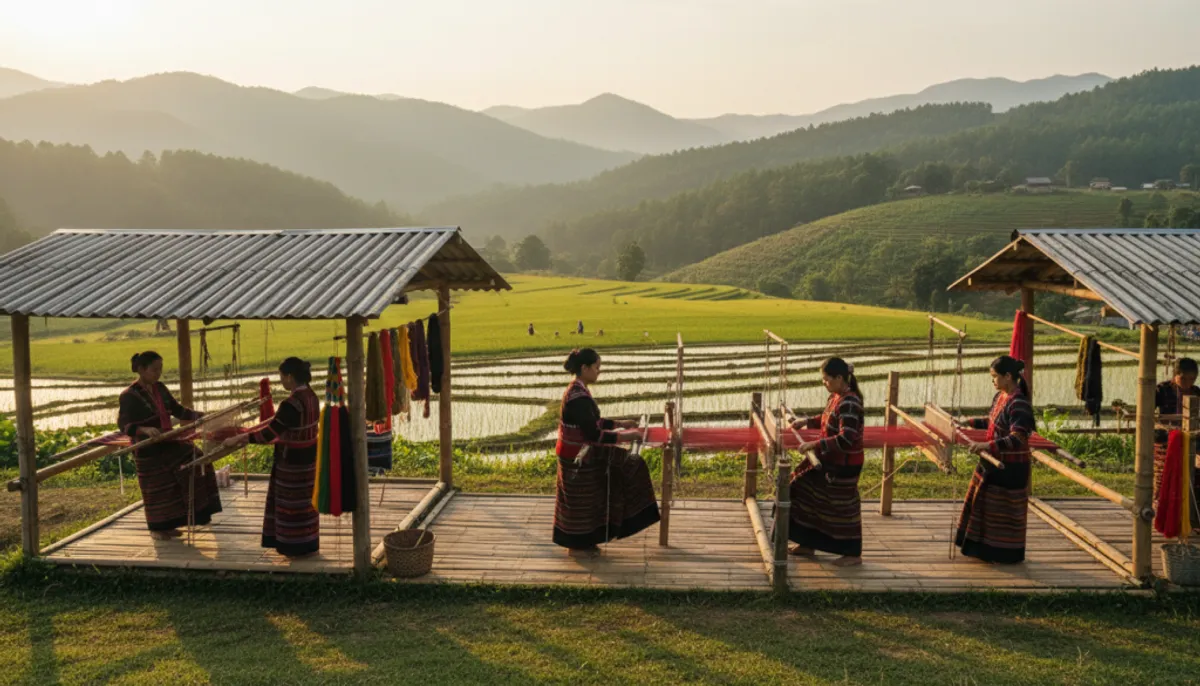
Chiang Mai serves as the ideal starting point for these adventures. From this city in the north, several routes lead to the hill villages. Each itinerary offers different experiences.
| Itinerary | Duration | Main Experiences | Difficulty |
|---|---|---|---|
| Chiang Mai – Tak Province | 2-3 days | Meetings with inhabitants, craftsmanship | Easy |
| Crossing the border | 5-7 days | Jungle, rivers, diversity of groups | Moderate |
| Southern Regions | 4-6 days | Agriculture, specific traditions | Easy to moderate |
The price of these trips varies according to duration and included services. It is essential to choose packages that directly benefit local communities.
Analysis of Traditions and Contemporary Challenges
These expeditions reveal the difficulties faced by these communities. Access to certain regions remains limited, particularly on the Burmese side.
The return from these trips brings deep reflection on the preservation of traditions. The fruits of these encounters include authentic intercultural understanding.
This respectful approach recognizes that visitors are privileged guests. It values ethical tourism that supports the preservation of their unique heritage.
Conclusion
At the end of this discovery, the resilience of this people stands out as a remarkable testament. Despite the difficulties faced over time, their distinct identity persists strongly.
The family and community bonds remain the fundamental pillars of the traditional way of life. These values structure each day in the hills as well as in the plains of the south.
The internal diversity of this ethnic group, spread across different regions and countries, enriches the collective heritage. Each sub-group contributes its unique part to this cultural mosaic, including the preservation of sundanese cultural patrimony that reflects their rich traditions.The fact that these dayak traditions – from rice cultivation to spiritual rituals – endure while adapting demonstrates an exceptional capacity for evolution. Their worldview offers valuable lessons for our time.This return to their origins and historical journey invites nuanced understanding. May this knowledge inspire lasting respect for this unique heritage.
FAQ
Where does the Karen people come from and where do they live today?
This ethnic group originates from the border regions between Myanmar and Thailand. Today, their communities are mainly established in the northern hills of these countries, notably near Chiang Mai.
What is the traditional lifestyle in a village?
Daily life is marked by agriculture, such as rice cultivation. The inhabitants live in harmony with nature, building their stilt houses and often sharing communal meals.
What are the main challenges faced by this people?
What role do women play in this society?
How does a trip to visit these communities unfold?
A responsible stay involves reaching a village via often winding roads, respecting local customs, and participating in daily life, such as helping in the fields or sharing a meal.
What are their main spiritual beliefs?
Many practice ancestral animism, with great respect for the spirits of nature, rivers, and elephants. Christianity, introduced by missionaries, is also present.