
Welcome to a fascinating exploration of a country with deep roots and a unique character. Kazakhstan is located at the crossroads of Central Asia and Europe. This geographical position has forged a rich and complex history.
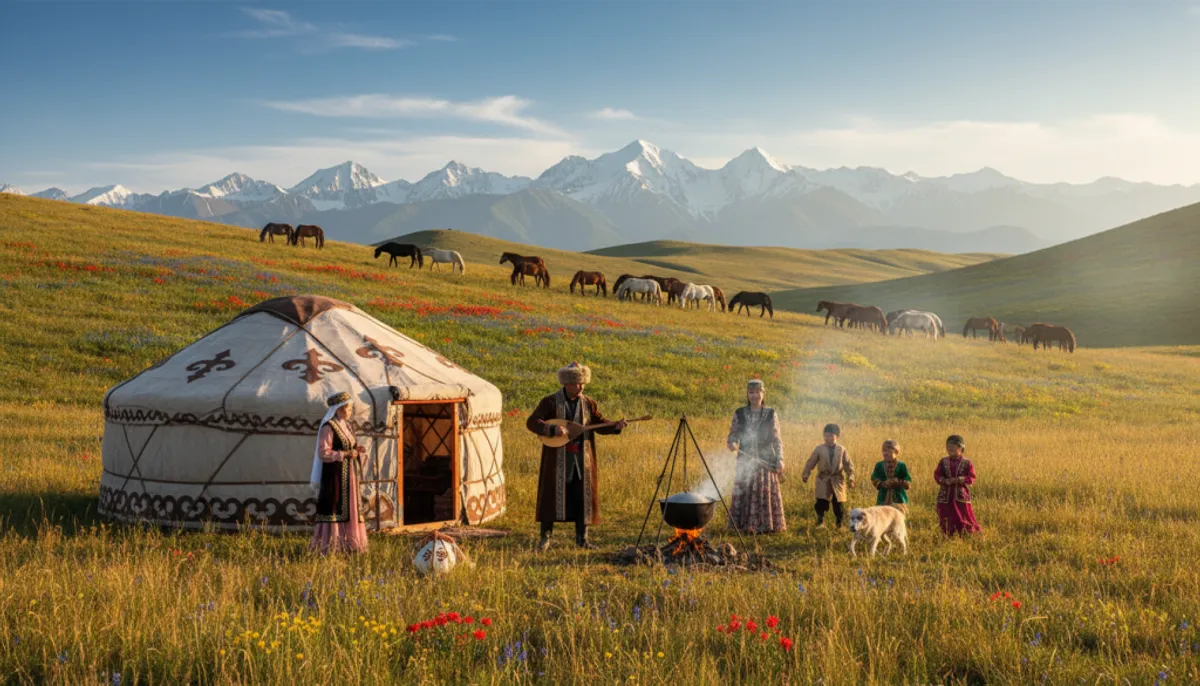
The soul of this nation draws its essence from an ancestral way of life: nomadic pastoralism. This way of life has wonderfully withstood the test of time, especially in the regions of Almaty and Altai. It constitutes the heart of a living and authentic heritage.
Over the centuries, this territory has welcomed influences from all over the world. China, Mongolia, Turkic peoples, and Russia have each added their touch. These constant exchanges, at every era, have enriched without erasing the local essence.
This fusion has given birth to a strong identity, visible in the arts, traditions, and worldview. The yurt, equestrian games, and music are powerful symbols of this identity, reflecting the rich kazakh traditions. Let us dive together into the customs that define this proud people.
Key Points to Remember
- Kazakhstan is a multinational country located at a strategic geographical crossroads.
- Its cultural identity is deeply linked to a nomadic pastoral way of life.
- The vastness of the steppe has fundamentally influenced its culture and traditions.
- Kazakh heritage is enriched by diverse influences (Chinese, Mongolian, Turkic, Russian).
- The yurt, equestrian games, and craftsmanship are major cultural symbols.
- This culture represents the essence of the nomadic spirit of Central Asia.
The Historical Legacy and Nomadic Tribes
Let us discover together the historical foundations that have built the unique character of this territory. It all begins with the Botai culture, over 5000 years ago.
This founding period saw the domestication of the horse. It marks the beginning of a special relationship between man and animal.
The Origins of Tribes and Nomadic Life
The first tribes developed a deep understanding of their environment. The “Thinker of Tobyl” testifies to their spiritual vision.
In the first millennium BCE, the Scythians and Saka emerged. Their world expanded across vast expanses.
The discovery of the “Golden Man” in 1969 reveals their artistic mastery. These ancestors created works of remarkable beauty.
The nomadic wisdom lies in the balance between movement and rootedness.
The Influence of Scythian and Turkic Civilizations
In the 6th century, the Turkic peoples established the first khaganate. This political model endured for centuries.
They achieved a unique symbiosis between nomadic life and sedentariness. Cities like Otrar became flourishing cultural centers.
| Historical Period | Civilization | Major Contribution |
|---|---|---|
| 4th millennium BCE | Botai Culture | Domestication of the horse |
| 1st millennium BCE | Scythians/Saka | Animal art and goldsmithing |
| 6th century | Turkic | Creation of the khaganate |
| 15th-17th century | Kazakh Khanate | Foundation of the nation |
The Kazakh khanate (1465-1718) represents the culmination of this long history. It united the various tribes under one name.
This era truly founded the identity of the modern people. The legacy of the nomads continues to inspire today.
Traditions at the Heart of Kazakh Steppe Culture
At the heart of traditional practices are elements that define the nomadic spirit. These customs have transcended time and remain alive today.
The Yurt: A Symbol of Home and Identity
The yurt represents much more than a simple shelter. This portable dwelling embodies home and nomadic identity.
Its structure consists of three main elements. The kerege forms the lattice frame. The yuk constitutes the roof posts. The shanyrak adorns the circular top.
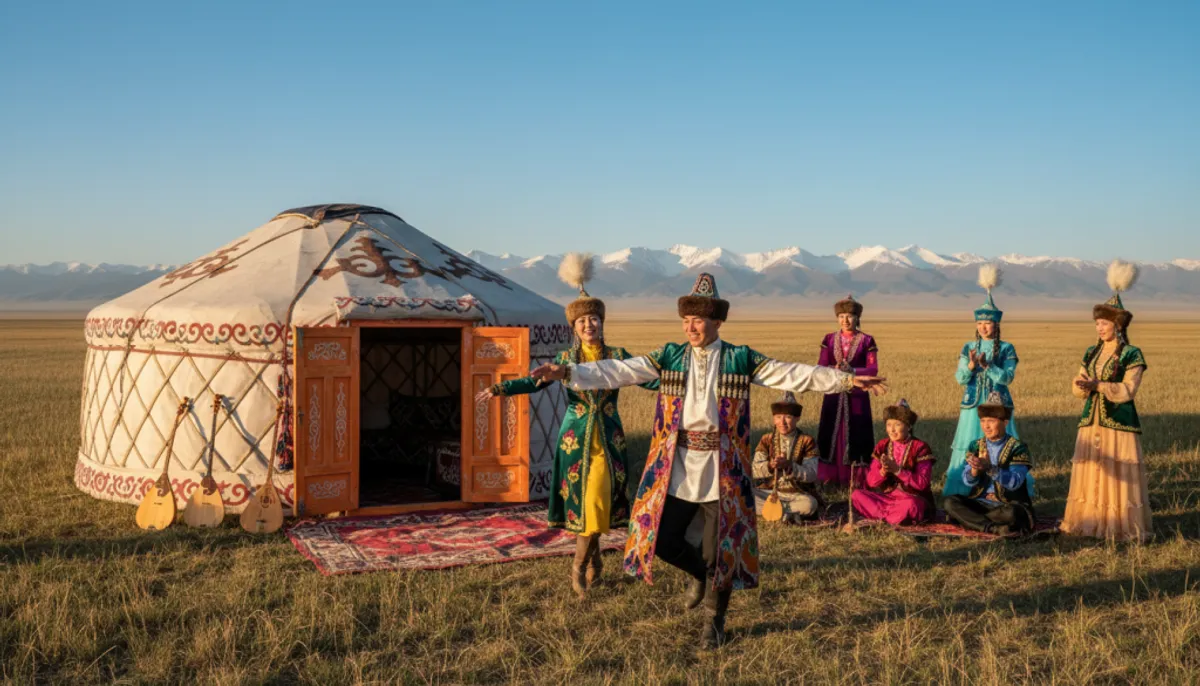
These objects testify to a tradition that is still present. Yurts are still used in rural areas. They also serve as elements of modern decoration.
Equestrian Games and Nomadic Rituals
Horse riding remains central to local life. It reflects an ancestral way of life linked to the horse.
Kokpar is a spectacular team sport. Riders compete for a goat carcass on the steppe. This practice requires strength and skill.
| Equestrian Game | Description | Particularity |
|---|---|---|
| Kokpar | Team sport with animal carcass | Requires strength and collective strategy |
| Alaman baiga | Long-distance race | Can reach 100 kilometers |
| Kyz kuu | Horse chase game | Traditional seduction ritual |
The alaman baiga tests the endurance of local horses. The kyz kuu illustrates seduction rituals with humor. These games perpetuate a rich tradition.
The Artistic and Craft Expressions of Kazakhstan
Kazakh creative expression draws its strength from a millennia-old oral tradition. These arts have been passed down from generation to generation without written notation.
Music, Tales, and Traditional Literature
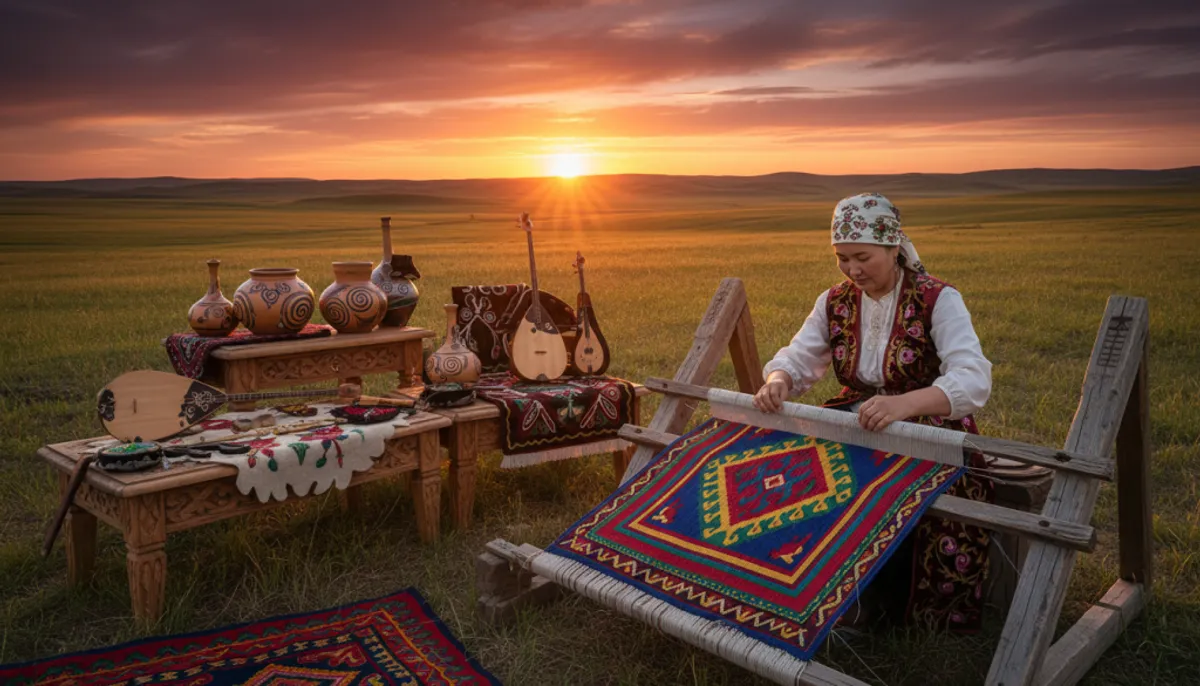
The kui represents a characteristic musical form. Musicians play the dombra, a string instrument, while narrating epic tales and popular legends.
This tradition thrived from the 15th to the 17th century. It preserves ancestral narratives through music.
The aytys were poetic competitions comparable to modern rap battles. Poets improvised verses accompanied by string instruments.
Abai Kunanbayev, a 19th-century writer, remains the most famous literary figure. His legacy is an integral part of the national heritage.
Craftsmanship and Decorative Objects in Daily Life
Craftsmanship has developed in response to the nomadic way of life. It creates objects that are both practical and aesthetic, including the vibrant and intricate baloch handicrafts that showcase the artistic heritage of the region.
The main trades include woodworking and felt production. The latter effectively insulates traditional dwellings.
The creation of equestrian gear and fur clothing reflects adaptation to the climate. Blacksmithing and jewelry making achieve great technical mastery.
The animal style was particularly popular in past goldsmithing. These works demonstrate remarkable artistic sensitivity.
Kazakhstan: A Crossroads of Cultures and Multiple Influences
Kazakhstan shines as a true bridge between civilizations. Its unique geographical position has made it a territory of encounters and constant exchanges.
The Impact of Cultural Exchanges with Asia, Europe, and Russia
This country has integrated elements from China, Mongolia, and Turkic peoples. Russia has also left its mark on this region.
In the 19th and 20th centuries, society underwent profound transformation. The shift from nomadism to sedentariness gave birth to modern cities.
Ahmet Yasawi, a 12th-century poet, played a crucial role in the development of Islam. His influence still resonates throughout Central Asia.
Museums, Exhibitions, and Contemporary Heritage
The mausoleum of Khoja Ahmet Yasawi in Turkistan is an architectural gem. Built under Tamerlane, it showcases magnificent blue and turquoise bricks.
This mausoleum represents one of the finest examples of Timurid architecture. It testifies to the artistic richness of this era.
The Guimet Museum in Paris features the exhibition “Kazakhstan, Treasures of the Great Steppe.” This exhibition offers a journey through the history of the country.
One can admire exceptional masterpieces, including the ornaments of the Golden Man. These unique pieces allow the world to discover this remarkable heritage.
Conclusion
In the heart of Central Asia, a unique identity endures despite the upheavals of time. The Kazakh people have managed to preserve their rich heritage while opening up to the modern world.
The nomadic way of life of the past continues to inspire contemporary life. This heritage can be found in traditional objects and ancestral rituals.
This fascinating land invites a journey of discovery. The region's museums and festivals allow for exploration of this authentic Kazakh culture.
The role of the nomadic ancestors remains essential in the national identity. Their wisdom still guides the country in the 21st century.
The man and the steppe maintain their age-old bond. This harmony constitutes a fundamental part of the soul of this unique region.
FAQ
What is the role of the horse in the nomadic way of life?
The horse is absolutely central. It was much more than just a means of transport; it was a companion for journeys, a tool for herding livestock, and an indispensable partner for equestrian games. It symbolized freedom and mobility across the vast expanses of the territory.
How does the yurt reflect the identity of the people?
The yurt is much more than a dwelling. Its style, structure, and the arrangement of objects inside follow precise traditional rules. It represents a mobile home, perfectly adapted to the lifestyle of the ancestors, and its decorative art often tells the stories of families and tribes.
Where can we discover this heritage today?
Many museums in Kazakhstan, such as the National Museum in Astana, preserve objects and present exhibitions dedicated to this rich history. One can also visit historical mausoleums and, in some regions, participate in festivals that revive uyghur music, legends, and craftsmanship of that era.
What are the most characteristic forms of craftsmanship?
Craftsmanship is very diverse! The work with textiles, such as carpets and felting, is renowned. The making of silver jewelry and saddlery for horses are also highly developed forms of art. Each object, from ropes to decorations, combines utility and beauty.
How have exchanges influenced this culture over the centuries?
As a crossroads in Central Asia, the country has always been a land of encounters. Influences from neighboring civilizations, Europe, and Russia have blended over time with local tradition. This is evident in certain decorative motifs, in music, and even in literature, creating a unique heritage.