
Welcome to this exploration of a fascinating heritage, at the heart of a nation's identity. This country in Southeast Asia, Myanmar, possesses a deep historical and artistic wealth, largely carried by its main ethnic group.
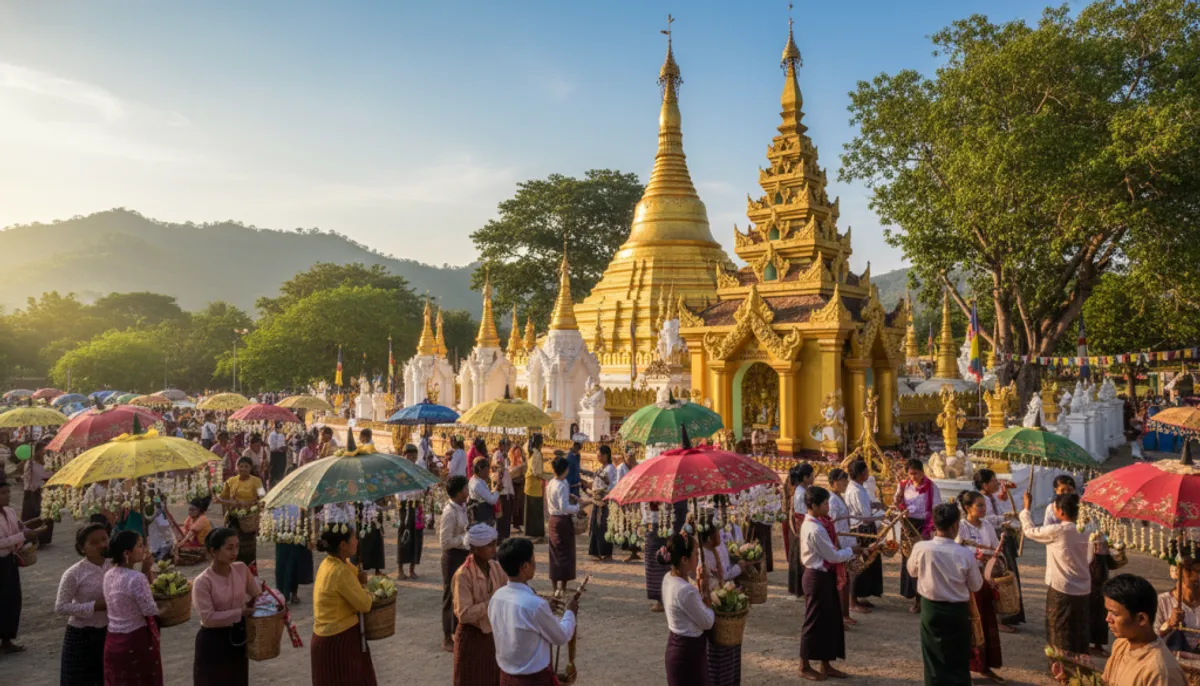
Over the centuries, this society has been built by integrating various contributions. Buddhist, Indian, and Chinese influences have harmoniously blended. They have given birth to a unique and vibrant identity.
The tumultuous history of the region has directly shaped its traditional expressions. Today, these traditions remain very much alive. From sacred architecture to narrative dances, the artistic panorama is of remarkable diversity.
This article offers you a journey through the multiple dimensions of this culture. We will discover its roots, its religious practices, and its contemporary challenges. Let us dive together into this captivating universe.
Key points to remember
- The majority ethnic group in Myanmar carries a rich and ancient culture.
- Its historical development has integrated Buddhist, Indian, and Chinese influences.
- The country's history has profoundly marked its artistic and social traditions.
- Architecture, such as that of the temples of Pagan, is a pillar of this heritage.
- Traditional dances often draw inspiration from great epics.
- This culture faces modern challenges in a complex ethnic context.
Introduction to Burmese culture
At the crossroads of civilizations, a fascinating identity has flourished. This country in Southeast Asia presents an exceptional cultural mosaic, including the rich and diverse khmer krom culture.
General overview and historical context
The history of this region reveals a journey rich in transformations. Powerful kingdoms have marked its development. Colonization and independence have also shaped its identity.
The ethnic groups contribute to this remarkable diversity. Their ongoing dialogue enriches the national heritage. Despite some tensions, this plurality remains a strength.
| Cultural Aspect | Indian Influence | Chinese Influence | Local Expression |
|---|---|---|---|
| Architecture | Temples and stupas | Construction techniques | Unique Burmese style |
| Cuisine | Spices and curries | Cooking techniques | Distinctive flavors |
| Performing Arts | Classical dances | Musical instruments | Traditional forms |
Cultural and artistic aspects
This article explores the multiple artistic expressions. Monumental religious architecture impresses with its beauty. Literature and narrative theater captivate minds.
Traditional music and refined craftsmanship complete this panorama. These elements form a living and dynamic heritage. They testify to a constantly renewed creativity.
The roots of Bamar Burmese culture
The origins of this civilization date back to millennia of migrations from the high plateaus. This human adventure has profoundly marked the development of society.
Historical origins and Asian influences
About 3000 years ago, populations left Tibet to settle in the Irrawaddy valley. These movements gave birth to the main identity of the country.
The current territory has always experienced very permeable borders. This geographical characteristic has favored constant exchanges with neighboring nations.
| Source of Influence | Main Contribution | Lasting Impact | Modern Expression |
|---|---|---|---|
| India | Buddhism and literature | Religious foundations | Sacred architecture |
| China | Political structures | Social organization | Traditional commerce |
| Local populations | Indigenous traditions | Cultural syncretism | Ethnic diversity |
The ability to integrate external elements while preserving a distinctive identity represents the strength of this society.
These different groups have gradually assimilated the populations present. The Pyu, earlier inhabitants of the region, have thus contributed to enriching the heritage of Sarawak.
The ancient history reflects remarkable adaptability. This capacity for absorption still characterizes the national culture today.
History of kingdoms and imperial influences
The kingdom of Pagan emerged as the first unified political entity of this country. Founded in 849, it lasted nearly four hundred years, leaving an indelible mark.
Its capital, Bagan, was a vibrant metropolis. It attracted merchants and thinkers from all over Asia.
The kingdom of Pagan and its legacies
The reign of King Anawrahta (1044-1078) was a decisive turning point. His conversion to Theravada Buddhism and his military victory in 1057 unified the territory.
This period saw the emergence of the Burmese language as the dominant language. It gradually replaced Pali and Sanskrit in administration and literature.
The most visible legacy of these years of glory remains the thousands of temples and stupas. They still dot the plains of Bagan today.
Cultural exchanges with India and China
The neighboring kingdoms profoundly influenced local development, showcasing their regional influence. India brought major religious, architectural, and artistic traditions.
China exerted more political and commercial influence. These exchanges shaped a unique identity, a blend of external contributions and local innovations.
The following kingdoms inherited this solid cultural foundation. This complex history continues to define the modern country.
Impact of British colonization
The British colonial period marked a decisive turning point in the evolution of the country. For several years, this domination profoundly transformed social and political structures.
Introduction of Western elements
The British established their educational system, creating an English-speaking elite. Victorian architecture altered the urban landscape, particularly in Yangon.
This westernization also affected the ethnic minorities. Christian missions converted several communities such as the Karens and the Karens customs, Kachin.
The colonial administration applied a strategy of division. It separated the territory into distinct zones, favoring certain minorities at the expense of the majority group.
- Transformation of the educational system based on the British model
- Colonial architecture visible in urban centers
- Conversion to Christianity of several ethnic groups
- Administrative separation creating lasting tensions
These years of domination left a complex legacy. Institutional modernization and social fractures still coexist today in this country.
Ethnic diversity and demographic distribution
With 135 distinct communities, this nation presents one of the richest ethnic mosaics in Asia. The officially recognized ethnic groups speak about a hundred different languages. This human diversity profoundly shapes the identity of the country.
Major and minority ethnic groups
The total population approaches 55 million inhabitants. The different ethnicities coexist in a complex demographic balance.
| Ethnic Group | Population Percentage | Main Region |
|---|---|---|
| Bamar | 57.2% | Central Irrawaddy Plain |
| Shan | 8.3% | Shan States (east) |
| Karen | 5.6% | Karen and Kayah States |
| Arakanese (Rakhine) | 4.9% | Rakhine State (west) |
| Môn | 2.1% | Môn State (southeast) |
The ethnic minorities represent about a third of the population. They predominantly inhabit the mountainous border areas.
This geographical distribution influences social dynamics. The different groups maintain their ancestral traditions. The country must cope with this rich diversity.
The role of Theravada Buddhism
Theravada Buddhism has deeply permeated the society of this Asian nation for centuries. This spiritual tradition, intertwined with balinese spirituality, represents much more than just a religion for the majority of inhabitants.
According to the 2014 census, about 88% of the population practices this ancient form of Buddhism. It guides individual and collective behaviors in daily life.
Religious practices and traditional ceremonies
Community life often organizes around the local monastery. The monks hold a respected position, supported materially by the laity.
Daily practices include morning offerings and visits to pagodas. Major festivals like Thingyan bring the entire population together.
These celebrations blend spirituality and conviviality. They mark the year according to the lunar calendar.
The influence on art and literature
The impact of Theravada Buddhism on artistic creation is considerable. Thousands of temples bear witness to this religious inspiration.
Literature has developed around Buddhist teachings. The jatakas, tales of the Buddha's past lives, constitute an important genre.
The monks have often been guardians of literary knowledge. They have preserved and transmitted these works through generations.
Traditions and cultural rituals
Rites of passage constitute a fundamental pillar of contemporary Burmese society. They mark important life stages and strengthen community ties, making the beneficiaries of the culture pass an integral part of these celebrations.
These ancestral practices are particularly vibrant in villages. They allow the transmission of values to new generations.
Novice ceremonies and family rituals
The shinbyu represents the most significant event for a young boy. This temporary initiation into the monastery symbolizes his passage to adulthood.
All boys are encouraged to become novices before the age of twenty years. This experience instills fundamental Buddhist principles in them.
For girls, an ear-piercing ceremony marks their maturation. These rites primarily concern Buddhist minorities but influence other communities.
| Type of Ceremony | Participants | Meaning | Duration |
|---|---|---|---|
| Shinbyu | Boys | Monastic initiation | Several days to weeks |
| Earring Piercing | Girls | Passage to adulthood | One day |
| Pagoda Festival | Entire community | Collective celebration | Several days |
Village festivals like the paya pwe bring together all groups. These events strengthen social cohesion and preserve traditions.
Some ethnic minorities adapt these rituals to their own customs, including dayak customs. This diversity enriches the national cultural heritage.These family and community celebrations keep the identity of the different groups alive. They constitute a precious legacy for future generations.
Burmese music, dance, and theater
The performing arts constitute a vibrant dimension of national expression. They reflect influences from neighboring regions while developing a distinctive character.
Influence of the Ramayana in the Yama Zatdaw
The Yama Zatdaw represents the national epic of this country. This adaptation of the Indian Ramayana incorporates Thai and local elements.
The Burmese version adds indigenous characters and Buddhist references. It thus creates a unique work that speaks directly to the identity of the territory.
Local artistic expressions
Traditional music uses remarkable instruments like the saung-gauk. The pat waing and the kyi waing produce enchanting melodies.
Dance is characterized by graceful movements and angular postures. The bending of knees and fingers creates a distinctive aesthetic.
Theater includes the zat pwe sung and the yoke thé pwe puppet show. The anyeint, a popular comedic form, mixes satire and entertainment.
These traditions are perpetuated during pagoda festivals. Traveling troupes present highly appreciated night performances.
This article shows how these arts evolve while preserving their essence. They constitute a living heritage for future generations.
Craftsmanship and literature in Myanmar
The skilled hands of artisans and the pen of writers have been telling the spiritual history of the territory for centuries. This article explores how these artistic expressions reflect the fundamental values of society.
Influence of Buddhism on the arts
Buddhism deeply permeates all creative forms. The lacquer of Bagan and handwoven textiles testify to ancestral know-how passed down through generations.
Lacquer objects stand out for their complex patterns applied in successive layers. This technique requires exceptional patience from local artisans.
Classical literature has developed around religious teachings. Palm leaf manuscripts combine elegant calligraphy and refined illustrations.
Traditional poetry explores themes such as impermanence and spiritual quest. These works follow complex metric forms inspired by metaphysics.
Religious architecture represents the most spectacular expression of this influence. Thousands of pagodas and temples feature sculptures narrating the life of the Buddha.
This article shows how craftsmanship and literature enrich the heritage of the country. These traditions continue to evolve while preserving their spiritual essence.
Traditional cuisine and gastronomy
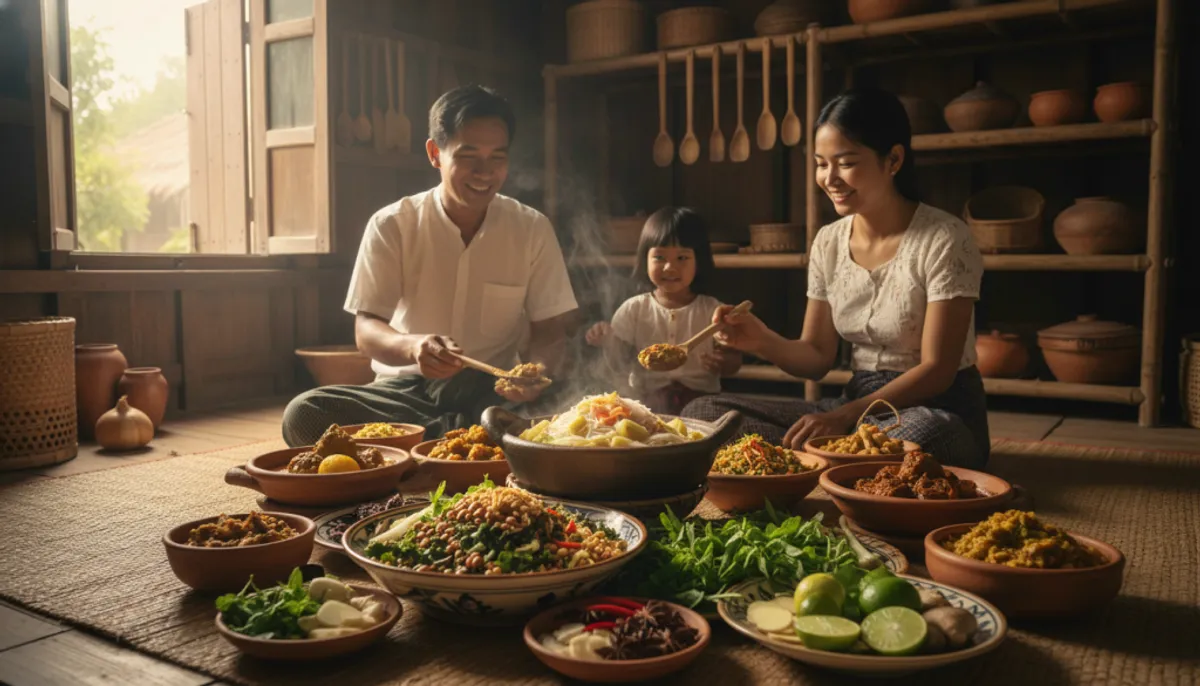
Flavors and aromas often tell the story of a society better than books. The local table reveals a symphony of tastes inherited from centuries of exchanges.
This cuisine harmoniously combines Indian, Chinese, and Thai influences. Yet it retains a well-defined culinary identity.
Mohinga, the emblematic national dish
Mohinga is considered the national dish of this country. It consists of rice noodles served in a rich catfish broth.
This broth is flavored with lemongrass, ginger, and banana stem powder. Traditionally, it is consumed at breakfast.
This emblematic dish is enjoyed throughout the territory with regional variations. Some versions are thicker and spicier than others.
The gastronomy also includes other remarkable specialties. The local curry is less spicy than its Indian or Thai cousins.
Ngapi, fermented shrimp paste, is an essential condiment. It seasons soups, salads, and stir-fried dishes with its unique flavor.
Meals generally consist of a main dish accompanied by many side dishes. This communal approach reflects a philosophy of sharing.
This culinary article shows how food unites the different regions. Each specialty tells a part of the common history.
The duality of names: Burma and Myanmar
The official naming of a nation often carries considerable historical and political weight. This country in Southeast Asia perfectly illustrates this complex reality.
Origin and meaning of the names
Upon independence in 1948, the territory adopted the official name "Union of Burma." This designation reflected its federal structure and British colonial heritage.
Forty-one years later, in 1989, the military government made a controversial change. The SLORC council imposed "Myanmar" as the international designation.
The choice of a name for a state is never neutral. It always reflects a specific political vision and power relations.
Etymologically, "Burma" literally means "the land of the Burmese." "Myanmar" would represent the entire national territory in a more inclusive way.
| Aspect | Burma | Myanmar | Current Usage |
|---|---|---|---|
| Language Origin | Derived from "Bamar" | Formal historical term | Coexistence depending on contexts |
| Ethnic Connotation | Reference to the majority group | Perceived as more neutral | Ongoing identity issue |
| International Recognition | Preferred by some Western countries | Official with the UN | Diplomatic division |
Historically, these two terms have always coexisted. "Burma" dominated everyday language, while "Myanmar" was used for official communications.
This duality of names reflects ethnic tensions and political controversies. It continues to divide the international community today.
The union of the different populations under one name remains a challenge. The choice of the name symbolizes this quest for national unity.
Languages and linguistic diversity
About a hundred different languages coexist in this territory, creating a unique oral heritage. This richness reflects the ethnic complexity of the nation.
The official language Burmese belongs to the Sino-Tibetan family. Its alphabet derives from Sanskrit and features characteristic rounded shapes.
Burmese and its regional variants
Burmese is not uniform throughout the country. There are several regional variants such as myeik, beik, and yaw.
Arakanese is sometimes considered a dialect or a distinct language. These differences show the local adaptation of the main idiom.
Minority languages and their distribution
The ethnic minorities speak languages belonging to three major families. Their distribution generally follows regional borders.
| Language Family | Main Languages | Concerned Regions |
|---|---|---|
| Sino-Tibetan | Burmese, Karen, Chin | Central plain, border areas |
| Austroasiatic | Môn, Wa, Palaung | Southern and eastern states |
| Thai-Kadai | Shan, Thai, Khun | Northeastern states |
English and Chinese serve as important lingua francas. The different groups maintain their idioms while learning Burmese.
This linguistic diversity represents a challenge for national unity. It also constitutes a cultural treasure for the entire population.
Federal system and political issues
The political organization of this Asian territory is based on a complex federal system, a source of many contemporary challenges. This structure divides the country into seven ethnic states and seven administrative regions.
Each entity theoretically has its own legislature and local government. However, the central power practically dominates the entire system.
The Panglong agreements and ethnic claims
In 1947, before the country's independence, General Aung San negotiated with the ethnic minorities. These discussions led to the Panglong agreements, promising significant autonomy.
This historical document guaranteed the different ethnic groups an administration respectful of their specificities. Unfortunately, the assassination of Aung San the same year changed everything.
The new constitution of 2008 maintains a façade of a union republic. It concentrates most of the power in the hands of the central government, limiting the autonomy of the states.
Conflicts, migration, and societal repercussions
The current humanitarian landscape reveals the scars of decades of intercommunal conflicts. These tensions date back to the post-colonial period and have intensified under various regimes.
Interethnic tensions and humanitarian realities
The military government led by General Win established a policy of systematic marginalization. This approach exacerbated divisions between communities.
The 1974 constitution ignored the political aspirations of the ethnic minorities. This document consolidated the dominance of the majority group for many years.
Military operations in border areas have caused massive displacements. Hundreds of thousands of people have fled their homes to neighboring countries.
| Type of Impact | Concerned Regions | Long-term Consequences | Affected Population |
|---|---|---|---|
| Forced Displacements | Kachin, Shan, Rakhine States | Lasting demographic change | Several hundred thousand |
| Rights Violations | Border areas | Intergenerational trauma | Entire communities |
| Refugee Camps | Thai, Bangladeshi borders | Prolonged humanitarian dependence | Karen, Rohingya, Chin |
The end of hostilities remains uncertain despite some ceasefires. The military power maintains its presence in sensitive regions.
International reports regularly document violations of fundamental rights. This situation has persisted for too long according to observers.
Contemporary perspectives on Myanmar
The 21st century has opened a complex chapter in the political history of the territory. After decades of military rule, the arrival of a partially civilian government in 2011 raised great hopes.
The 2015 elections brought to power the National League for Democracy of Aung San Suu Kyi. This historic victory promised profound reforms and the end of ethnic conflicts.
However, the 2008 constitution significantly limits civil authority. The army retains 25% of parliamentary seats and controls key ministries.
The Rohingya crisis in 2017 tarnished the international image. Nearly one million people fled to Bangladesh following military operations.
Aung San Suu Kyi's silence in the face of persecution disappointed her supporters. This Muslim ethnicity is not recognized by the majority Buddhist ethnicity.
Recent developments with the arrival of civilian power
The coup d'état of February 1, 2021, abruptly interrupted the transition. The government of Aung San Suu Kyi was overthrown by the military junta.
A massive civil disobedience movement organized in response. Several armed ethnic groups intensified fighting against the central army.
The humanitarian situation has significantly deteriorated since then. Millions of people are displaced and fundamental rights are massively violated.
Tensions persist among different groups and minorities. Decades of discrimination and unresolved territorial claims fuel conflicts.
The future of this country will depend on the ability of the different parties to find a compromise. Building an inclusive democracy remains the main challenge after so many years of turmoil.
Conclusion
Our journey through the multiple facets of this Asian heritage is coming to an end. This Bamar culture represents an exceptional treasure shaped by millennia of history.
This article has explored historical roots, religious traditions, and artistic expressions. The distinctive gastronomy completes this fascinating panorama.
The culture of the majority ethnicity is set in a context of remarkable diversity, including the lao loum culture. The different ethnic groups enrich the national heritage.
The country faces significant contemporary challenges. Unresolved conflicts remind us that cultural richness requires social justice.
Understanding this ethnicity involves grasping its historical and political complexity. This part of Asian heritage deserves special attention.
This article hopes to have provided a balanced insight. The country retains a living heritage despite current turbulence.
FAQ
What are the main ethnic groups in Myanmar?
The population is very diverse. The Bamar constitute the majority group. There are also Shan, Karen, Rakhine, and many others. This diversity is a fundamental aspect of the Republic of the Union of Myanmar.
What is the role of Theravada Buddhism in society?
It is central. This religion profoundly influences art, values, and daily life. Monks are highly respected and ceremonies, such as novice initiation, are major family events.
Why is the country referred to as both Burma and Myanmar?
It is a matter of language and history. "Myanmar" is the official name used by the government, while "Burma" is the traditional designation in French. The debate surrounding these names is also political.
What dishes are emblematic of Burmese cuisine?
Mohinga, a fish noodle dish, is considered the national dish. The gastronomy reflects influences from neighboring countries such as India, China, and Thailand, creating a unique cuisine.
How has the history of ancient kingdoms marked the culture?
The legacy of the kingdom of Pagan is immense, especially in architecture with its thousands of temples. Exchanges with India and China have also shaped language, art, and long-standing traditions.
What are the political issues related to ethnic diversity?
The Panglong agreements, negotiated by General Aung San, attempted to establish a federal union. However, tensions persist between the central power and some minorities, impacting rights and the stability of the country.