To the south of the Arabian Peninsula lies a vast and fascinating country: Yemen. This territory occupies the southernmost fringes of this mythical region. It reveals a heritage of extraordinary richness.
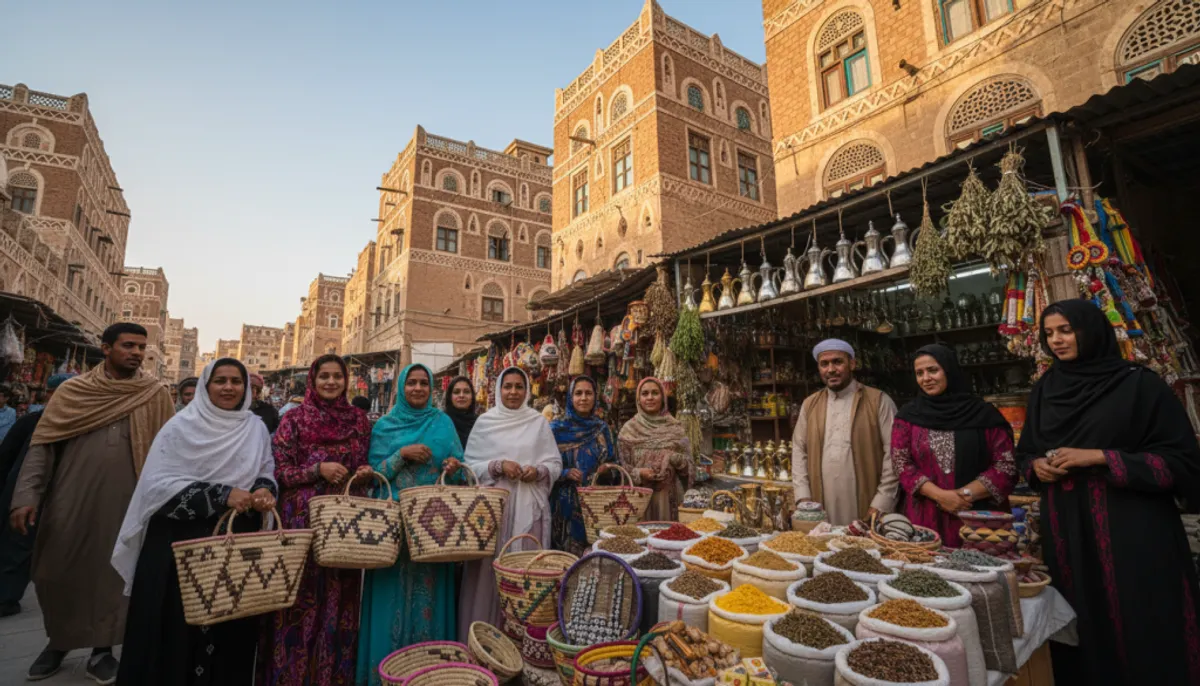
The population of this nation has undergone remarkable evolution. It has grown from about 2.5 million inhabitants at the beginning of the 20th century to over 34 million today. This growth reflects a certain vitality.
The contrast is striking between a natural environment that is often arid and a cultural heritage of great diversity. Despite geographical challenges, the inhabitants have managed to develop unique social and artistic practices.
This article offers you a journey into the heart of these ancestral traditions. Together, we will explore social customs, distinctive architecture, and delicious gastronomy. This heritage represents a precious treasure for all of humanity.
Key Points to Remember
- Yemen is a vast country located in the south of the Arabian Peninsula.
- Its population has significantly increased, exceeding 34 million inhabitants.
- A striking contrast exists between a challenging environment and exceptional cultural wealth.
- Its cultural heritage consists of unique social, architectural, and gastronomical traditions.
- This heritage is the result of a long history and various influences.
- It represents an invaluable asset, far beyond regional borders.
Introduction to Yemeni Culture
The identity of a nation is often built through the words it uses. To approach the foundations of this society, one must listen to its rich mosaic of languages.
The country exhibits exceptional linguistic diversity. Yemeni Arabic is the main language, but one can also hear Ta'izzi-Adeni, Mehri, and Shehri.
Languages such as Hobyot, Somali, and Baluchi complement this soundscape. These modern South Arabian dialects are a living heritage.
This variety reflects a complex history and multiple regional influences. Different ethnic groups have contributed to this unique heritage.
The diaspora has also spread these languages to other countries. Interactions between communities shape a dynamic social fabric throughout the peninsula.
Understanding these demographic foundations is essential. It is the bedrock of contemporary culture and its exchanges.
History of Yemeni Civilization
The human epic in this region begins hundreds of thousands of years ago, long before the first kingdoms. This history is long and complex, divided into several major periods.
Prehistory and Origins
The earliest traces date back 700,000 years in Hadhramaut. Later, rock sites in Saada, dating back 7,000 years, reveal Neolithic occupation. The Bronze Age then spans from 3,000 to 1,200 BC.
Antiquity and Emergence of Kingdoms
Antiquity marks the beginning of great kingdoms. The first, the Sabaean kingdom of Marib, appears around 1500 BC. Its history is confirmed in the 8th century BC by Assyrian inscriptions.
These societies developed sophisticated irrigated agriculture. The famous Marib dam, built at that time, is its symbol.
Pre-Islamic Period and Islamization
This time is marked by struggles between different tribes. Foreign influences, such as those from the Sassanian Persians, are felt.
The definitive rupture of the dam around 615 AD ends this era of prosperity. The gradual Islamization of the country begins after 632, transforming Southern Arabia.
Kingdoms and Dynasties of Yemen
From the 8th century BC to the 6th century AD, a common civilization unified different kingdoms. This fascinating history has shaped the identity of this part of the world.
The Sabaean Kingdom and South Arabian Civilization
The most famous is the kingdom of Saba. It is often associated with the legendary Queen of Sheba. However, this character remains mythical.
Karib'il Watar I founded the first unified Sabaean empire. This occurred between 689 and 681 BC. He established Marib as the capital.
These kingdoms shared a common culture. The same writing, irrigation techniques, and architectural practices. Their political and social system was coherent throughout the south of the peninsula.
From Pre-Islamic Dynasties to Modern Periods
Several empires succeeded one another. Saba, Qataban, Hadhramaut, and Himyar illustrate these power struggles.
The Qataban era lasted until 110 BC. It represents a remarkable artistic peak. The Himyarite Empire achieved complete unity of Southern Arabia in the 4th century.
| Kingdom | Peak Period | Major Contribution |
|---|---|---|
| Saba | 8th century BC – 1st century AD | First unified empire, Marib dam |
| Qataban | 500 – 110 BC | Artistic peak of civilization |
| Hadhramaut | Early 1st century AD | Established commercial hegemony |
| Himyar | 4th century AD | Political unification of Southern Arabia |
This region, sometimes called Happy Arabia, developed remarkable prosperity. Trade and agriculture were its pillars.
Natural Wealth and Ancient Trade
The ancient prosperity of this land relied on unique natural resources and strategic trade routes. A monsoon climate transformed the mountains into a green haven.
This part of the arid world became a fertile granary. Agriculture thrived thanks to these regular rains.
The most valuable resources were aromatic resins. Myrrh and incense, harvested from Commiphora and Boswellia trees, were exported to the ancient Near East.
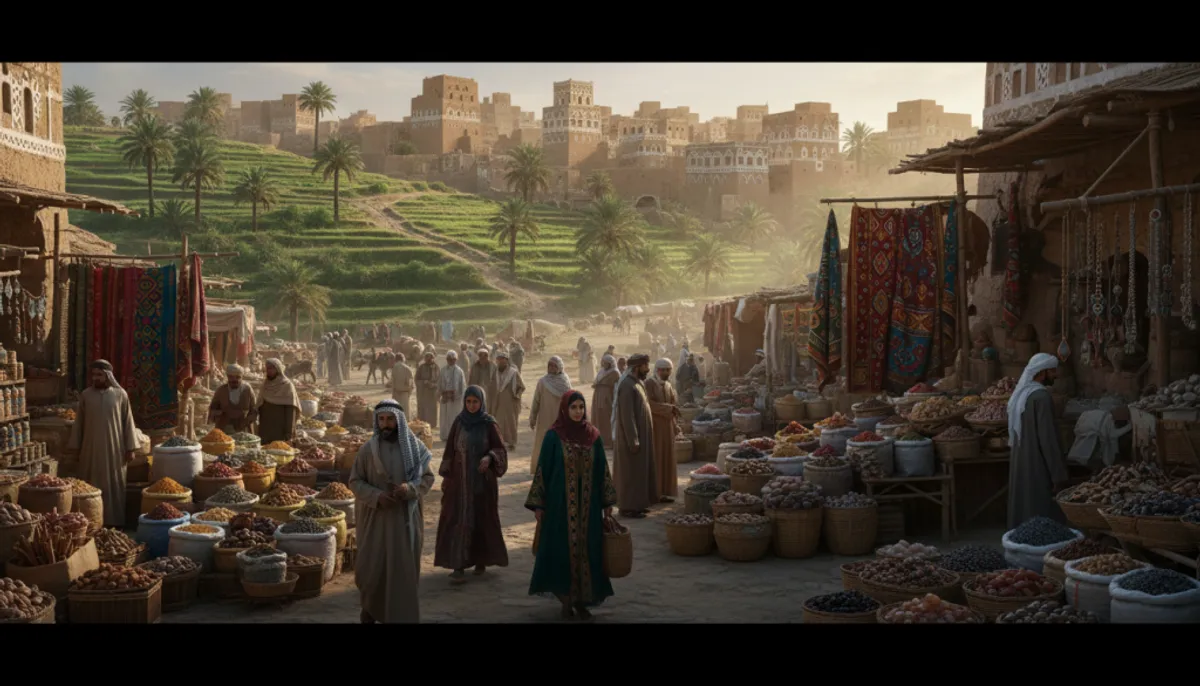
Coffee later joined this catalog of treasures. These goods fueled international trade for centuries.
The domestication of the dromedary, over 3000 years ago, was a revolution. It enabled long-distance caravan exchanges with Mesopotamia and Egypt.
With 2000 kilometers of coastline, the country also became a maritime power. Mastery of ocean currents boosted navigation at the turn of the Christian era.
The control of routes between India and the Mediterranean made the fortune of this region.
This commercial development positioned the territory at the heart of networks. It connected the Persian Gulf, the Red Sea, and the Indian Ocean.
| Product | Main Use | Trade Route |
|---|---|---|
| Incense | Religious rituals, perfumes | Caravans to the Levant |
| Myrrh | Medicine, embalming | Maritime export to Rome |
| Coffee | Social drink | Red Sea ports |
| Spices | Seasoning, preservation | Indian Ocean route |
In the Middle Ages, Aden illustrated this success. This port became the hub of trade throughout southern Arabia.
This intense activity, maintained over millennia, generated extraordinary wealth. It explains the architectural and cultural heritage that we still admire today.
Social Traditions and Daily Customs
Family relationships and collective celebrations form the beating heart of Yemeni society. These practices create a solid framework for everyday life.
They unite people and strengthen community ties. Let’s explore these fascinating customs together.
Marriage, Family, and Rites of Passage
Marriage is a central pillar. It unites not only two people but also two families.
Polygamy exists in this system. The tribes retain significant influence over social organization.
Rites of passage mark each stage of life. For women, the body and its transformations are the subject of specific rituals.
Anthropologist Hanne Schönig studied these practices in 2006. They reveal deep beliefs.
Celebrations and Traditional Festivals
An impressive number of festivals punctuate the year. The population celebrates both national and religious dates.
National Unity Day (May 22) and the Anniversary of the Revolution (September 26) are widely observed. They commemorate recent history.
Islamic festivals, such as Eid al-Fitr and Eid al-Adha, bring communities together. They follow the lunar calendar.
The entirety of these festivities strengthens cohesion across all regions. These traditions have been passed down for hundreds of years.
Arts and Crafts: From Music to Architecture
Creativity manifests through various artistic forms, from music to decorative objects. These expressions enrich the heritage and captivate the senses.
Music, Dance, and Performing Arts
Musical traditions present extraordinary richness. They include ancestral Jewish songs like Galbi and Sufi melodies from the Ibn Alwan brotherhood.
Dance and theater play an important role in celebrations. These performing arts unite communities during festivals.
Traditional and Decorative Crafts
Local craftsmanship includes a beautiful line of know-how. The weaving of ikat textiles and the making of traditional clothing are examples.
Contemporary pottery has been studied by researchers. Unfortunately, many of these crafts have not been sufficiently documented in a specialized book.
The recent development of street art, with artists like Murad Subay, shows a new vitality. Photographer Bushra Almutawakel also contributes to the visual arts.
| Type of Art | Examples | Characteristics |
|---|---|---|
| Music | Jewish songs, Sufi chants | Oral tradition, spiritual |
| Dance | Festive performances | Collective, rhythmic expression |
| Textile Crafts | Ikat fabrics, clothing | Elaborate patterns, ancestral techniques |
| Pottery | Vases, decorative objects | Utilitarian and artistic forms |
These crafts are recognized as intangible cultural heritage of humanity worldwide. They vary according to the regions of the country.
The traditional architecture, which we will see next, beautifully complements this artistic ensemble.
Traditional Architecture and Urbanism
Shibam, often nicknamed 'the Manhattan of the Desert', is the symbol of millennial ingenuity. This country reveals a built heritage of great sophistication.
Iconic Tower Houses and Mosques
The vertical architecture of Shibam is spectacular. Its tower houses made of mud rise several stories.
This site is unique in the world. The tradition of building this way has persisted after the arrival of Islam.
The mosque of Jibla, in the Ibb governorate, features refined ornamentation. It rivals the most beautiful ancient monuments.
Researchers like Lucien Golvin and Paul Bonnenfant have studied this domestic architecture. Their work in the 20th century reveals its complexity.
Beyond the buildings, agricultural terraces sculpt the mountains. This landscaping has developed over several millennia.
These terraces prevent erosion. They have allowed the cultivation of vines, coffee, and qat.
| Type of Structure | Example | Main Characteristic | Development Period |
|---|---|---|---|
| Tower House | Shibam | Vertical construction in mud | Millennial tradition |
| Mosque | Jibla (Ibb) | Refined sculptural ornamentation | Islamic period |
| Agricultural Terraces | Mountain Valleys | Anti-erosion system, hanging gardens | Several millennia |
The whole is a testament to remarkable adaptation to a challenging environment. It has shaped the identity of this region for centuries.
Literature, Theater, and Media in Yemen
Beyond visual arts and music, intellectual creation expresses itself powerfully through writing and modern media. This heritage reflects a millennial tradition that is still alive.
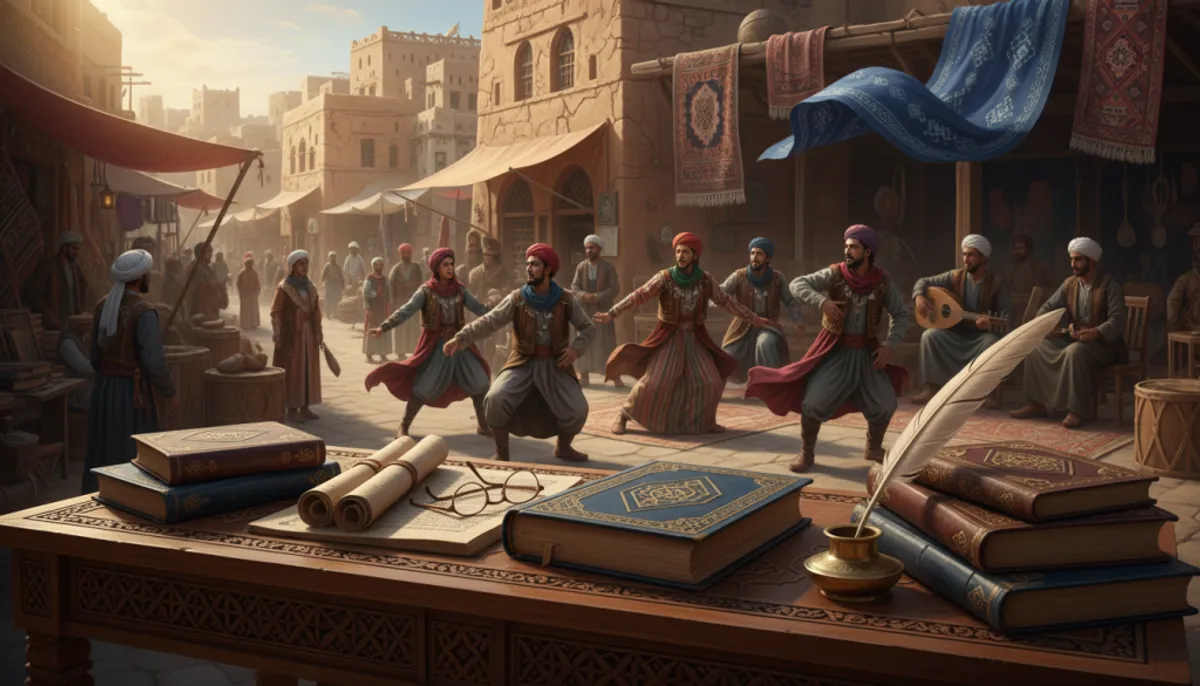
The libraries of Sanaa and Zabid preserve unique treasures. They house the oldest folios of the Quran, dating from the early centuries of Islam.
In Zabid, teaching by families of literati has persisted since the 11th century. These precious books cover religion, history, biographies, and sciences.
Contemporary literature is carried by voices like poet Sana Uqba. The Yemeni university plays a key role in preserving each book and transmitting this knowledge.
The development of media has been rapid in recent years. The country has several newspapers, each with its own editorial line.
Radio and television are very present. The online community uses the .ye extension, and bloggers are active.
| Media Format | Examples/Formats | Scope and Impact |
|---|---|---|
| Print Media | National and regional newspapers | Local information, idea debates |
| Radio & Television | Public and private channels | Entertainment, continuous information |
| Internet & Digital | .ye sites, blogs, social networks | Space for expression and dialogue |
Press freedom remains an important issue for this society. It shapes the future of the digital book and the university.
Yemeni Gastronomy and Traditional Beverages
The Yemeni table offers a sensory journey into the heart of ancestral culinary traditions. It is an integral part of Arab and Middle Eastern heritage.
Unique flavors have developed over centuries. They are adapted to the local resources of this region with its particular climate.
Beverages occupy a central place in social life. One enjoys Arabic coffee, black tea, Qishr, and Shahi Haleeb.
A sophisticated irrigated agriculture system, thousands of years old, has enabled this abundance. It has nourished a significant population organized into sedentary tribes.
The agricultural terraces of the mountains have created cultivable spaces. Where the rest of the territory would have remained barren, vines, coffee, and qat are cultivated.
Water represents a precious resource, and its management has always been essential. Today, access to drinking water remains a major issue for the regions of the country.
This issue directly influences contemporary agricultural practices. The consumption of khat, a stimulating plant, also raises questions about the use of water.
The Influence of Religion and Beliefs
From ancestral polytheistic cults to the dominant Islam, the spiritual journey of this peninsula is fascinating. The current heritage is a layering of epochs and beliefs.
Religious Practices and Syncretism
Today, Islam structures the lives of 99% of the population. It is primarily divided between Zaydi Shiism and Shafi'i Sunni.
Small Christian and Hindu communities also exist. They number a few thousand faithful.
This apparent unity hides a complex history. In the 4th century, King Abîkarib As'ad converted to Judaism.
The tribes then experienced conflicts between Jews and Christians. Islam established itself at the beginning of the 7th century, around 632.
It permanently transformed the religious landscape of the peninsula. The Jewish community, once flourishing, has nearly disappeared.
It has declined from 150,000 members in 1929 to fewer than 200 today. This evolution shows the profound transformation of beliefs.
Different regions of the country retain specificities. The distribution of branches of Islam reflects this tumultuous history.
Impact of Conflicts and Recent Social Transformations
Recent history is marked by a series of conflicts that have transformed society. The last century has been particularly tumultuous.
A major revolution broke out in 1962. It abolished the monarchy on September 27 and created the Arab Republic of Yemen, also known as North Yemen.
This event marks the beginning of a long civil war. The country remains torn for many years.
The south of the territory has followed a different trajectory. It was under British influence until the end of the 1960s.
The 20th century also saw other confrontations. A proxy war between Egypt and Saudi Arabia ended in 1970.
At the beginning of the 21
The current war, which started in 2015, has caused a major humanitarian crisis. Human rights violations are widely documented.
Despite these trials, creativity persists. Engaged street art, illustrated by Murad Subay, has developed during the conflict.
These successive wars have had a devastating impact. They threaten the very unity of the territory and its access to the Indian Ocean routes.
Discovering Yemeni Culture and Its Foundations
To understand the deep roots of this region, the work of specialists like Jérémie Schiettecatte is essential. This CNRS researcher in Paris dedicates his career to South Arabian archaeology.
His publications document the entirety of the heritage. He co-directed the Catalogue of Archaeological and Epigraphic Pieces from Jawf with Mounir Arbach.
Another major collaboration with Arbach and Ibrahim al-Hadi focuses on the Collection of Funerary Stelae from the Jawf Valley. It reveals a unique funerary art.
For an accessible approach, Jérémie Schiettecatte has appeared on France Culture. His show “Yemen and the South Arabian Kingdoms” presents this fascinating history.
Online resources allow exploration of this civilization from anywhere in the world. The website archeologie.culture.gouv.fr/yemen and the Digital Archive for the Study of Pre-Islamic Arabian Inscriptions are valuable.
These tools make accessible a heritage accumulated over centuries. They offer everyone the keys to discover extraordinary foundations.
Tourism, Heritage, and Must-See Sites
From the Socotra archipelago to ancient cities, Southern Yemen possesses a globally recognized heritage. UNESCO has inscribed an impressive number of treasures on its lists.
These places testify to a millennial history and unique biodiversity. They attract travelers from all over the world.
Must-See Archaeological Sites and Museums
The old city of Sanaa, with its unique architecture, has been classified since 1986. Shibam, the “Manhattan of the Desert”, has been classified since 1982.
Zabid, a historical city, is unfortunately on the endangered heritage list. The Socotra archipelago, in the Indian Ocean, is a region with extraordinary landscapes.
The chants of Sanaa are also part of the intangible heritage. For artifacts, visit the National Museum of Yemen or the House of Folklore.
The ancient ports of Biʾr ʿAlî and Sharwayn recall the crucial commercial role of Southern Yemen. Aden was a major hub between the Red Sea and the Indian Ocean.
Travel Tips and Tourist Resources
The current situation in the country requires great caution. Always consult travel advisories from governments.
French, Canadian, Swiss, and American sites provide updated information. They cover all regions of the territory.
These resources are essential for planning a safe stay. They help you discover each part of this fascinating world.
Despite the challenges, the heritage of Southern Yemen remains a jewel for humanity. Its preservation concerns a large part of the international community.
Conclusion
The essence of this discovery lies in the sustainability of a unique heritage. This country of the Arabian Peninsula has forged its identity over time, despite a demanding environment.
The contemporary culture carries this ancient heritage. Traditions, crafts, and arts still live on today.
Recognized by UNESCO and studied worldwide, this treasure must be preserved. It enriches our understanding of the south of this region.
May this exploration inspire you. The heritage of this nation remains a vibrant testament to human creativity.
FAQ
What are the most famous ancient kingdoms of the Arabian Peninsula?
The most well-known kingdoms are Saba, Ma'in, Qataban, and Hadhramaut. The Sabaean kingdom, with the legendary Queen of Sheba, is particularly famous for its wealth, derived from the trade of incense and spices to the rest of the ancient world.
How do traditional wedding celebrations unfold?
The festivities last several days and mix songs, dances, and large meals. They strengthen the bonds between families and tribes. The ceremony is a crucial rite of passage, marking the union of two people and their communities.
What traditional dish is emblematic of local cuisine?
Salta is a savory stew, often considered the national dish. Prepared in a stone pot, it is made with meat, vegetables, herbs, and a unique spice called hulba (fenugreek).
What major historical sites can be visited today?
Sites like the old city of Shibam, nicknamed “the Manhattan of the Desert” for its tower houses, and the millennial agricultural terraces are must-sees. The museums in Sanaa also house treasures from the ancient kingdoms.
How have recent conflicts affected heritage?
Unfortunately, the war has caused damage to archaeological sites and historical architecture. Despite this, the population strives to preserve its traditions and heritage, demonstrating great resilience.