
Dive into the heart of an exceptional heritage, heir to a civilization that has fascinated the whole world for millennia. This unique legacy continues to shape the life and identity of its inhabitants today.
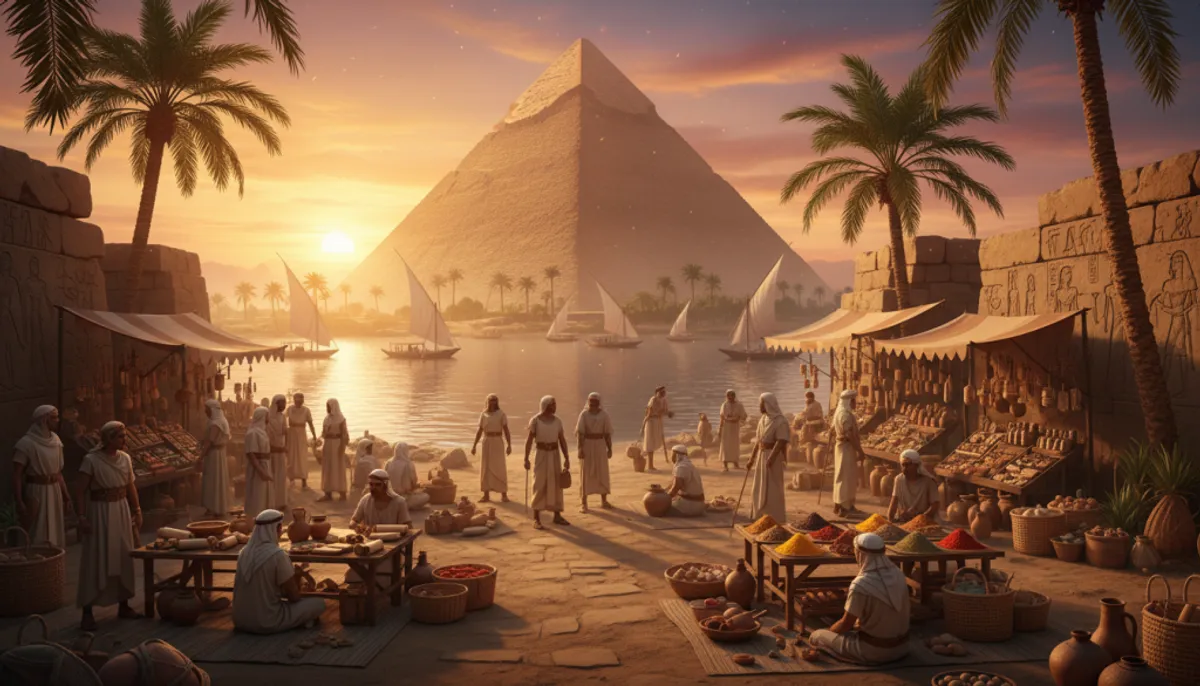
Located at the crossroads of Africa and the Middle East, this country is home to more than 113 million inhabitants. It forms a melting pot where the most varied influences blend.
Its current diversity is the result of a unique historical mix: the pharaonic foundations, followed by Greek, Roman, Arab, Ottoman, and modern contributions. Each era has left a lasting imprint.
Ancestral traditions are not mere relics. They engage with modernity to define a dynamic identity, both on national territory and abroad. This continuity is key to understanding its vitality in the contemporary world and its impact on daily life.
Key points to remember
- Egypt possesses one of the richest and most fascinating cultural heritages on the planet.
- The country is situated at a strategic geographical crossroads between Africa and the Middle East.
- With a population exceeding 113 million inhabitants, it is a unique human and cultural melting pot.
- Its modern identity is the result of multiple overlapping historical influences.
- There is a strong and vibrant link between ancient traditions and current cultural practices.
- This culture continues to evolve while preserving its deep essence.
- It significantly influences the daily life and collective identity of Egyptians.
- Additionally, online french broadcasting has become a popular medium for sharing this rich cultural narrative.
Introduction to the wealth of Egypt
Located at the crossroads of Africa, the Middle East, and the Mediterranean, Egypt is a unique civilizational crossroads in the world. This country has always been a meeting and exchange point.
With more than 113 million inhabitants projected by 2025, it houses the largest population in the Arab world. This demographic mass contributes to a vibrant and complex identity.
The Egyptians have forged a society of remarkable permanence. Yet, it also knows how to integrate external influences with great flexibility.
This adaptability is seen in daily life. The historian Herodotus noted millennia ago that the Egyptians were "excessively religious."
This religiosity still permeates all aspects of social life. It is one of the pillars of the wealth of this country.
This wealth consists of an immense historical heritage, linguistic diversity, traditional arts, and a unique savoir-vivre. The pharaonic legacy dialogues with Arab, Mediterranean, and modern contributions, including notable museums nevers that showcase this rich tapestry of history.
The historical foundations of Egyptian civilization
Since the dawn of organized humanity, this region of the Nile has seen the emergence of one of the first great civilizations.
From pharaonic origins to great empires
Around 4000 BC, two distinct kingdoms already existed. King Narmer unified them around 3100 BC.
This founding act marked the beginning of the archaic Empire. It was the true melting pot of this society.
The oldest known hieroglyphs date from this period. Over the centuries, the power of the country has experienced ups and downs.
The legacy of conquests and revolutions
This land has always attracted conquerors. Libyans, Greeks, and then Romans have aggregated to its cultural foundation.
The Arab conquest of the 7th century was a turning point. It brought deep Islamization and Arabization.
Each era of contact has left a lasting imprint. This forms a rich historical palimpsest.
Closer to us, the revolution of 1952 and the Arab Spring also shaped the country. They define a complex modern period.
The present time is thus the heir of all these layers. Understanding this long course is essential.
Successive transformations, including through the revolution, show a remarkable capacity for adaptation. Each time has its mark, each era its lesson. Understanding these key steps for an introduction to the history of Egypt is essential.The pharaonic legacy and its great dynasties
From the construction of the pyramids to the erection of colossal temples, pharaonic history is divided into three major phases. These empires defined the foundations of a unique civilization.
The periods of the Old, Middle, and New Kingdoms
The Old Kingdom begins around 2700 BC with the III dynasty. Memphis is its capital. Its power is expressed in architectural form, with the pyramids of Saqqara and Cairo.
The Middle Kingdom begins at the end of the III millennium. The capital moves to Thebes. This kingdom values the Fayoum and the Nile delta.
The New Kingdom starts in the 16th century. King Ahmose founds the XVIII dynasty. This brilliant phase lasts until the 11th century BC.
The New Kingdom sees legendary figures reign. Among them are Thutmose I, Queen Hatshepsut, Akhenaten and Nefertiti, as well as Tutankhamun.
The achievements of the New Kingdom are monumental. The temples of Abu Simbel and the Amon-Re complex at Karnak testify in stone form to its grandeur.
| Empire | Approximate period | Capital | Iconic achievement |
|---|---|---|---|
| Old Kingdom | 2700 – 2200 BC | Memphis | Pyramids of Saqqara |
| Middle Kingdom | 2050 – 1750 BC | Thebes | Development of the Fayoum |
| New Kingdom | 1550 – 1070 BC | Thebes | Temples of Abu Simbel |
These three periods establish the artistic and political foundations of this heritage. Their influence persists until the end of pharaonic civilization. Their power is still manifested today in the form of impressive monuments.
The political and social evolution in Egypt
The political organization of the Nile country has undergone a spectacular metamorphosis, transitioning from a divine monarchy to a modern republic. This journey reflects the profound upheavals of its society.
From the power of pharaohs to the modern era
In the past, power was embodied by a single man, the pharaoh. The revolution of 1952 changed everything.
Led by the Free Officers of Gamal Abdel Nasser, it overthrew the monarchy. It established a new model of republican and nationalist government.
Decades later, the Arab Spring of 2011 demonstrated the desire for change within society. This event briefly brought Mohamed Morsi to power.
The current system is defined by the constitution of 2014. The president of the Republic is the head of the executive and holds significant power.
The legislative power belongs to a bicameral parliament. This structure represents the culmination of a long evolution of institutions.
| Period | Form of Government | Figure of Power | Main Characteristic |
|---|---|---|---|
| Ancient (Pharaonic) | Divine Monarchy | Pharaoh | Absolute and centralized power |
| Monarchy (1805-1952) | Constitutional Monarchy | King | British colonial influence |
| Republic (1952-2011) | Presidential Republic | President (Nasser) | Revolution of the Free Officers |
| Contemporary Era | Presidential Republic | President (al-Sissi) | 2014 constitution, power of the executive |
These political changes are accompanied by social transformations. New actors, such as movements for the rights of men and women, as well as cultural games for children, are emerging.
The legacy of a centralized government still influences the modern conception of power. Today's politicians inherit this long history.
The diversity of languages and populations
The linguistic landscape of Egypt is a living kaleidoscope, where several forms of Arabic and minority languages coexist. This verbal richness defines an essential part of national identity.
Standard Arabic, dialectal Arabic, and other minority languages
The Egyptians primarily use three forms of Arabic. Local dialectal Arabic is the mother tongue of nearly 67% of the population.
Modern standard Arabic governs administration and media. Classical Arabic remains reserved for the religious sphere.
Sa'idi Arabic is spoken by 23% of the inhabitants. Domari is also found, spoken by nearly a million people.
Coptic survives as a liturgical language. English and French complement the education of cultured Egyptians.
The different communities and their cultural heritage
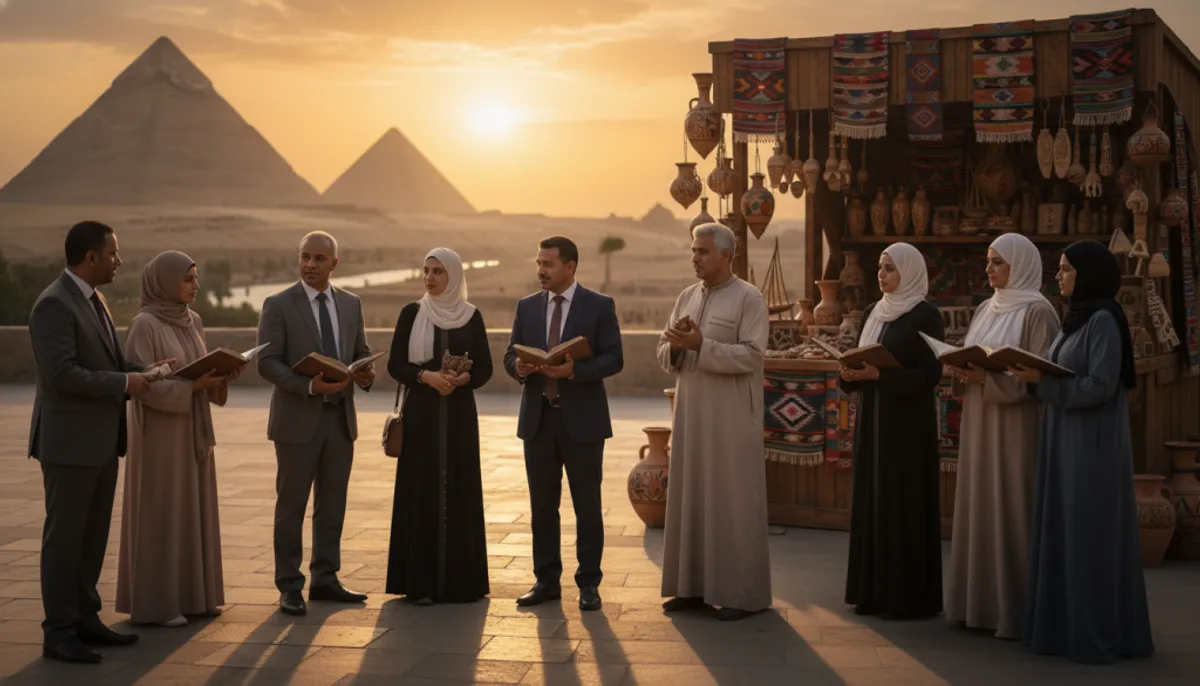
This linguistic mosaic reflects the diversity of communities. The Copts represent about 10% of the country's population.
The Nubians constitute another important community. Various European, Asian, and African diasporas enrich the social fabric.
This plurality makes Egypt a unique member of the Arab world. It maintains a specific and open identity.
The country draws its strength from this coexistence. It forges a plural national identity within the Arab world.
The major religions and beliefs in Egypt
Religious practices in Egypt reflect remarkable diversity, ranging from the majority Sunni Islam to ancient Coptic Christian traditions and elements of swiss folklore. This spiritual plurality is a foundational element of national identity.
From Sunni Islam to Coptic traditions
Sunni Islam is professed by 80 to 90% of the population. This faith profoundly structures society. The al-Azhar University in Cairo is an intellectual pillar. Its influence extends throughout the Muslim world.
Coptic Christians form the first religious minority. They represent about 10% of Egyptians. Their orthodox faith is one of the oldest in the world. It is believed to have been founded by the evangelist Mark around 62 AD.
This miaphysite confession is autocephalous. It is led by the patriarch of Alexandria. Egyptians of all confessions share a strong religiosity. It permeates all aspects of society.
A few thousand Jews and other minorities also practice their faith. This peaceful coexistence enriches the local spiritual heritage. The forms of faith specific to this land blend pharaonic heritage and Mediterranean influences.
The Egyptian pantheon: myths and deities
Contrary to popular belief, the world of Egyptian gods did not consist of twelve but several hundred deities. A cult was performed for this multitude over the millennia.
A striking feature is the use of animal forms. The gods were often represented with hybrid bodies.
The emblematic goddesses and their symbolism
Bastet embodies femininity and the home. She has the body of a woman and the head of a cat.
Hathor represents fertility. She is depicted in the form of a woman with a cow's head.
Sekhmet is the powerful goddess. She appears with a lioness's head.
Isis, the sorceress, wears a throne on her head. Ma'at symbolizes order with her ostrich feather.
The gods and their role in the cosmic order
Horus embodies divine royalty. He is represented in the form of a falcon or a man with a falcon head.
Anubis watches over the dead. He has the form of a man with a canine head.
These hybridizations expressed abstract concepts. They attributed animal traits to the gods.
| Deity | Representation | Main Role | Symbol |
|---|---|---|---|
| Bastet | Woman with a cat's head | Protection of the home | Cat |
| Hathor | Woman with a cow's head | Love and fertility | Cow |
| Horus | Man with a falcon's head | Royalty and sky | Falcon |
| Anubis | Man with a dog's head | Funeral rites | Canine |
The importance of each cult has varied with the dynasties. Some local gods became national.
Visual arts and architectural art
The distinctive aesthetic of this country rests on the balance between pure line and symbolic form, from hieroglyphs to modern paintings.
Ancient art, known as hieratic, followed strict rules. It served beliefs and rites. Yet, artists managed to draw astonishing creativity from it, often employing creative techniques that allowed them to express their unique vision.The hieroglyphic heritage and monumental sculpture
The gods and goddesses were represented in the form of codified drawings and sculptures. This constraint engendered a unique and recognizable style.
Monumental architecture, like the pyramids, structured the sacred space. It created a direct line between earth and sky.
Islamic architecture, such as the Mamluk style, also marked the landscape. The Citadel of Saladin and the Al-Manyal Palace are brilliant examples.
| Artist | Field | Period | Characteristic |
|---|---|---|---|
| Mahmoud Sa'id | Painting | 1897-1964 | Fusion of local themes and modern techniques |
| Chafik Charobim | Painting | 1894-1975 | Scenes of daily life and portraits |
| Tahia Halim | Painting | 1919-2003 | Expressionism and vibrant colors |
| Gamal El-Sagini | Sculpture | 1917-1977 | Abstract forms inspired by heritage |
These creators have renewed the visual arts, including influences from genres like french jazz. They engage with the heritage while integrating modern influences.
Contemporary art perpetuates this tradition. It explores form and symbol, in the form of new expressions. It is a living heritage, seen from another side.
Music and dance: rhythms and poetry
From mystical trance to popular celebration, music and dance shape the collective soul of this nation. These arts define an essential part of its expression, much like the best podcasts 2026 that capture the essence of contemporary culture.
Traditional sounds and modern influences
The 20th century saw the birth of legends. Oum Kalthoum (1898-1975) captivated the entire East with her voice. Her commitment marked the spirit of her people.
Farid El Atrache (1910-1974) was a virtuoso of the oud. His melancholic style embodied a unique form of sensitivity.
The art of Arabic singing produces tarab, a deep emotion. This form of poetry touches on the spiritual spirit, beyond entertainment.
Dance is equally varied. Oriental dance (Raqs sharqi), the Ghawazi, and the Tanoura of the dervishes are famous.
The Saidi and Baladi styles are rooted in daily life. Each form tells a story.
This music has influenced the entire Arab world. It has also forged a strong national identity. It remains at the heart of social life.
Egyptian cuisine and its Mediterranean influences
The culinary reputation of Egypt deserves much more attention. It hides unsuspected culinary treasures, far from clichés.
This gastronomy is a clever blend. It mixes Lebanese, Syrian, Turkish, and Greek contributions.
Bread is the central and sacred element. No meal is conceived without it.
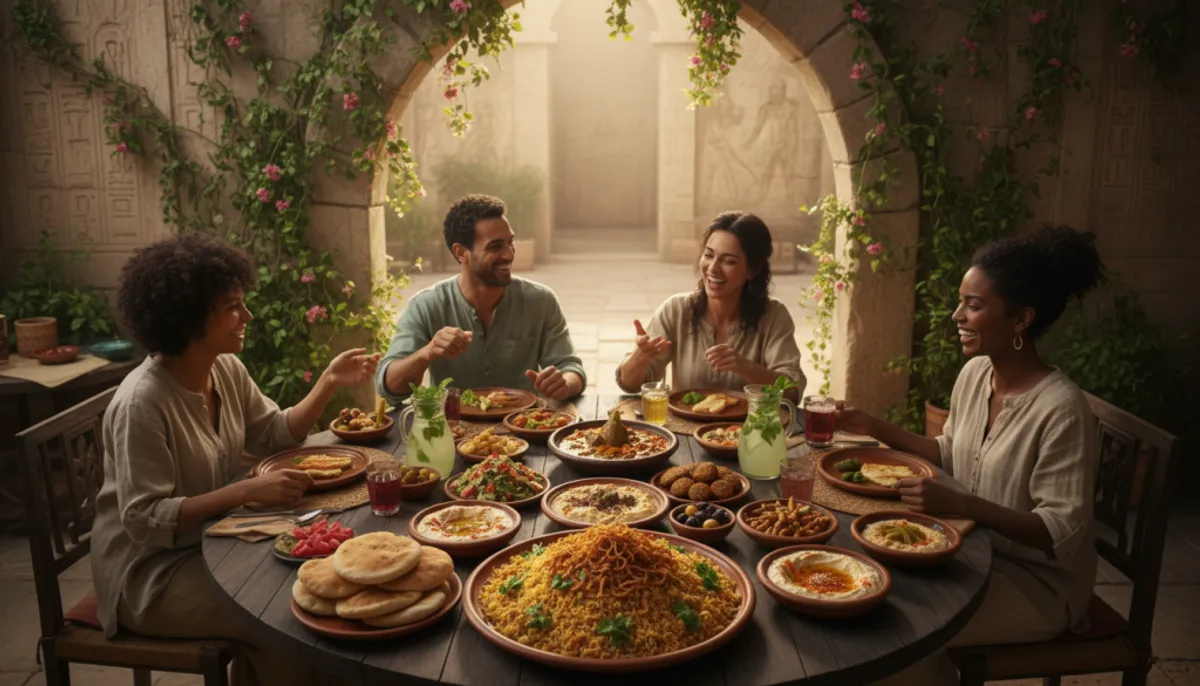
The basic ingredients are simple and nourishing. Legumes such as chickpeas, lentils, and the essential fava beans are found.
The fertile banks of the Nile provide fresh vegetables in abundance. This results in a healthy cuisine rooted in its terroir.
In daily life, some dishes are essential. Mloukhiya is a fragrant green soup.
Chich taouk offers marinated chicken skewers. Foul is a dish of cooked fava beans, often consumed at breakfast.
Ka'ak is a circular sesame bread, perfect for snacks. These specialties punctuate the days.
At the table, a tradition persists. People often eat with their right hand, according to a widespread Arab custom.
This practice is part of local savoir-vivre. It strengthens social bonds during shared meals.
Each historical conquest has enriched this heritage. Current cuisine reflects this history, offering much more than a simple meal.
It is a vibrant expression of daily life and identity, savored at the fingertips.
Traditions and savoir-vivre in the land of Egypt
To avoid any social disorder, understanding local customs is essential during your journey. These traditions facilitate interactions and show your respect.
Tipping customs and rules of conduct
Tipping, or baksheesh, is a common practice. It rewards a service rendered.
| Service | Indicative amount (Egyptian pounds) | Note |
|---|---|---|
| Porter | 50 | Per suitcase |
| Local contact | 100 per day | For ongoing assistance |
| Driver | 150 per day | For private service |
| Tour guide | 300 per day | For expertise |
| Restaurant | 10% of the bill | If service is not included |
Women should adopt modest attire. Avoid overly short or tight clothing.
Cover your head to enter a mosque. This is a sign of respect for the sacred place.
If a man invites you into his home, wait for him to say "bismillah" before eating. Use your right hand.
Remove your shoes at the entrance if other shoes are lined up. Never photograph a person without their consent.
These simple gestures avoid any disorder and honor local hospitality. They make your journey more harmonious.
Contemporary Egyptian culture: between heritage and modernity
The 21st century sees a dynamic society skillfully navigating between ancestral traditions, including kurdish traditions, and modern innovations. This synthesis defines a unique identity for our era.The impact of ancient traditions on modern life
The pharaonic values of permanence still inspire daily life. This heritage gives a particular strength to current social life, as well as the writing techniques in general knowledge that reflect this continuity.
Intellectual figures embody this dialogue. Laila Soueif, born in 1956, has been advocating for human rights since the 20th century.
Her children, Alaa Abdel Fattah and Mona Seif, are prominent faces of the 2011 revolution. Their commitment shows how this event transformed political expression.
Lina Attalah, founder of Mada Masr, uses digital media to shape the debate. Her work illustrates the new cultural life post-2011 revolution.
| Personality | Role | Period of activity | Key contribution |
|---|---|---|---|
| Laila Soueif | Professor & activist | Late 20th century to present | Advocacy for human and women's rights |
| Alaa Abdel Fattah | Computer scientist & blogger | 2000s to present | Symbols of the 2011 revolution |
| Mona Seif | Activist | 2000s to present | Central figure of the 2011 revolution |
| Lina Attalah | Journalist & founder | 2010s to present | Independent online media |
The diaspora also maintains a strong connection to traditions. It enriches this ever-evolving identity for our era.
The role of arts and literature in national identity
Throughout the 20th century, artistic and literary creation has played a key role. It has served as a mirror to profound social transformations.
Essential literary and artistic figures
Naguib Mahfouz, Nobel Prize winner in 1988, is a central figure. His novels depict a society torn between tradition and modernity. Cairo is the literary space par excellence throughout his work.
On the international stage, figures like Boutros Boutros-Ghali embodied humanism. Mohamed el-Baradei, Nobel Peace Prize laureate, worked for security in the world.
The literary heritage is further enriched much more with Francophone writers. Albert Cossery and Edmond Jabès create cultural bridges. In cinema, Youssef Chahine marked the Arab and international world throughout the century.
International influence and tourism in Egypt
Bonaparte's expedition at the end of the 18th century awakened Western interest in the treasures of the Nile. This event placed the country at the center of scientific attention. It gave birth to Egyptology and a true Egyptomania.
A century later, Ferdinand de Lesseps oversaw the digging of the Suez Canal. This crucial maritime route repositioned Egypt at the center of global trade exchanges. It reinforced its strategic role on the international stage.
Discovery of iconic monuments and museums
Visitors on a journey discover legendary sites. The Egyptian Museum in Cairo and the pyramids are must-see places. Alexandria remains a mythical place of meeting between civilizations.
The desert also offers treasures. The Saint Catherine Monastery in Sinai is a spiritual jewel nestled in the heart of the desert. These remote sites complement the offerings of urban centers.
Tourism has become a major economic pillar. It allows for the discovery of a unique heritage while supporting development. This sector illustrates the country's integration into globalization, a process that began as early as the Hellenistic period.
The adventure in the desert and cultural discovery in the city attract different types of travelers. This diversity enhances the country's appeal on a global scale.
Social values and daily life in Egypt
Social interactions in Egypt revolve around precise codes, particularly regarding gender and status. Society places great importance on family and hospitality, influenced by the dutch cultural influence. These values form an essential part of collective identity.
Men and women often have distinct roles. Inequalities persist in several cases, whether in professional or public life. Honorific titles, such as Ustaz or Hagg, mark social rank and respect.
Marriage remains a central institution. It structures society and evolves with modernity. Unfortunately, issues like sexism or mass assaults have marked certain cases during gatherings.
The population is diverse. It includes Arabs, Copts (the main minority), Nubians, and diasporas. Festivals, such as Orthodox Christmas on January 7 or Ramadan, punctuate the year. They give hands to communities to express their identity. These celebrations are a joyful part of daily life.
Conclusion
At the end of this exploration, one thing is clear: the Egyptian heritage is a permanent dialogue between yesterday and today. This civilization shows remarkable continuity through time, from ancient cults to the practices of our era.
Its rich heritage expresses itself in the form of grand monuments and living traditions. The artistic forms evolve while integrating diverse influences.
The importance of faith, from animal-headed deities to contemporary rites, still structures social existence. Its symbolic power fascinates the whole world.
This country is an intellectual center of the Arab world and a place where tradition and modernity coexist. From the desert to the banks of the Nile, this unique cultural space continues to inspire.
It fully deserves its title of "Mother of the World." It is a living place where the cycles of life and death perpetuate millennia-old rites.
FAQ
What are the main periods of pharaonic history?
The ancient history of this country is divided into three great empires. The Old Kingdom is famous for the first pyramids. The Middle Kingdom consolidated central power. The New Kingdom, a period of great expansion, saw rulers like Ramses II.
How did the 2011 revolution influence society?
This major event of the 20th century marked a turning point in the Arab world. It initiated a period of political and social change, redefining the relationship between government and the population, and its impact still resonates in public life today.
What languages are spoken in Egypt today?
The official language is standard Arabic. In daily life, Egyptians use Egyptian dialectal Arabic. Minority languages, such as Nubian or Coptic, are also spoken by certain communities, thus preserving a rich heritage.
What are the dominant religious beliefs?
Sunni Islam is the religion of a large majority. The Coptic Orthodox community constitutes the largest Christian minority. These two major traditions coexist and together shape the spiritual and cultural landscape of the country.
Who were the main gods of the Egyptian pantheon?
The ancient cult included many deities. Ra, the sun god, was central. Osiris ruled the world of the dead. Isis, the goddess of magic, and Horus, with a falcon head, were also venerated. Each god had a specific role in the cosmic order.
What is the most visible architectural heritage?
Ancient architectural art is globally known for its monumental forms: the pyramids, the temples of Karnak and Luxor, and the tombs of the Valley of the Kings. These structures illustrate the technical mastery and power of the ancient builders.
Is traditional music still listened to?
Absolutely! Traditional sounds, with instruments like the oud and tabla, remain very popular. They coexist with modern influences, creating a dynamic musical scene that resonates throughout the Arab world.
How do ancient traditions influence modern life?
The pharaonic heritage is omnipresent, from the sense of hospitality to artistic motifs. Egyptians take pride in this past that shapes a part of their national spirit. Even in contemporary arts, ancient symbols find a new form of expression.