At the heart of the Horn of Africa lies a heritage of extraordinary richness. This treasure is the result of several millennia of civilization.
This nation has the unique characteristic of having preserved its independence in the face of colonization. Its traditions have thus been able to develop in an authentic and continuous manner.
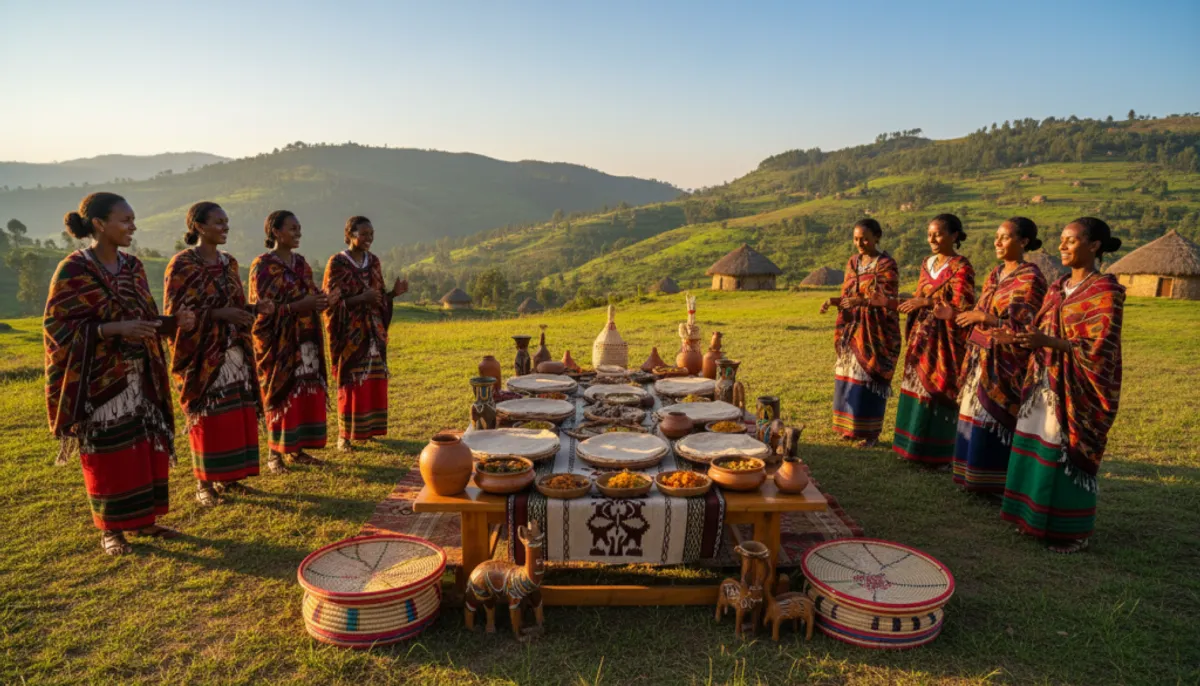
The territory is home to a population of over 130 million inhabitants today. They are divided into more than 80 distinct ethnic groups.
This mosaic of populations creates an unparalleled cultural diversity on the continent. Each group adds its own colors to the national identity.
Among the fundamental customs, respect occupies a prime place. It is particularly manifested towards the elders.
It is traditional to rise from one’s seat for an older person, even if they are only one year older. This practice illustrates deeply rooted social values.
Diving into this universe means discovering a world where spirituality, art, and social traditions intertwine. A fascinating heritage that continues to inspire the entire globe.
Key Points to Remember
- Ethiopia has a unique cultural heritage, forged by millennia of history.
- The country is one of the few that has never been colonized, preserving the authenticity of its customs.
- With over 80 ethnic groups, cultural diversity is exceptional.
- Intergenerational respect and hospitality are pillars of society.
- Considered a cradle of humanity, its heritage dates back to the origins of our species.
- Millennia-old traditions coexist harmoniously with modernity.
- Art, gastronomy, and spirituality form a socially cohesive fabric.
Introduction to Ethiopian Culture
Defining this heritage involves exploring a mosaic of traditions where each people brings its distinctive note. More than eighty ethnic groups coexist, creating an incomparable wealth.
The social organization of this country is based on ancestral principles. Hierarchical respect, particularly towards the elders, is fundamental. The wisdom acquired with age confers a special status within the community.
A legendary hospitality is another pillar. Welcoming a stranger with generosity is seen as an honor and an almost sacred duty. This value transcends all layers of society.
The cultural development has occurred relatively autonomously. The absence of colonization has allowed local practices to maintain their authenticity. This explains the profound originality of the customs observed today.
The Ethiopians place paramount importance on codes of politeness. Elaborate greeting formulas vary according to the age and gender of the interlocutor. Respectful titles such as “ato” (mister) or “woyzäro” (madam) are used.
A strong spiritual dimension permeates daily life. It influences dietary practices and community celebrations. Understanding these foundations requires grasping a dynamic balance between traditions and modernity.
The Major Periods of Ethiopian History
From ancient civilizations to medieval empires, Ethiopian history is a continuous narrative of greatness and resilience. This narrative spans nearly three millennia.
The first major chapter begins with the Kingdom of Aksum. It flourishes from the 1st century BC to the 10th century.
From the Kingdom of Aksum to the Ethiopian Empire
This kingdom represents an ancient golden age. It dominates maritime trade on the Red Sea.
A turning point occurs around 330. The Negus Ezana adopts Christianity as the official religion. This makes the country the second Christian nation in the world.
The Solomonid and Zagwe Dynasties
The Zagwe dynasty comes to power around 1140. Its most famous ruler, Gebre Mesqel Lalibela, orders the construction of rock-hewn churches. These monuments are now classified by UNESCO.
In 1270, Yekouno Amlak establishes the Solomonid dynasty. It lasts until 1974. This lineage claims descent from King Solomon.
The reign of Amda Syon I (1314-1344) sees a phase of expansion. The reign of Zara Yaqob (1436-1468) witnesses remarkable cultural development. These years form the golden age of the empire.
This rich millennial history explains the identity pride of Ethiopians. Successive centuries have shaped a strong national identity.
Diversity of Peoples and Languages
The richness of Ethiopia lies in its extraordinary plurality of peoples and languages. This nation has over eighty distinct ethnic groups.
On its territory, more than eighty different languages are also spoken. This mosaic constitutes one of the most remarkable characteristics of the country.
The Main Languages and Their Historical Role
The Amharic serves as the working language for the federal government. About 70% of Ethiopians understand it, whether as a mother tongue or a second language.
Other languages are widely spoken. Notably, Oromo, Somali, Tigrinya, and Afar are prevalent.
The Ge'ez plays a fundamental historical role. This liturgical language has conveyed ancient literature and religious texts for over fifteen centuries.
The Distribution of Ethnic Groups in Ethiopia
The Oromo form the largest group. They represent about one-third of the total population.
The Amhara constitute the second demographic group. They have exerted significant political and cultural influence throughout history.
Other significant peoples include the Somali, Tigrayans, and Sidama. The federal system organizes administration based on this geographical distribution.
This mosaic of communities is a source of pride. It forms a living heritage that the country strives to promote.
Customs Embedded in Ethiopian Culture
Social customs in Ethiopia constitute a complex network of gestures and words that guide each interaction. They rest on a solid foundation of values passed down through generations.
Respect for elders is a fundamental pillar. It is customary to rise immediately in the presence of an older person, even if they are only one year older.
Hospitality is legendary in this country. The coffee ceremony is a perfect example. This ritual can last several hours and symbolizes the honor bestowed upon a guest.
Politeness codes are highly developed. Specific greeting formulas are used according to the age and status of the interlocutor.
The use of honorific titles like “Ato” or “Woyzäro” is systematic. This reflects the respect given to each individual.
Gestures also follow precise rules. The table below illustrates some common behaviors and their social significance.
| Gesture | Social Significance | Context |
|---|---|---|
| Rising at the arrival of an elder | Respect and deference | Daily interactions |
| Avoiding pointing with a finger | Politeness and discretion | All situations |
| Not crossing legs in front of an elder | Formal and respectful attitude | Formal meetings |
| Serving coffee with the right hand | Hospitality and honor | Coffee ceremony |
The clothing traditions vary by region. Wearing a shemma, a white cotton cloth, is common during formal occasions.
These embedded customs create a harmonious social framework. Everyone knows their place and their duties towards the community in this country.
Religious and Spiritual Practices in Ethiopia
The Ethiopian religious landscape presents remarkable diversity, where several faiths have coexisted for centuries. Faith structures the calendar, diet, and social organization of the country.
The Influence of the Orthodox Church and Other Confessions
The Ethiopian Orthodox Church is an ancient institution, founded in the 4th century. It follows the monophysite doctrine and uses Ge'ez in its liturgies.
The faithful observe about 180 days of fasting per year. This strict dietary practice reinforces spiritual discipline.
Sunnite Islam, often tinged with Sufism, gathers more than one-third of the population. Catholicism, introduced by the Jesuits, represents a small minority.
Traditional Religious Rituals and Symbols
The rituals are distinguished by rich symbolism. They include complex processional crosses and colorful liturgical garments.
The rock-hewn churches of Lalibela are major pilgrimage sites. Their hypnotic chants in Ge'ez create a unique atmosphere.
| Confession | Estimated Percentage | Main Characteristic |
|---|---|---|
| Ethiopian Orthodox | ~43% | Pre-Chalcedonian church, strict fasts |
| Protestantism | ~18% | Recent growth, various denominations |
| Islam | ~34% | Sunnite tradition with Sufi influence |
| Catholicism | Historical presence since the 16th century | |
| Others (traditional, etc.) | ~3-5% | Diversity of ancestral beliefs |
This plurality reflects a relative tolerance in the country.
National Symbols and Emblems
Flag, anthem, emblems: each element carries the weight of a millennial identity. These symbols unite a country with many ethnicities around a common pride.
The current flag, adopted in 1996, displays the colors green-yellow-red. These hues, chosen in the 19th century, inspired many pan-African banners after independence.
The national anthem, “March Forward, Dear Mother Ethiopia”, dates back to 1992. It celebrates unity and calls for building a common future.
The Lion of Judah embodies the ancient Solomonid dynasty. The Ethiopian cross with interwoven patterns is an omnipresent religious symbol.
The national flower, the Zantedeschia, represents the beauty of the highlands. These emblems, whether ancient or modern, unite the peoples.
Addis Ababa, the capital, plays a major symbolic role. It houses the headquarters of the African Union, confirming this nation’s continental leadership.
These visible signs forge a strong collective identity. They remind of a glorious history and a sovereignty that is always defended.
Folklore, Myths, and Traditional Festivals
The rhythm of life in Ethiopia is marked by a unique calendar and festivals with deep roots. These celebrations blend ancient stories and historical moments to create a living heritage.
Rituals and Festive Ceremonies
The Enkutatash, the New Year, marks the end of the rains and renewal. The Meskel festival, at the end of September, commemorates the discovery of the cross in the 4th century with immense bonfires.
The Orthodox Christmas, Gänna, features nighttime processions and a traditional cross game. Timkat, the Epiphany, is spectacular with its collective baptisms.
National dates also honor the victory of Adwa in 1896. This tradition of resistance is a pillar of national pride.
Particularities of the Ethiopian Calendar
This system has thirteen months, the last being very short and festive. It follows the ancient Coptic calendar, creating a seven-year difference with the Gregorian calendar.
The local time is also unique. It starts counting from 6 AM, following the natural rhythm of the sun.
This conception of time influences all celebrations. It unites communities in a rich and shared annual cycle.
The Family and Social Values
The family unit forms the foundation of Ethiopian society, structuring relationships and responsibilities for everyone. This organization traditionally relies on an extended structure.
Several generations often live under the same roof or in close proximity. The elders hold natural authority and are deeply respected.
The naming system reflects this importance of lineage. A person carries their first name, followed by their father's name and then their paternal grandfather's name.
Women occupy varied positions depending on the regions and ethnic groups. Their economic role in agriculture and trade is crucial.
Progress in education and political participation is notable in urban areas. Marriage practices are evolving but retain traditional traits.
The birth of a child, especially a boy in rural areas, leads to great celebrations. Protective rituals involve the entire community.
| Aspect of the Family | Traditional Characteristic | Contemporary Evolution |
|---|---|---|
| Structure | Extended patriarchal family | Smaller nuclear families in cities |
| Decision-making | Authority of the elders | Broad consultation |
| Role of women | Centered on the home and agriculture | Increased access to education and professions |
| Celebrations | Community rituals for weddings and births | Maintaining rites, adapted forms |
Intergenerational solidarity remains an essential safety net. Urbanization and education are gradually modifying these dynamics.
Ethiopian Cuisine and Culinary Traditions
A culinary journey in Ethiopia invariably begins with a spongy, tangy flatbread that is much more than just bread.
Typical Dishes and Their History
The injera, made from fermented teff flour, forms the base of every meal. It serves as a plate, cutlery, and main food.
On it, wat, spicy stews made with berbere, are placed. This spice blend offers a range of flavors, from mild to very spicy.
The many days of Orthodox fasting have fostered a refined vegetarian cuisine. Shiro (chickpea puree) and gomen (spinach) are stars of this cuisine.
Eating together from a central injera reinforces social bonds. This sharing practice is a fundamental culinary tradition.
Strict dietary prohibitions, inherited from religious precepts, shape the menus. Pork, seafood, rabbit, and duck are absent from the tables.
This country is the cradle of Arabica coffee. The coffee ceremony, a hospitality ritual that can last for hours, honors the guest.
They also serve t’edj (honey wine) and tella (local beer). The coffee harvest, after the rains around November, is a key moment.
Crafts and Decorative Arts
Beyond words and rites, the soul of a people is also read in the objects they create and use. Artistic expression takes both utilitarian and deeply symbolic forms here.
Textiles, Pottery, and Traditional Trades
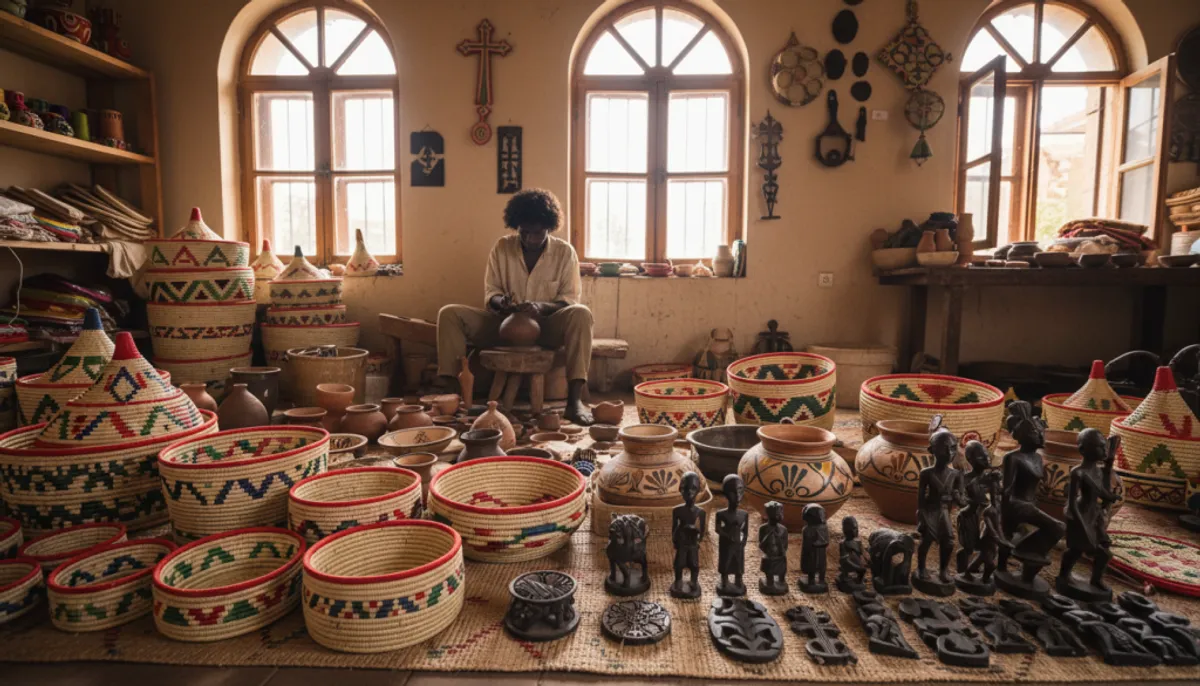
Textiles such as shemma or netela are handwoven. Their colorful borders tell a story of identity and craftsmanship.
Woodworking produces monoxyle headrests, true personal sculptures. Metal transforms into processional crosses with complex geometric patterns.
Clay gives life to the jebena, the traditional coffee pot. These everyday objects are often small works of art.
The illumination of religious manuscripts is another major tradition. It combines Byzantine influences with a very distinct local style.
These trades, passed down in specialized families, preserve a valuable heritage. They reflect the diversity of this culture in a tangible and beautiful way.
Ethiopian Literature and Philosophy
Among the lesser-known treasures, the literary and philosophical tradition shines with a particular brilliance. It constitutes one of the oldest written traditions in sub-Saharan Africa.
Its history dates back over fifteen centuries with the adoption of the Ge'ez alphabet. Ancient texts include chronicles, hymns, and legends.
The epic work Kebra Nagast (Glory of Kings), written in the 14th century, recounts the saga of the Queen of Sheba. Religious literature, with its hagiographies, long dominated production.
In the 17th century, the philosopher Zera Yacob wrote the treatise Hatata. His rationalist thought is often compared to that of Descartes.
Contemporary authors give a modern voice to this rich past. Maaza Mengiste, for example, explores the traumas of war in her books.
This Ethiopian literature, both ancient and modern, creates a bridge between the past and the present. It nourishes a proud and complex identity.
Music, Dance, and Ethio-Jazz
The sound of Ethiopia is immediately recognizable. It is based on the pentatonic qenet system. This scale creates unique melodies in the world.
Ethio-jazz emerged in the 1960s. This genre fuses jazz with millennia-old traditions. It represents a completely original musical art.
Mahmoud Ahmed is its living legend. He began with the Imperial Bodyguard Band. His powerful voice marked these golden years.
Traditional dances form a spectacular art of body movement. The shoulder movement eskista is its signature. It varies by region of the country.
This heritage is experiencing an exciting revival. A new generation of artists incorporates electronic influences. They continue to fascinate the whole world.
Sports and Olympic Achievements
The Ethiopian highlands have produced some of the greatest long-distance runners in history.
Athletics has dominated the sports scene for over sixty years. It has turned the country into a true factory of champions.
Abebe Bikila entered legend in 1960. He became the first sub-Saharan athlete to win an Olympic gold medal.
He ran the Rome marathon barefoot. This achievement marked the whole world.
The 1990s and 2000s saw the emergence of superstars. Haile Gebreselassie and Kenenisa Bekele broke numerous records.
They are multiple Olympic and world champions. Female athletes have also shone for many years.
Tirunesh Dibaba and Meseret Defar dominated long-distance races. Their success inspires generations.
The altitude of Addis Ababa, at 2400 meters, offers a natural advantage. It develops the aerobic capacities of runners.
A culture of effort and collective determination explains this success. The table below compares popular sports.
| Sport | Popularity | International Results | Characteristic |
|---|---|---|---|
| Athletics (long-distance running) | Very high | Exceptional (multiple Olympic medals) | Geographical advantage of the highlands |
| Football | High | Moderate | National passion, but limited success |
| Traditional sports (Genna, Donga) | Local / cultural | Non-competitive internationally | Practiced during festivals, linked to traditions |
Beyond athletics, ancestral games persist. Genna is a variant of hockey played at Christmas.
Donga is a traditional wrestling with sticks. These activities perpetuate a unique heritage.
Football is highly appreciated by the population. Its results do not yet rival those of running.
These repeated achievements make the continent of Africa proud. They motivate young athletes everywhere in the world.
Education, Media, and Modernity in Ethiopia
At the crossroads of education and information, Ethiopia is building its future with unique challenges. The country has radically transformed its educational system in a century.
Until 1900, the Orthodox Church dominated education. A secular system was then adopted.
Educational and University Institutions
The current government allocates a significant budget to education development. A regionalization policy allows teaching in local languages.
The standard curriculum lasts twelve years. It includes six years of primary, four of secondary, and two of upper secondary.
Access remains unequal between rural areas and large cities. The capital Addis Ababa concentrates the best infrastructures.
Universities play a crucial role. They train the elites and participate in the scientific development of the country.
| University | Year of Establishment | City | Notable Specialties |
|---|---|---|---|
| Addis Ababa | 1950 | Addis Ababa | Sciences, Medicine, Law |
| Baher Dar | 1999 | Baher Dar | Engineering, Pedagogy |
| Jimma | 1999 | Jimma | Public Health, Agriculture |
| Mekele | 1993 | Mekele | Technology, Social Sciences |
The government also closely controls the media. The anti-terrorism law of 2009 is often used against the press.
The ranking of Reporters Without Borders is low. The print media struggles to disseminate outside major cities.
The media organization is dominated by state-owned entities. However, private channels are emerging.
This situation illustrates the tensions between aspirations for modernity and the government's desire for control.
Contemporary Challenges and Social Development
The path to progress in Ethiopia today is strewn with complex obstacles that test its social cohesion. Despite notable economic growth in recent years, inequalities between regions persist.
The population, which exceeds 130 million inhabitants, is growing rapidly. This dynamic exerts enormous pressure on the resources and infrastructures of the country.

The government of Abiy Ahmed, which came to power in 2018, initially embodied hope. His reforms and peace with Eritrea earned him the Nobel Prize in 2019.
This hope has been tarnished by a devastating civil war in Tigray, triggered in November 2020. The conflict has caused a humanitarian catastrophe and challenged the stability of the country.
Ethnic tensions pose a structural challenge for this multi-ethnic nation. Episodes of intercommunal violence have marked several regions in recent years.
Corruption and human rights violations, according to international reports, hinder development. Forced displacements affect millions of people.
Food security remains precarious in some areas. Recurring famines, exacerbated by conflict and climate, remind of the 2011 crisis.
The government must reconcile the democratic aspirations of its youth with traditional political structures. The events of November 2020 showed the fragility of national unity.
Despite these immense challenges, the country has strong potential. Its young population and strategic position are major assets for the future.
Conclusion
From the discovery of Lucy to Olympic peaks, Ethiopia continues to mark world history with its contributions. This country is considered a cradle of humanity, where our oldest origins have been revealed.
It preserved its sovereignty during the partition of Africa in the 19th century. Its colors even inspired the pan-African movement.
On the international stage, its role exceeds its size. Addis Ababa hosts the headquarters of the African Union and the Economic Commission for Africa.
The Ethiopian culture represents an exceptional heritage developed over several millennia. It is a treasure for all of humanity.
On one hand, the millennial heritage offers solid foundations. On the other hand, modern transformations open new perspectives.
The future of this country will depend on its ability to value this unique heritage. It must build an inclusive society on this fascinating land.
Exploring this culture is embarking on a journey from the dawn of humanity to the challenges of the 21st century. A journey that continues to captivate the whole world.
FAQ
What are the major periods that shaped the history of the country?
The history is marked by founding empires like Aksum, known for its obelisks. Then came the Zagwe and Solomonid dynasties, whose reign consolidated the state and the Christian religion. The 20th century saw changes in government, a civil war, and the formation of the current Union.
How many languages are spoken and which is official?
More than 90 languages are counted! Amharic is the working language of the federal government. Ge'ez, an ancient liturgical language, is crucial for literature and religion. Oromo, Tigrinya, and Somali are also widely used by different peoples.
What is the role of the Orthodox religion in society?
The Ethiopian Orthodox Church, very influential, structures the calendar with its many festivals. Its rituals, symbols like the cross, and its rock-hewn churches are at the heart of art and social life. Other confessions, such as Islam and Catholicism, coexist and enrich the spirituality of the Ethiopian world.
Is local cuisine solely based on injera?
Injera, this fermented flatbread, is the central element of the meal, serving as both plate and cutlery. But the gastronomy is very diverse! It offers iconic dishes like wat (spicy stew), kitfo, and coffee, celebrated during social ceremonies that strengthen family ties.
Is there ancient and modern literature?
Absolutely! The written tradition dates back centuries with religious and royal texts in Ge'ez. Contemporary literature, in Amharic and other languages, explores social and political themes. Authors like Haddis Alemayehu have played a major role in its development.
What makes the music so distinctive, like ethio-jazz?
Traditional music uses unique instruments like the krar and the masenqo. In the 60s-70s, artists like Mulatu Astatke created ethio-jazz, an innovative style merging these sounds with jazz and funk. This musical scene remains very vibrant today.
How are traditional arts and crafts perpetuated?
Craftsmanship is an essential part of heritage. It includes weaving colorful textiles, pottery, silverwork for jewelry, and cross-making. These trades, often family-based, transmit ancestral know-how and symbolic patterns related to religion and history.
What are the main current social challenges?
The country is working towards equitable development, improving access to education and healthcare for its entire population. Issues related to federal organization, women's rights, and resource management are at the center of debates to build a stable and prosperous future.