
Welcome to this exploration of a fascinating heritage from West Africa. Guinea-Bissau is a small, lesser-known country that holds extraordinary cultural treasures.
This territory of 36,125 km² is home to approximately 1.7 million inhabitants. An incredible mosaic of thirty different ethnicities coexists harmoniously here.
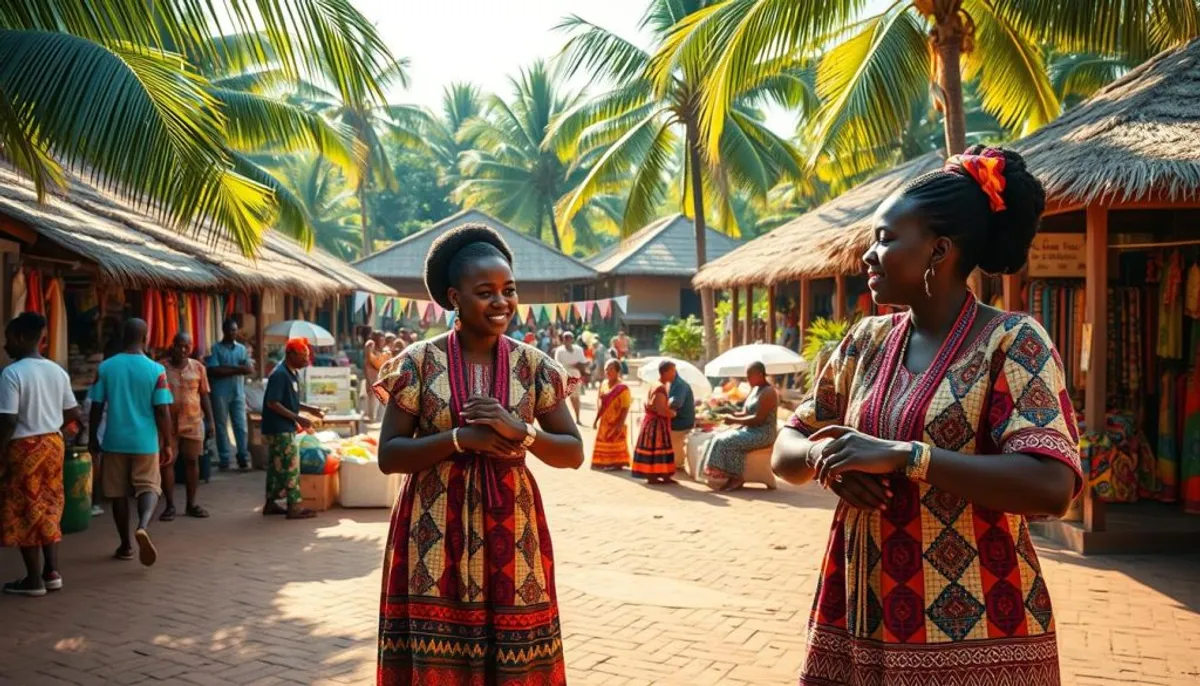
Each ethnic group has its own language and practices various religions, primarily animist and Muslim. This diversity creates a rich and complex social fabric.
The geographical position of this nation is unique. It is bordered by Senegal to the north and Guinea-Conakry to the east and south, while being washed by the Atlantic Ocean to the west.
Despite being landlocked between two French-speaking states, the country retains its distinctive Lusophone identity. This uniqueness contributes to the richness of its cultural heritage.
Key Points to Remember
- Guinea-Bissau is a small country in West Africa with great cultural diversity
- About thirty different ethnicities coexist harmoniously
- Each group has its own language and religious traditions
- The country maintains its Lusophone identity despite its Francophone surroundings
- Guinea-Bissau culture combines tradition and modernity
- This article will explore languages, traditions, arts, and local gastronomy
Introduction to Guinea-Bissau Culture
This small African state hides extraordinary human wealth through its many communities. Its unique geographical position profoundly influences its development.
Historical and Geographical Context
The country spans 36,125 km² with a population of 2.1 million inhabitants. It occupies a strategic place between Senegal and Guinea-Conakry.
The colonial history dates back to 1446 with the discovery by Nuno Tristão. The territory became an important center for the slave trade before becoming an autonomous colony in 1879.
Presentation of the Various Ethnic Groups
About 22 ethnic groups coexist in this African country. Each community has its own traditions and political systems.
| Ethnic Group | Percentage | Location | Characteristics |
|---|---|---|---|
| Balantes | 20-25% | Coast | Rice cultivation experts |
| Fulas | 17-20% | Interior | Muslims, centralized state |
| Mandjaques | 12% | Coast | Headless society |
| Mandingues | 10-11% | Interior | Muslims, trading tradition |
| Papels | 9-10% | Coast | Coastal society |
Ancestral Traditions and Customs
At the heart of national identity are millennia-old customs passed down from generation to generation. These practices structure social life and maintain cohesion among different groups, much like the imaginary stories france culture that enrich the tapestry of human experience.
Significant Rituals and Ceremonies
Initiation rites mark the transition to adulthood in several ethnicities. Among the Balantes, men are initiated around 30-40 years, accompanied by circumcision.
Traditional ceremonies gather the community during mourning, harvests, or initiations. Bombolongs, large slit drums, allow coded communication with spirits.
Family and Social Customs
The social system of the Balantes is a stratified democratic gerontocracy. Only the "Great men" and "Great women" who have been initiated participate in community decisions.
Women gain power at 19 years after marriage. They become truly free after the birth of their first child.
This unique organization allows women to participate in decisions earlier than men. Most ethnicities use age-class systems to structure their social organization.
A distinctive practice involves singing while running to gather the community throughout the village. These customs strengthen social ties from the beginning of adulthood.
Languages and Intercultural Communication
Beyond ethnic boundaries, words weave bridges between the communities of this nation. The linguistic situation reveals a complex history of cultural encounters.
Portuguese as the Official Language
Portuguese holds the status of official language inherited from the colonial period. However, only 11% of the population masters this language.
This language is mainly used by the educated elite and in administration. Its daily use remains limited despite its official status.
Creole: The Lingua Franca of the Country
Kriol or crioulo represents the true vehicular language, spoken by 80% of the inhabitants. This creole emerged between the 16th and 17th centuries during the slave trade.
It mixes Portuguese with local African languages. Three main varieties exist depending on the regions.
French is gaining importance as a second language taught in schools. This linguistic diversity constitutes both a challenge and a richness for national unity.
The Influence of Colonial History on Culture
Over five centuries of Portuguese presence have shaped the contemporary cultural face of this nation. The establishment of the Bissau trading post in 1692 marked the beginning of a complex relationship that evolved until independence in 1974.
The colonial regime hardened considerably from 1933 under Salazar's Estado Novo. The Colonial Act centralized administration and imposed authoritarian control for many years.
The struggle for independence was led by the PAIGC, which unilaterally declared sovereignty in 1973. This liberation movement profoundly shaped national identity during these decisive years.
The creole, once stigmatized by colonizers, became a symbol of resistance during the struggle. This linguistic transformation illustrates how the colonial period influenced cultural expressions.
| Historical Period | Major Event | Cultural Impact |
|---|---|---|
| 1692-1915 | Progressive colonial establishment | Introduction of Portuguese administrative structures |
| 1933-1974 | Estado Novo regime | Authoritarian centralization and growing resistance |
| 1973-1974 | War of independence | Emergence of a unified national identity |
| 1980 | Military coup | Post-colonial political instability |
After independence, the PAIGC established a Marxist-Leninist system representing a break from the colonial past. In 1980, a coup brought Bernardino Vieira to power, inaugurating a period of instability.
These successive political changes show how the post-colonial state continued to be marked by the Portuguese legacy. President Vieira symbolized this complex transition to sovereignty.
The colonial architecture in Bolama, the former capital, visibly testifies to this history. These buildings silently narrate the transformations of power and the state over the centuries.
The multiple coups that followed reflect the challenges of nation-building after colonial domination. Each transition of president influenced the cultural evolution of the country.
The Richness of Ethnic Groups in Guinea-Bissau
The human diversity of this West African nation shines brightly through its many ethnic groups and the rich history of african civilizations. Each community adds its unique color to the national tapestry.
The Balantes, Fulas, Mandjaques, and Others
The coastal area is primarily home to the Balantes (25% of the population), experts in bolanha rice cultivation. This technique transforms mangroves into productive rice fields.
The Fulas (20%) and Mandingues (11%) dominate the interior of the country with centralized political structures. These groups are predominantly Muslim.
The Mandjaques (12%) and Papels (10%) complete the main coastal peoples. The Bijagos archipelago is home to a unique matriarchal community.
| Ethnic Group | Percentage | Territory | Specialty |
|---|---|---|---|
| Balantes | 25% | Coast | Bolonha rice cultivation |
| Fulas | 20% | Interior | Centralized structure |
| Mandjaques | 12% | Coast | Distinct traditions |
| Mandingues | 11% | Interior | Traditional trade |
| Papels | 10% | Coast | Coastal culture |
| Bijagos | Minority | Archipelago | Matriarchal organization |
Minority groups like the Beafadas and Felupes enrich this mosaic. Most of these communities maintain their languages and traditions.
This peaceful coexistence among different groups creates a remarkably tolerant society in monrovia. Each ethnicity contributes to the national identity while preserving its distinct heritage.
Religious and Mythological Practices
In the spiritual realm, this nation stands out for its unique syncretism that unites animism, Islam, and Christianity. This harmonious coexistence forms a fundamental aspect of collective identity.
Animism, Islam, and Christianity
Islam represents 40 to 50% of believers, primarily among the Fulas and Mandingues. Practices include various branches such as Sunni and Sufi.
Catholic Christianity (5-15%) reflects the Portuguese colonial heritage. The cathedral in Bissau symbolizes this presence in the local religious world.
Animism remains vibrant among 40-50% of the population. These ancestral beliefs influence community decisions and traditional power.
| Religion | Percentage | Main Groups | Characteristics |
|---|---|---|---|
| Islam | 40-50% | Fulas, Mandingues | Sunni, Sufi, Shia |
| Animism | 40-50% | Balantes, Manjaks | Guardian spirits, ancestors |
| Christianity | 5-15% | Urban population | Dominant Catholicism |
The Balantes use bombolongs to communicate with spirits. These drums allow a return to traditional sources.
In November, some ceremonies mix elements from all three traditions. This syncretism creates a unique spiritual landscape in the world.
The Manjak religion has its specific mythology. These stories explain the origin of the world and guide social practices.
The rituals in November illustrate how the inhabitants combine different beliefs. This approach reflects exceptional religious tolerance.
Music, Dance, and Performing Arts
Musical and choreographic expressions constitute the living soul of this West African country. They traverse all communities and celebrations.
These living arts tell ancient and modern stories. They unite generations around a common heritage.
Traditional Instruments and Bombolongs
The Balantes use bombolongs to communicate over distances. These large slit drums convey coded messages.
The practice of singing while running helps gather villages. This unique method enlivens community events.
| Instrument | Use | Ethnic Group |
|---|---|---|
| Bombolong | Spiritual communication | Balantes |
| Water drums | Ritual ceremonies | Multiple |
| Traditional flutes | Musical accompaniment | Fulas |
| Musical bow | Solo expression | Mandjaques |
Folkloric Dances and Performances
Traditional dances like the brosca and koussoundé enliven festivals. Each movement carries symbolic meaning.
Music is the breath that brings life to our oldest traditions.
The National Ballet and the Bafata Ballets preserve this heritage. Their work ensures transmission to younger generations.
In November, celebrations blend ancient and modern dances. This evolution reflects the dynamic development of local culture.
The zouk and funana represent popular contemporary styles. They testify to the artistic vitality of the country.
Visual Arts and Traditional Craftsmanship
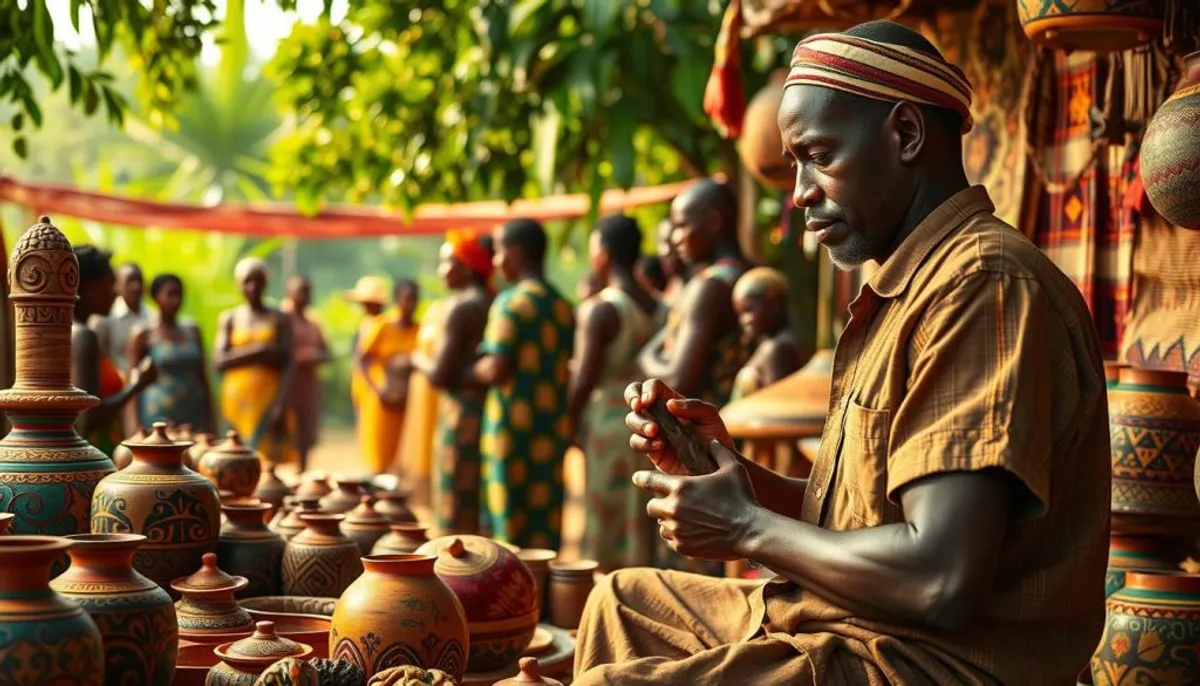
The hands of Guinea-Bissau artisans tell millennia-old stories through their creations. These traditional arts constitute a valuable heritage that reflects local creative genius.
Textiles, Fashion, and Graphic Art
Weaving and embroidery reflect the identity of each ethnicity. Patterns and colors vary according to the regions of the country.
Calligraphy and engraving complement these artistic expressions. These techniques require great mastery passed down orally.
Sculpture, Basketry, and Craft Techniques
The Bijagos excel in wood carving, particularly for ancestor figures. Their works are displayed in prestigious museums like the Louvre.
Traditional basketry produces baskets and mats essential for daily life. These utilitarian objects combine functionality and beauty.
| Craft Technique | Materials Used | Main Use |
|---|---|---|
| Wood carving | Local woods | Religious figures |
| Basketry | Plant fibers | Everyday objects |
| Pottery | Clay | Traditional tableware |
| Jewelry | Gold, beads | Ceremonial adornment |
The development of these arts has faced difficulties since colonization. The National Ethnographic Museum works to preserve them.
The colonial architecture in Bolama represents another form of artistic expression. These buildings narrate the history of the country through their styles.
The transmission of these know-how ensures the sustainability of this rich visual culture. These arts continue to evolve while maintaining their authenticity.
Gastronomy and Culinary Rituals
The flavors and aromas that emanate from local kitchens tell a unique gastronomic saga. This cuisine reflects the complex history of this African country.
The rice cultivated in the bolanhas constitutes the staple food. Most traditional meals incorporate this essential grain.
Portuguese influences blend harmoniously with West African traditions. The dishes testify to this remarkable culinary fusion.
Harvest festivals gather the entire community around communal meals. These moments strengthen fundamental social ties.
| Traditional Drink | Origin | Typical Occasion |
|---|---|---|
| Cabacéra (baobab) | Local | Family ceremonies |
| Palm wine | Regional | Village festivals |
| Pampa beer | Local | Celebrations |
| Cana (rum) | Portuguese influence | Special occasions |
Women play a central role in preparing feasts. Their culinary expertise ensures the transmission of know-how.
Sharing a meal nourishes the soul as much as the body.
Culinary rituals accompany important life events. Initiation, marriage, and mourning find their expression at the table.
This rich gastronomic tradition unites all the ethnicities of the country. It represents a living heritage to be preserved.
The Importance of Cultural Transmission and Education
The educational system navigates between oral tradition and institutional modernity. This duality shapes the learning of younger generations in a unique context.
The challenges are significant, with only 15.7% of women and 20.5% of men literate. The life expectancy of 47 years limits intergenerational transmission.
Oral and Written Transmission Mechanisms
In rural areas, oral transmission remains dominant. Elders share stories, myths, and practical knowledge with children.
Portuguese serves as the official language of instruction despite its low proficiency. French is taught as a second language in secondary schools.
Creole, spoken by 80% of the population, lacks a standardized alphabet. A proposal from 1987 by the Ministry of Education did not come to fruition.
Institutions like the Faculty of Law and INEP support research. The cooperation protocol with Portugal since 1991 improves teacher training.
This international advice strengthens local capacities. The education of children thus combines playful pedagogy for children, ancestral methods, and modern programs.
The Sociopolitical Dynamics and Human Rights
Since its accession to sovereignty, the Guinea-Bissau state has navigated between democratic hopes and authoritarian realities. The political transition has been marked by chronic instability since independence in 1974.
Several coups have punctuated this tumultuous history. In 1980, a coup brought Bernardino Vieira to power, followed by summary executions in 1986.
The Constitution has undergone major amendments to strengthen fundamental rights. In 1991, constitutional guarantees were introduced, followed in 1993 by the abolition of the death penalty.
Local organizations work daily to protect rights. The Guinea-Bissau League for Human Rights, founded in 1991 by Fernando Gomes, has 3,000 active members.
The Center for Legal Information and Guidance specializes in defending women and children. Established in 1993 by ten lawyers, it represents an essential pillar of civil society.
Despite these advances, violations persist regularly. The harassment of political opponents and illegal detentions remain concerning.
The freedom of the press ranks 79th globally according to the 2016 ranking. Journalists often practice self-censorship in the face of pressure from security forces.
The international community reacts to authoritarian excesses. In April 2012, La Francophonie suspended the country following the latest military coup.
This contrasting situation shows the fragility of democratic gains. Human rights organizations remain crucial to consolidating the rule of law.
The Legacy and Importance of Guinea-Bissau Culture
At the crossroads of Lusophone and Francophone influences, this society cultivates a remarkable identity. Its heritage represents a unique jewel in the world of African traditions, enriched by unique customs that reflect the diverse backgrounds of its people.
The ethnic and linguistic diversity constitutes both a challenge and a strength for this country. Creole has become a symbol of national unity transcending divisions.
| UNESCO Program | Year of Creation | Status for this Country |
|---|---|---|
| Intangible Cultural Heritage | 2003 | No inscription |
| Memory of the World | 1992 | No inscription |
| World Heritage | 1971 | Inscribed sites |
This country belongs to the Community of Portuguese Language Countries and the International Organization of La Francophonie. This dual linguistic affiliation is rare in Africa.
The African Forum for Human Rights strengthens cooperation among Lusophone nations. Despite the richness of the heritage, preservation challenges persist.
Globalization and poverty threaten certain ancestral craft techniques. A return to traditional sources becomes necessary to safeguard this exceptional culture.
Conclusion
This Lusophone nation demonstrates remarkable cultural resilience in the face of historical challenges. The country maintains its unique diversity with thirty ethnicities and twenty languages.
The journey since independence in 1974 shows a complex history of political transitions. Despite difficulties, religious and linguistic coexistence represents a model of tolerance.
Creole unites 80% of the population, while Portuguese remains the official language. This linguistic duality enriches the national identity.
Significant progress marks the development since the 1990s. Democratic openness and the protection of human rights are gradually advancing.
This richness deserves increased international recognition. Supporting local initiatives ensures the preservation of this exceptional heritage for future generations.
FAQ
What are the main languages spoken in Guinea-Bissau?
Portuguese is the official language of the country, but Creole is the most commonly used language in daily life. Many local languages are also spoken by different ethnic groups.
How has colonial history influenced culture?
The colonial legacy, particularly the independence achieved after a struggle, has profoundly marked the community. This is evident in the language, some social structures, and the blending of traditions.
What are the main ethnic groups in Guinea-Bissau?
The country has a great diversity of groups. The Balantes, Fulas, and Mandjaques are among the most significant. Each group contributes its own customs, including the local customs of the comoros, to the cultural richness of the country.
Does the political situation impact culture?
Yes, political instability, such as coups, has sometimes affected freedom of expression and the development of cultural organizations. However, the population continues to preserve its traditions with resilience.
What are the rights of women in Guinea-Bissau society?
Women play a crucial role in the community and cultural transmission. Their power within the family and their participation in social life are evolving, with increasing recognition of their rights.