
Welcome to the fascinating world of the Solomon Islands, a true Melanesian treasure. This impressive archipelago consists of over 900 islands scattered across the Pacific Ocean.
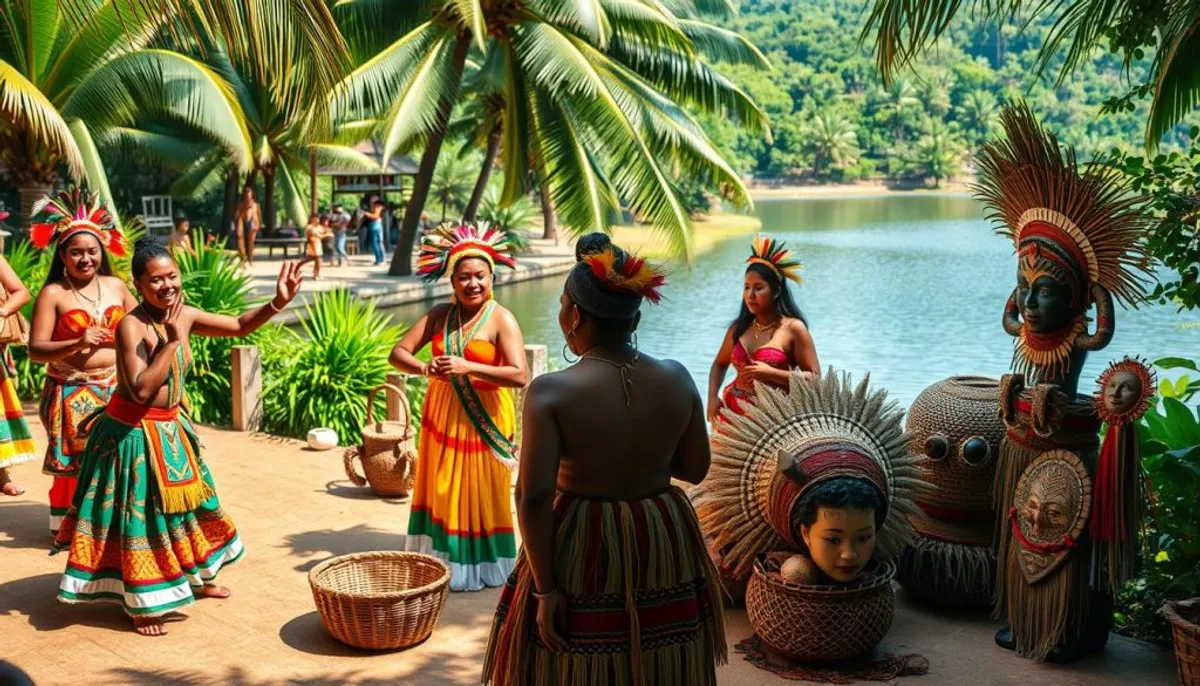
Nearly 550,000 inhabitants live on this territory of 28,450 km². The population is predominantly of Melanesian origin. Traditions remain very present in daily life.
This article invites you to explore the ancestral customs of the Solomon Islands. You will discover how these practices are passed down from generation to generation. Contemporary artistic expressions also testify to this rich heritage.
The linguistic diversity is remarkable with over 80 languages spoken. This variety reflects the complexity and richness of the Oceanic heritage. The inhabitants of the Pacific Islands have managed to preserve their customs despite a tumultuous history.
Today, they create a harmonious synthesis between modernity and respect for ancestral values. This adaptability is the strength of this unique society.
Key Points to Remember
- The Solomon Islands archipelago consists of over 900 islands in the Pacific
- About 550,000 inhabitants live on this territory of 28,450 km²
- 95% of the population is of Melanesian origin
- More than 80 different languages are spoken in the archipelago
- Ancestral traditions remain very present in daily life
- There is harmony between modernity and respect for customs
- Solomon culture represents a unique Oceanic heritage
Introduction to Solomon Culture
Discover the foundations of community life in the archipelago. This fascinating human mosaic brings together Polynesian, Micronesian, and especially Melanesian influences.
The inhabitants develop a rich identity that has endured for millennia. About 75% live off a subsistence economy in rural villages.
Context and Cultural Importance
The following table summarizes the main demographic characteristics:
| Characteristic | Value | Meaning |
|---|---|---|
| Ethnic Origin | 95% Melanesian | Cultural Homogeneity |
| Number of Languages | 80+ distinct | Exceptional Diversity |
| Way of Life | 75% rural | Preservation of Traditions |
Multilingualism characterizes each person. Each individual generally masters several family languages and Solomon Pidgin.
The "Wantok" system unites communities through clan solidarity.
The local societies show remarkable adaptability. They integrate external influences while maintaining their fundamental identity.
The Origins and Migrations in Oceania
Let’s dive into the fascinating story of the first Oceanic migrations. The history of settlement dates back nearly 28,000 years.
The First Waves of Settlement
The first inhabitants arrived from Southeast Asia. They crossed the sea via Papua New Guinea.
These pioneers took advantage of periods of low sea levels. They established the first human communities in the Pacific.
The Austronesian and Melanesian Heritage
3,200 years ago, a second Austronesian wave brought new techniques. Lapita pottery and navigation transformed the region.
The Austronesians merged with the existing population. This analysis and synthesis created the dual heritage we see today.
| Period | Origin | Main Contribution |
|---|---|---|
| 28,000 years ago | Southeast Asia | First Settlement |
| 3,200 years ago | Austronesians | Lapita Pottery |
| 13th-15th century | Polynesians | Island Enclaves |
Polynesian migrants formed distinct enclaves between the 13th and 15th centuries. They can be found in the islands of Rennell and Bellona.
These islands have never known political unification. Autonomous villages developed 75 distinct languages.
The Impact of Colonization and Conflicts on Cultural Identity
The arrival of Europeans marked a turning point in the development of the archipelago. This encounter between different worlds created tensions but also significant exchanges.
The Influence of Colonial Protectors
The European history begins with Álvaro de Mendaña in 1568. The Spanish explorer named the archipelago after the biblical King Solomon.
His stay on Santa Isabel was marked by violent conflicts with the inhabitants. The Spaniards demanded resources by force.
The British protectorate established in 1893 brought formal administration. This period allowed missionaries to settle more permanently.
The Role of Missionaries and Intercultural Exchanges
The efforts of evangelization faced difficult beginnings. The Marist mission of 1845 tragically ended with the death of Jean-Baptiste Épalle.
The British protectorate ultimately facilitated religious establishment. Cultural exchanges intensified despite initial resistances.
World War II profoundly disrupted the Solomon Islands. The Battle of Guadalcanal left indelible marks on the collective memory.
At the end of the conflict, millenarian movements and demands for autonomy prepared the way for independence. This world war accelerated social transformations.
The Rituals and Objects of Solomon Culture
Material traditions testify to a spirituality that remains alive. Ritual objects occupy a central place in community life.
These artifacts tell the story of exchanges between clans and families. They reveal a sober yet profound aesthetic.
Shell Money and Figureheads
Shell money serves both as adornment and as a medium of exchange. Made with red, white, and black beads, they can measure up to five meters.
These impressive lengths are worn during public ceremonies. They signal the social status of their owner.
The figureheads, called "nguzu nguzu," protected navigators. Carved from wood and inlaid with mother-of-pearl, they adorned the bows of canoes.
Their wide-open eyes watched over the men at sea. They frightened malevolent beings and warned the enemy.
Traditional and Funeral Ceremonies
Funeral bowls can reach several meters in diameter. They are still used in the eastern part of the archipelago for about ten years after a death.
These rituals maintain the bond between the living and the ancestors. They illustrate the continuity of spiritual relationships.
Traditions adapt to contemporary realities while preserving their essence.
Ritual objects continue to evolve. Their production now also responds to the demands of collectors.
Craftsmanship and Local Artistic Expression
In the heart of the Pacific, Solomon art reveals a unique identity. This artistic production is distinctly different from neighboring creations in Melanesia.
The islands develop a sober and refined aesthetic. It contrasts with the colorful productions of Vanuatu or Papua New Guinea.
Lacquered Wood Sculptures and Mother-of-Pearl Inlays
Artisans work with wood with exceptional mastery. They apply traditional lacquering techniques. The mother-of-pearl inlays create striking contrasts.
These ritual objects dating from the 19th century are now preserved in international museums. Their meticulous aesthetic reflects their ceremonial importance.
The collections of museums include about 200 representative pieces. They feature figureheads and ceremonial bowls.
Contemporary craftsmanship perpetuates these traditions. Artisans adapt their production to tourist demands while preserving the essence of their heritage.
Daily Life and Community Organization
Community organization in Solomon villages is based on ancestral principles that structure daily life. About 75% of the inhabitants live off a subsistence economy in these rural communities.
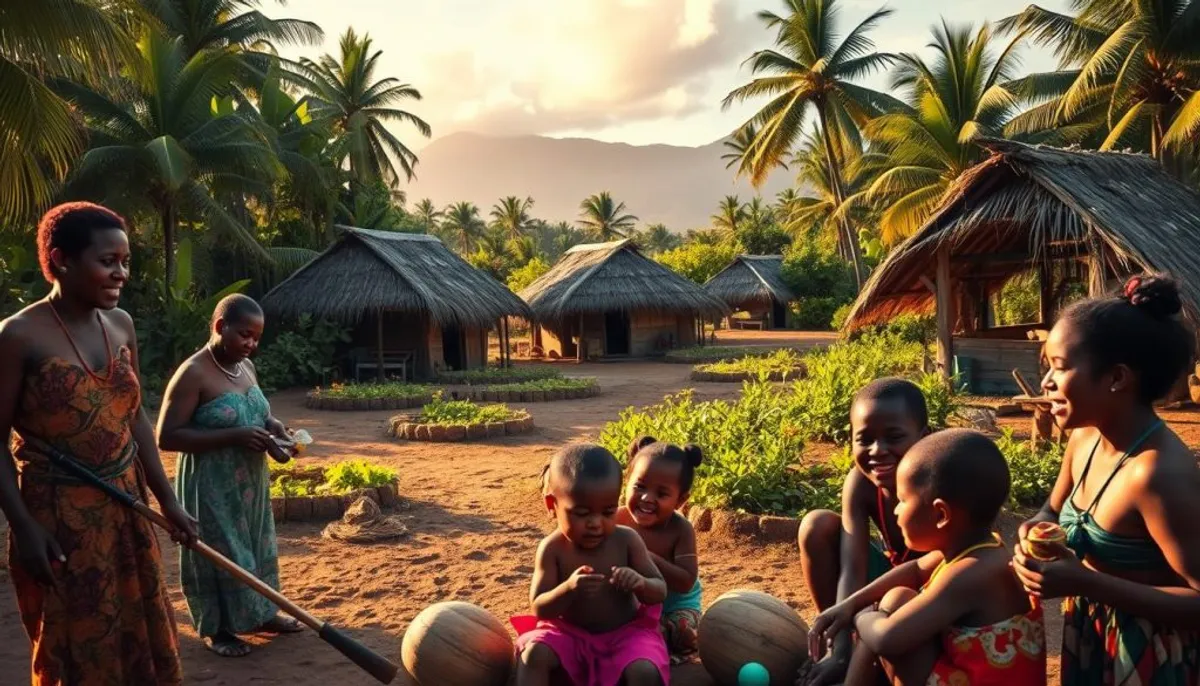
Coexistence in the Villages
Traditional houses, often on stilts, adapt perfectly to the tropical climate. Each family house also serves as a space for socialization and knowledge transmission.
Subsistence agriculture and fishing are the main economic activities. Traditional fishing techniques are passed down from generation to generation.
The Wantok system creates a vital network of solidarity. Each person belongs to a linguistic clan and can count on its support.
| Aspect of Life | Traditional Village | Urban Life (Honiara) |
|---|---|---|
| Economy | Subsistence (agriculture/fishing) | Wage/commerce |
| Housing | Stilt Houses | Modern Buildings |
| Authority | Village Chief | State Administration |
| Social Links | Strong Clan System | Individual Relationships |
The authority of the village chief remains important even for inhabitants who have migrated. A part of the population maintains its clan ties from the capital.
This organization contrasts with urban life. The duality between rural traditions and modernity characterizes contemporary Solomon Islands.
Contemporary Challenges of Heritage Preservation
In the face of globalization, the Solomon Islands navigate between modernity and identity preservation. This Oceanic country must tackle complex challenges to safeguard its unique heritage.
Modernity and Preservation of Ancestral Traditions
Ancestral traditions face serious threats. The feather money from the southern part of the archipelago illustrates this phenomenon. Few artisans still master its complex production.
The divide between urban and rural areas is widening. The capital Honiara offers a modern lifestyle with cars and infrastructure. A large part of the rural population lives in villages without roads or electricity.
This duality affects cultural transmission. Younger generations are drawn to urban opportunities. Societies must find a balance between development and conservation.
Missionary approaches have had variable impacts. Some islands have lost a significant part of their heritage. Others have preserved their traditions through tolerated coexistence.
In recent years, a growing awareness has emerged. Initiatives document endangered languages. Young people are training in traditional artisanal techniques.
The National Library, founded in 1974, works for this country. It collects and preserves the intangible heritage of the Solomon Islands. These institutions recognize the importance of this heritage.
Solomon societies demonstrate remarkable adaptability. They maintain a pragmatic balance between Christianity and traditional beliefs. Inhabitants of both the capital and the villages preserve this precious heritage.
Stories and Testimonies from Solomon Inhabitants
The stories passed down by the elders constitute a living treasure of the archipelago. These testimonies preserve the memory of the Solomon Islands across generations.
Oral Histories and Collective Memory
The Battle of Guadalcanal remains etched in memories. Elders recount the battles of 1942-1943 that transformed their island.
These stories also evoke the British protectorate and its consequences. The collective memory keeps track of significant events.
The Link Between Past and Present
The inhabitants maintain a bridge between their history and the present, including the history of afghanistan. Ancestral practices coexist with modernity.
Oral traditions continue to enrich community life. They ensure the transmission of a unique heritage to younger generations.
Conclusion
The Solomon Islands offer a lesson in cultural resilience in the face of modernity's challenges. This Melanesian archipelago has managed to preserve its unique identity despite historical upheavals.
The balance between ancestral traditions and contemporary adaptation characterizes these societies. Linguistic diversity and ritual practices remain alive in the communities.
This archipelago deserves international attention to highlight its exceptional heritage. The Solomon Islands remind us of the importance of preserving global cultural diversity.
Their heritage constitutes a valuable source of inspiration for future generations. These islands of the Pacific demonstrate how tradition and modernity can coexist harmoniously.
FAQ
What is the significance of shell money in the archipelago?
Shell money, like that used in Santa Isabel, is central to exchanges and ceremonies. It symbolizes wealth and strengthens social ties among the inhabitants.
How did the Battle of Guadalcanal mark the country's history?
This major conflict of World War II profoundly affected the islands and their societies. It also paved the way for new exchanges and influenced the British protectorate.
What types of artisanal objects can be discovered in local museums?
The museums of the Solomon Islands showcase superb canoes, lacquered wood sculptures, and figureheads. These objects tell the story of daily life and the traditions of the villages.
How is community life organized in the villages today?
Life in the villages is based on strong mutual support. Activities like fishing or maintaining plantations are often done in groups, under the respected authority of the chief.
What are the main languages spoken in the archipelago?
There are over 70 languages! English is the official language, but pidgin is widely used for exchanges among different populations.
What role do missionaries play in the evolution of customs?
Arriving at the end of the 19th century, missionaries introduced new beliefs. Their influence altered some practices while coexisting with ancestral traditions.