
For several decades, a phenomenon from the United States has profoundly marked Western societies. It involves intense ideological conflicts that divide public opinion on fundamental value issues.
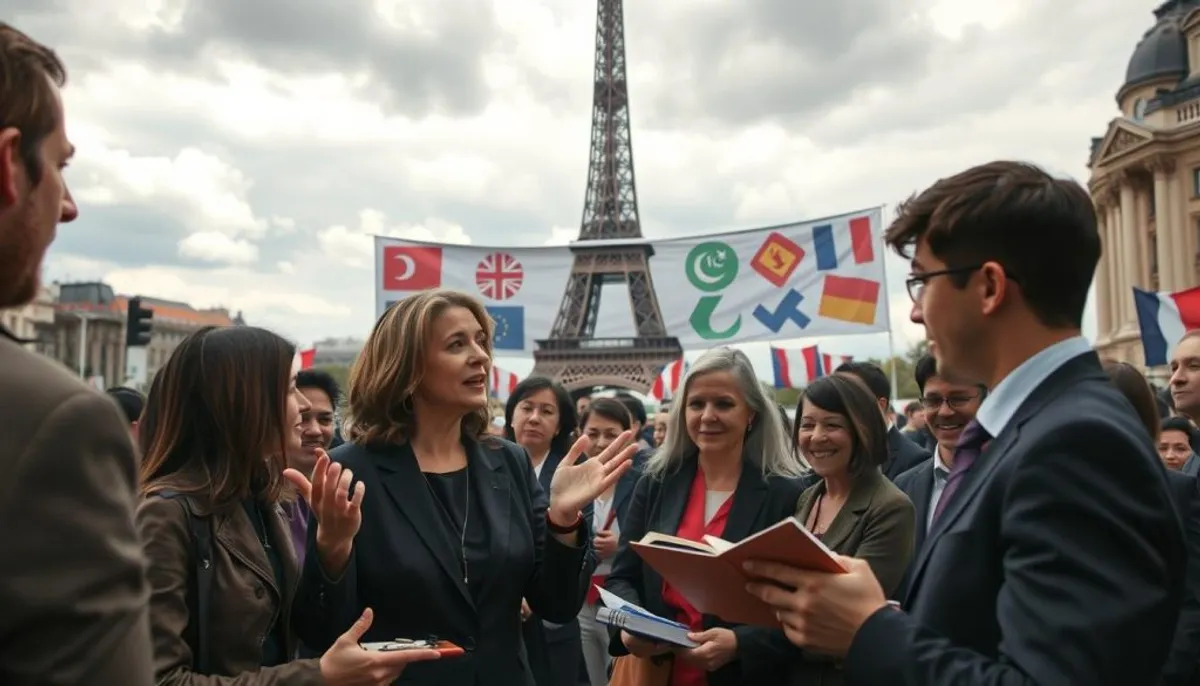
The term “culture war” originates from the German word Kulturkampf. The latter referred to a historical confrontation between the Prussian state and the Catholic Church in the 19th century.
In France, authors like Olivier Roy prefer to speak of a “war of values.” These tensions manifest at the very heart of our society. They touch upon our collective identity and the norms that govern us.
The subjects of discord are numerous and current. Secularism, national identity, education, as well as issues of gender and ecology, structure these oppositions. Understanding these dynamics is essential to grasp the growing polarization of our public life.
Key Points to Remember
- The concept of “culture war” refers to deep ideological conflicts over moral values.
- Its etymological origin traces back to the German term “Kulturkampf.”
- In France, this phenomenon is often described as a “war of values.”
- These debates concern collective identity and social norms, well beyond economic policy.
- Central themes include secularism, national identity, gender, and ecology.
- Understanding these mechanisms is crucial for analyzing the polarization of public opinion.
- This article offers a historical and sociological analysis of these tensions in France.
Introduction
It was in the early 1990s that sociologist James Davison Hunter formulated an innovative analysis of ideological tensions. His work Culture Wars: The Struggle to Define America, published in 1991, provided a powerful conceptual framework for understanding the deep divisions in American society.
This notion quickly established itself as an essential lens for interpreting contemporary social conflicts. Media and public discourse widely adopted this term following Pat Buchanan's speech in 1992.
The relevance of this concept has seen a resurgence in light of several current phenomena. The rise of populist parties in Europe, the growing polarization of public debates, and the fragmentation of the media landscape make this analysis more pertinent than ever.
Our central issue examines how these dynamics manifest in France. What specificities do they present compared to the original American model? This question guides our reflection throughout this article.
Our methodology combines several complementary approaches. A historical perspective traces the emergence of the concept, while a sociological analysis examines the actors and stakes. The discursive study also explores the rhetorical strategies employed.
The academic debate surrounding the culture war remains vibrant. Some see it as a profound sociological reality, while others view it as a media or political construct. This diversity of interpretations enriches our understanding of the phenomenon.
This article develops several structuring axes of reflection. Historical origins, theoretical definitions, and French manifestations constitute the pillars of our analysis. Specific thematic stakes and perspectives for evolution complement this exploration.
Historical Context and Origins of Culture Wars
The term “culture war” finds its roots in a 19th-century German conflict opposing Bismarck to the Catholic Church. This Kulturkampf (1871-1878) established a model of confrontation between secular and religious power.
In the 20th century, these tensions evolved into debates between urban and rural values. Al Smith's campaign in 1928 illustrates this growing polarization.
From Kulturkampf to Modern Culture Wars
The legacy of the Kulturkampf directly influences contemporary conflicts. It lays the groundwork for confrontations over education and moral authority.
These historical dynamics gradually transform. They move from purely religious domains to touch upon fundamental societal values.
The Contribution of James Davison Hunter
In 1991, James Davison Hunter published his seminal work. This publication theorizes American polarization around moral issues.
Hunter's model contrasts orthodoxy and progressivism. He demonstrates how these visions create new political alliances.
The concept entered public discourse after 1992. James Davison thus provides an essential analytical framework for understanding our era.
Definitions and Essential Stakes of Culture Wars
At the heart of contemporary societal tensions lies a fundamental opposition regarding the sources of moral authority. These conflicts go beyond mere differences of opinion to touch upon the foundations of our collective identity.
The Battle of Values and Identity
According to James Davison Hunter, the culture war represents a deep confrontation over the value systems that structure our existence. These systems give meaning to our lives and establish a coherent social order. In this context, the emergence of interactive art plays a significant role as a means of expression and reflection on these values.
The key element of polarization lies in the source of moral authority. The orthodox rely on a transcendent and definable authority. Progressives adapt their values according to historical context and current knowledge.
This symbolic battle creates divisions that transcend traditional affiliations. It forges new, unexpected ideological coalitions.
| Aspect | Orthodoxy | Progressivism | Social Impact |
|---|---|---|---|
| Source of Authority | Transcendent and immutable | Contextual and evolving | Opposing worldview |
| Foundation of Values | Tradition and sacred texts | Rationalism and subjectivism | Conflict over moral legitimacy |
| Temporal Approach | Historical continuity | Adaptation to the present | Tension between permanence and change |
| Fields of Application | Family, education, religion | Individual rights, expression | Redefinition of social norms |
The very meaning of the nation becomes the central issue. Each camp claims legitimacy to define collective identity and the principles of social cohesion.
This notion of cultural conflict takes on a particular hue in France. The republican heritage and secular tradition profoundly influence the terms of the debate.
Analysis of the Culture War Phenomenon in France
The French context of ideological tensions presents unique characteristics shaped by national history. Unlike the American model, the culture wars in France revolve around the republican and secular heritage.
Olivier Roy proposes the term “war of values” to describe these internal conflicts within Western society. This approach clearly distinguishes these tensions from the concept of the clash of civilizations.
The rise of French populism is partially explained by the theory of cultural backlash. This conservative reaction responds to rapid social changes such as LGBT rights and multiculturalism.
The main actors in these debates include political parties like the National Rally and La France Insoumise. Media intellectuals and activist associations also animate these controversies.
Several moments have crystallized recent French culture wars. The debate over marriage for all (2012-2013) and the #MeToo movement are striking examples.
The French specificity lies in the tension between republican universalism and identity claims. This dynamic profoundly influences contemporary political debate, particularly concerning Lyon's culture.
Unlike the United States, religion plays a different role in the French culture wars. The absence of strict bipartisanship and the tradition of state intervention also shape these conflicts.
Debates on Family and Abortion within the Culture Wars
Family and reproductive issues crystallize contemporary ideological oppositions. The family constitutes the fundamental institution for the transmission of values and social reproduction.
Impact on Traditional Family
James Davison Hunter identifies the family as the most obvious battleground. Conservatives defend the traditional family as the natural foundation of society.
Progressives value the diversity of family models. This opposition reveals radically different conceptions of moral authority.
The Abortion Debate and Its Social Resonances
Abortion perfectly embodies these tensions. It irreducibly opposes pro-choice and pro-life positions.
This debate goes beyond the simple medical question. It touches upon the definition of women's roles and moral authority.
| Aspect | Pro-Choice Position | Pro-Life Position | Societal Impact |
|---|---|---|---|
| Ethical Foundation | Body autonomy | Sanctity of life | Conflict of absolute values |
| View of Women | Reproductive freedom | Natural maternal role | Definition of obligations |
| Legal Approach | Individual rights | Protection of the fetus | Tension between rights/duties |
| Contextualization | Societal evolution | Immutable principles | Relation to change |
In France, the debate on abortion has evolved since the Veil law of 1975. Recent controversies over constitutional inclusion illustrate the persistence of these divides.
The mobilization around marriage for all in 2012-2013 represents a foundational moment. It has profoundly marked the landscape of contemporary French culture wars.
Polarization between Tradition and Modernity
A fundamental divide currently runs through our society, systematically opposing defenders of tradition to proponents of modernity. This bipolar structure characterizes all contemporary social issues.
Each camp develops a coherent but radically different vision of collective organization. Conservatives defend tradition and the established moral order, relying on a transcendent authority.
Arguments of Conservatives vs. Progressive Positions
The arguments of conservatives criticize moral relativism and excessive individualism. They value historical continuity and traditional institutions.
In contrast, progressives prioritize social change and individual autonomy. They adapt norms to the contemporary context and reject traditional hierarchies.
This opposition generates profound mutual hostility. Each camp perceives itself as the legitimate defender of true national values.
The paradox lies in the rhetorical symmetry used by both camps. Each accuses the other of extremism and intolerance, creating a dialogical impasse.
In France, this polarization manifests in debates over sexual education and the post-colonial question. It restructures the political landscape beyond the traditional left-right divide.
Secularism and the Role of Religion in Cultural Debates
In France, the question of the role of religion in the public space is at the heart of current social tensions. This debate is deeply structured by the principle of secularism, a fundamental legacy of the 1905 law.
Unlike the United States, religion in France is primarily conceived as a matter of the private sphere. This strict separation directly influences the nature of local culture wars.
Contemporary controversies are numerous. They concern the wearing of religious symbols, such as the Islamic veil, in schools and in administration.
The divide generally opposes two visions of secularism. On one side, a strict approach defends absolute neutrality in the public space. On the other, a more inclusive vision accepts discreet religious expression.
| Conception of Secularism | Fundamental Principles | Practical Application |
|---|---|---|
| “Strict” Secularism | Absolute neutrality of the state and public space. | Prohibition of ostentatious religious symbols for public agents and sometimes users. |
| “Open” Secularism | Freedom to express convictions while respecting public order. | Acceptance of discreet religious symbols and seeking reasonable accommodations. |
Islam occupies a particular place in these political discussions. It is perceived differently, sometimes as a challenge to republican values, sometimes as an object of discrimination.
This tension between secularism and religious freedom crystallizes opposing visions of collective life. It remains a major issue in contemporary French culture, where ultra culture plays a significant role.
Education as an Ideological Battleground
The French school, the quintessential republican institution, today finds itself at the heart of major ideological tensions. According to James Davison Hunter, education goes beyond mere knowledge transmission to become the primary site of reproduction of community identities.

Teaching the Theory of Evolution and Transmission of Values
The controversy surrounding the teaching of the theory of evolution perfectly illustrates these tensions. For some creationists, the opposition to Darwin stems from moral rather than scientific concerns.
In France, educational debates take specific forms. History curricula often oppose traditional national vision and critical approaches. Sexual education and inclusive writing also crystallize divergent conceptions.
These confrontations reveal opposing visions of the nation and the authority of knowledge. The republican school, intended to be neutral, thus becomes a battleground where different conceptions of what should be transmitted to future generations clash.
Freedom of Expression and the Fight against Political Correctness
The issue of political correctness has transformed discussions on freedom of expression. This debate opposes two radically different visions of public speech.
On one side, advocates of absolute freedom reject any limitation. On the other, proponents of regulation seek to protect against hate speech.
Political correctness has become a central rhetorical weapon in these culture wars. Conservatives see it as a freedom-restricting censorship of authentic speech.
Progressives, on the other hand, view political correctness as mere respect for minority groups. This divergence creates deep tensions.
| Position | View of Freedom of Expression | Approach to Political Correctness | Social Impact |
|---|---|---|---|
| Conservatives | Absolute and unlimited freedom | Unjustified censorship | Claim of transgression |
| Progressives | Responsible freedom with safeguards | Necessary respect and civility | Protection of minorities |
Donald Trump popularized the anti-political correctness critique. He used this rhetoric to legitimize transgressive remarks and mobilize his base.
University campuses have become battlegrounds of this ideological war. Safe spaces and trigger warnings crystallize the oppositions.
In France, the debate takes specific forms with caricature cases and laws against hate speech. Cancel culture also fuels these tensions, as do the artistic job offers that emerge in this complex cultural context.
The Economic and Societal Dimensions of Culture Wars
The economic and social dimensions of modern ideological conflicts are often overlooked. Researchers vigorously debate their root causes, including the impact of club history on these tensions.
Two main theories clash in the academic world. The economic anxiety theory explains populist voting through material insecurity and social downgrading.
Hunter's model has transformed traditional political analysis. It has shifted attention from class divides to cultural oppositions.
The cultural backlash theory offers another perspective. It sees these wars as a reaction from once-dominant groups.
Some researchers criticize this purely cultural approach. Morris Fiorina argues that polarization mostly affects political and media elites.
Economic transformations create fertile ground for these conflicts. Globalization and precarity generate resentment.
Immigration perfectly illustrates this intertwining. It mixes economic anxiety with identity issues.
These wars can also serve as a diversion. They divert attention from economic inequalities to moral conflicts.
Understanding this economic dimension is crucial. It is an integral part of analyzing contemporary tensions.
The Influence of Social Media and the Press
Digital platforms have radically transformed the way ideological debates spread in our society. They create spaces for instant mobilization where positions polarize quickly.
The Dissemination of Ideas and the Rise of Misinformation
Social media algorithms naturally favor emotional and divisive content. This technical logic amplifies tensions by creating information bubbles where everyone only sees what confirms their beliefs.
Misinformation becomes a rhetorical weapon in these conflicts. Actors deliberately spread false ideas to fuel outrage and mobilize their supporters.
The Black Lives Matter movement perfectly illustrates this new dynamic. It used hashtags to organize transnational mobilizations against police violence.
New actors are emerging in this digital landscape. Influencers and online communities now structure ideological battles around specific cultural identities.
Donald Trump masterfully exploited this new reality. His strategic use of Twitter allowed him to bypass traditional media and directly fuel controversies.
The controversies over wokism in Hollywood or diverse casting show how these tensions invest popular culture. Networks become the theater for these symbolic wars.
Perspectives for Evolution and New Stakes
The years 2010-2020 saw culture wars expand into unexpected areas of social life. Technical questions like climate policies or public health have become identity issues.

The debate over religious freedom has undergone a major transformation. After the legal gains of the LGBT community, tensions have emerged between religious freedoms and civil rights.
Movements like Black Lives Matter have broadened the scope of ideological conflicts. They oppose historical recognition to the defense of the traditional national narrative.
James Davison Hunter proposes in 2024 an innovative reading of the culture wars. He evokes a shared nihilism where each camp victimizes itself.
In the face of global challenges, these tensions could either intensify or show signs of exhaustion. The world is witnessing a growing fragmentation of the public space.
New stakes are already emerging for the future. Artificial intelligence and bioethical questions will structure the debates of the coming years.
Critical Approach and Theoretical Reflections
A fundamental question animates researchers: are ideological tensions authentic or constructed? This inquiry opens an exciting debate on the validity of explanatory models.
Academic Debates and Critiques of the Hunter Model
James Davison Hunter's model has been widely discussed in scientific articles. Several academic papers have tested his theory with varying results.
Morris Fiorina questions Davison Hunter's approach. He argues that polarization mainly affects political and media elites.
The general population would remain rather moderate according to this critique. Fiorina speaks of the myth of the “50/50 nation” to describe this illusion.
Alan Abramowitz, on the contrary, defends the reality of polarization. His works on James Davison show a deep division among engaged voters.
Some researchers suggest that these tensions are strategically amplified. Political actors would create conflicts to mobilize their electoral base.
Research on James Davison has evolved since the 1990s. It now integrates social psychology and behavioral economics.
This article illustrates the complexity of academic debates. The very concept of culture war can reinforce the polarization it describes.
Conclusion
This analysis of ideological tensions reveals complex mechanisms that divide our society. The French specificities, marked by republican and secular heritage, give a unique hue to these debates.
The observed polarization transcends traditional political divides. It touches upon the foundations of our collective identity and the values that define the nation, including the heritage of the south.
In the face of these divisions, the major challenge remains the search for constructive dialogue. Understanding these dynamics allows us to avoid radicalization and preserve our ability to live together.
The future will depend on our ability to articulate cultural differences and a common foundation. This reflection paves the way for a peaceful coexistence beyond sterile oppositions.
FAQ
What exactly is a “culture war”?
A “culture war” refers to a deep conflict within a society over values, norms, and identity. These tensions often oppose different worldviews, such as tradition versus modernity, and touch on subjects like family, religion, or individual rights. Sociologist James Davison Hunter popularized this notion to describe these ideological battles.
How are the debates on abortion in France an example of a “culture war”?
Discussions on voluntary termination of pregnancy crystallize opposing visions of society. On one side, progressive positions defend women's rights and individual autonomy. On the other, some conservatives see it as an ethical issue related to life and traditional family. This debate symbolizes the broader battle of values.
How has secularism become a central issue in these conflicts?
Secularism, a fundamental principle in France, is currently at the heart of intense exchanges. It raises questions about the place of religion in public space and the expression of personal convictions. These discussions reflect deeper tensions regarding national identity and the coexistence of different cultures.
What role do social media like Twitter play in these controversies?
Digital platforms amplify and accelerate the dissemination of ideas. They allow for rapid mobilization around causes but also facilitate misinformation and polarization. Movements like Black Lives Matter have gained visibility through them, illustrating their power in contemporary debates, particularly during fpv competitions.
Is James Davison Hunter's theory still relevant for analyzing the French situation?
Hunter's analysis remains a reference for understanding the dynamics of cultural conflicts. However, some scholars believe that the current landscape, marked by social media and increased fragmentation, requires complementary approaches. His model offers a useful framework, but the phenomenon is constantly evolving.