At the heart of Southeastern Europe lies a country with enchanting charm and a unique identity. Its heritage is the result of a fascinating blend that has shaped over the centuries.
This identity draws its roots from four main sources. It features a Latin linguistic background, ancestral rural and pastoral traditions, Byzantine and Slavic Eastern influences, as well as a Western contribution linked to the Enlightenment.
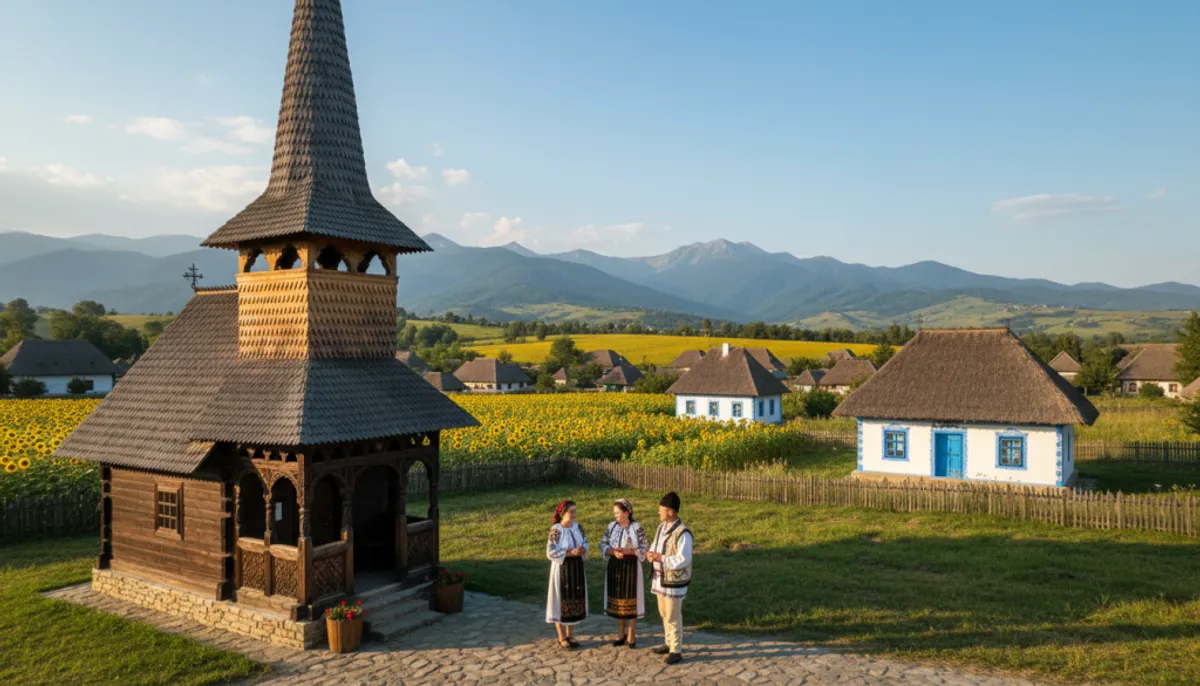
Despite a tumultuous history marked by various foreign influences, this nation has managed to preserve the strength of its unique character. It represents a true crossroads where different European spheres meet.
The cultural renaissance of the 18th century was a decisive turning point. It introduced modern ideas and fostered the emergence of a learned national consciousness. Today, living traditions coexist harmoniously with modernity.
Key Points to Remember
- Romania has a unique cultural identity, born from a mix of Latin, Eastern, and Western influences.
- Its foundations rest on four pillars: Latin heritage, rural traditions, Byzantine and Slavic contributions, and Western Enlightenment.
- This country is a geographical and cultural crossroads between Central Europe, Eastern Europe, and the Balkans.
- Its heritage and identity have withstood complex historical periods and external influences.
- The 18th century marked a crucial renaissance, integrating Enlightenment ideals into society.
- The expression "island of Latinity" partially describes its distinctive linguistic and cultural position.
The Origins and Cultural Influences in Romania
The foundations of Romanian identity plunge their roots into a complex mix. This country has synthesized various contributions to forge a unique heritage.
The Latin, Rural, and Eastern Roots
The Romanian language, of Latin origin, is a central pillar. It constitutes the linguistic foundation of the nation.
Rural and pastoral traditions remain very present. They testify to a deep connection with the Proto-Romanian ancestors.
The Eastern influence marks the Orthodox Christian religion. The Byzantine and Slavic heritage is seen in ancient architecture and cuisine.
The Cultural Renaissance and Western Influence
Starting from the 18th century, a renaissance transforms society. It introduces the spirit of the Enlightenment and Western ideas.
The revolutions of 1784, 1821, and 1848 punctuated this history. They shaped national consciousness and the aspiration for freedom.
These multiple currents create a unique hybrid culture. It harmoniously combines East and West.
The Emblematic Traditions and Celebrations
From the end of winter to the summer solstice, popular customs create a deep bond with nature and community. These festivals mark the year and unite generations.
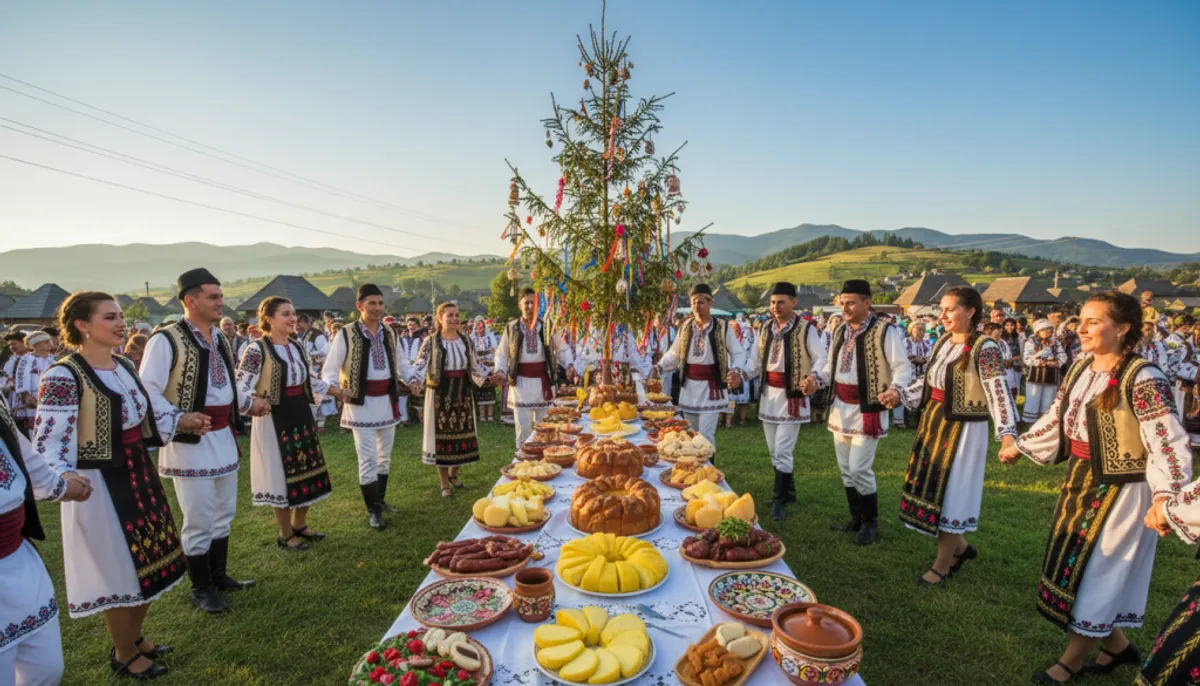
Mărțișor, Dragobete, and Sânziene
The 1st of March marks Mărțișor. Small red and white talismans are given for health.
Dragobete, on February 24th, celebrates love. Young people sing and pick flowers in the woods.
On June 24th, Sânziene honors the fairies. Flowery crowns are thrown into the water to predict the future.
| Festival | Date | Symbols | Traditions |
|---|---|---|---|
| Mărțișor | 1st of March | Red and white string | Exchange of amulets for spring |
| Dragobete | 24th of February | Field flowers | Singing, dancing, and romantic rituals |
| Sânziene | 24th of June | Flower crowns | Predictions and connection with nature |
“A forgotten tradition is a lost soul.”
Christmas, Easter, and Traditional Colinde
In December, the colinde resonate. Children sing from house to house for Christmas.
The Christmas Eve dinner on December 24th features a feast. Sarmale, cozonac, and piftie are enjoyed.
At Easter, religious fervor peaks. Red-dyed eggs and the midnight mass bring families together. The shared meal celebrates the resurrection.
These eggs symbolize the blood of Christ. It is a day of great joy and sharing.
The Artistic and Musical Expressions
The vibrant soul of a nation often expresses itself through its arts and melodies. These creations reflect a rich and diverse heritage.
Traditional and Contemporary Music
This sound art is a unique alchemy. It merges Greek, Hungarian, Slavic, Turkish, and Western influences.
Traditional music includes two main styles. The first is festive folk music, with lively songs and dances. The second is the colinde, religious or historical-themed invocations.
Classical artists have gained worldwide fame. Georges Enescu, Sergiu Celibidache, and Angela Gheorghiu are brilliant examples.
The Hora Dance and Folklore Festivals
This hora dance is emblematic. This circular dance from the Balkans symbolizes unity and continuity.
Other regional dances enrich the heritage. There are the călușari (male fertility dance), the swirling învârtita from Transylvania, and the perinița with colorful handkerchiefs.
Festivals celebrate these living traditions. The Transylvanian International Film Festival is a contemporary example. Other regional folklore festivals pass these arts on to new generations.
Composer Béla Bartók created the Six Romanian Popular Dances in 1915. He was fascinated by these melodies.
| Dance | Region | Characteristics | Occasion |
|---|---|---|---|
| Hora | Balkans | Circular dance, hands linked | Weddings, celebrations |
| Călușari | Everywhere | Male dance, fertility ritual | Spring |
| Învârtita | Transylvania | Swirling, fast | Festivals |
| Perinița | Muntenia | In a circle with handkerchiefs | Local celebrations |
“Music is the language of the soul.”
Romanian Culture in Daily Life
Daily life in Romania is imbued with remarkable human warmth, where hospitality is not an option but a second nature. These simple gestures structure social life and create a strong sense of belonging.
Hospitality and Local Customs
Warmly welcoming a visitor is an integral part of local values. It is common to spontaneously offer coffee or a meal, even during an unexpected visit.
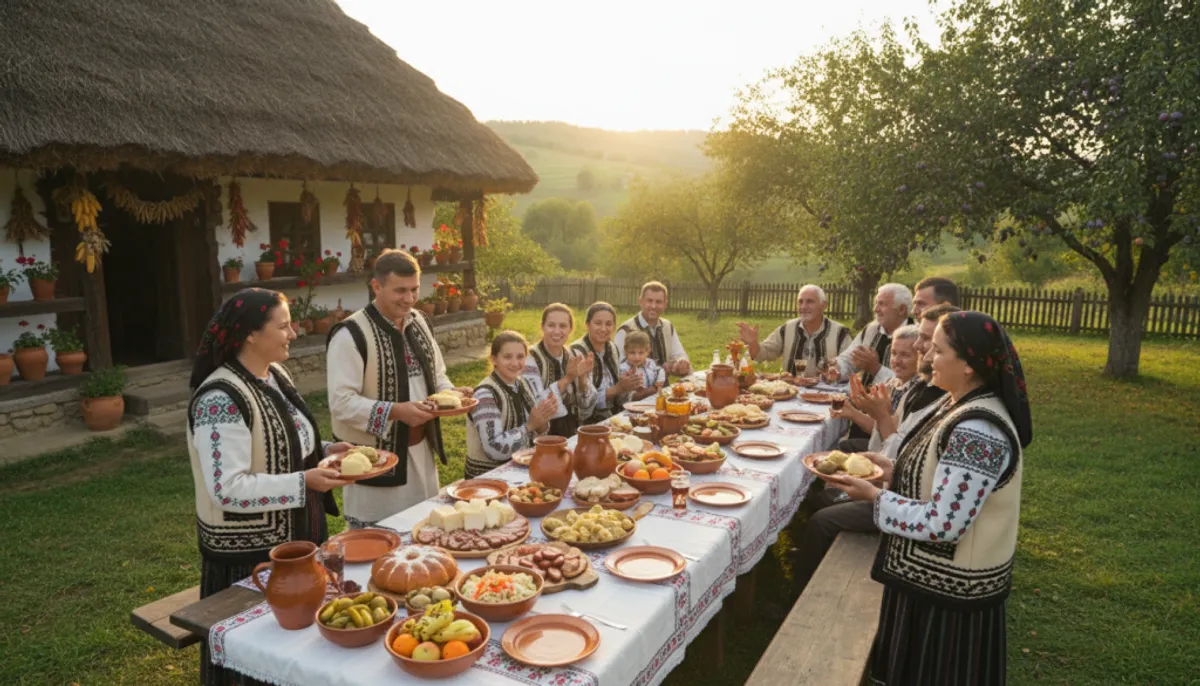
In villages, the offering of bread and salt symbolizes a kind welcome. This ancestral custom shows deep respect for the guest.
During celebrations, community support expresses itself naturally. Neighbors share their dishes with the elderly or isolated individuals.
For guests, certain customs are appreciated. Arriving with a small gift, such as an odd number of flowers, is a polite gesture. At the table, one waits for the host to begin. Toasts, pronounced while looking the guests in the eye, seal the conviviality.
| Custom | Meaning | Occasion |
|---|---|---|
| Bread and salt | Welcome and generosity | Arrival of a guest |
| Spontaneous coffee | Warm welcome | Unexpected visit |
| Sharing dishes | Community solidarity | Local festivities |
| “Noroc” toast | Wishes of good luck | Festive meal |
These practices are not empty formalities. They form an integral part of the life of Romanians. They reflect values of respect and generosity that unite people.
These customs often turn visitors into friends. Romanians consider this welcome a duty and a source of pride.
The Architecture and Visual Art in the Romanian Landscape
The Romanian landscape reveals a fascinating history through its stones and architectural forms. This country is a true open-air museum.
Its heritage spans millennia. It ranges from Dacian fortresses to contemporary masterpieces.
From Ancient Fortresses to Wooden Churches
The Orăștie Mountains house Dacian citadels that are 2000 years old. Roman remains, such as the Tropaeum Traiani, testify to a crucial part of European history.
Vernacular architecture is spectacular. The wooden churches of Maramureș, built without nails, are UNESCO-listed.
The fortified churches of Transylvania combined worship and defense. The Horezu Monastery is a jewel of Brâncovan style.
| Site | Period | Feature | Status |
|---|---|---|---|
| Dacian Fortresses | Iron Age | Mountain citadels | World Heritage |
| Wooden Churches (Maramureș) | Middle Ages | Nail-free construction | UNESCO |
| Fortified Churches (Transylvania) | 13th-16th century | Defensive structure | National Heritage |
| Center of Sighișoara | Medieval | Preserved citadel | UNESCO |
After 1880, Neo-Romanian architecture created a distinct national style. Contemporary visual arts continue to enrich this heritage.
Painting, sculpture, and photography thrive today. These contemporary arts perpetuate vibrant creativity.
Social Norms and Rites of Passage
Social interactions in Romania follow precise codes that structure daily life. These customs facilitate exchanges and strengthen community ties.
Greetings, Politeness, and Hierarchy
A firm handshake with direct eye contact shows sincerity and respect. Polite phrases vary according to the time: Bună dimineața in the morning, Bună ziua during the day.
Adding Domnule (Mr.) or Doamnă (Mrs.) signifies respect. Punctuality is crucial in a professional setting.
Romanians generally avoid discussing certain sensitive topics during first meetings. Politics and religion are among these topics.
Family Rituals and Traditional Weddings
Traditional weddings are lavish celebrations that last several days. They include rituals such as the bride's bath and the bread dance.
These weddings are true community events. Folk dances and typical dishes hold a central place.
In villages, rites of passage into adulthood persist. Romanians thus perpetuate the transmission of ancestral values.
The Influence of Regions on Cultural Identity
Exploring Romania is discovering several worlds in one. Each territory brings its unique color to the fascinating national patchwork.
Transylvania, Moldavia, Maramureș, and Dobroudja
Transylvania reveals a marked Central European heritage. Its embroidered costumes and elaborate weddings testify to a distinctive identity.
In Moldavia, rituals related to fertility and doina songs are vivid. The celebration of Mărțișor holds particular importance there.
Maramureș impresses with its masterpieces of carved wood. Its UNESCO-listed churches are the heart of lively village celebrations.
Dobroudja, on the other hand, blends Greek and Turkish influences. Its cuisine and festivals celebrate remarkable ethnic diversity.
Diversity of Regional Customs
These local particularities enrich the common heritage. The majority of national customs are a creative synthesis of these.
Visiting each region is akin to a distinct journey. The traditions, architecture, and costumes vary significantly.
This diversity does not weaken the unity of the country. It instead offers an exceptional cultural richness.
Each region thus contributes its own nuances. Together, they form the complete picture of Romanian culture.
Conclusion
Ultimately, Romania offers much more than just a tourist destination. Its unique heritage harmoniously fuses Latin, Eastern, and Western influences.
From the Mărțișor on the 1st of March to Christmas carols, the year is punctuated by ancestral festivals. Traditional music and dances form its vibrant heart.
The legendary hospitality of Romanians transforms every visit. Sharing and conviviality are an integral part of their daily life.
The majority of travelers discover several cultures in one country. Each region brings its own color.
Understanding these traditions facilitates integration. Contemporary events, from festivals to weddings, showcase a dynamic vitality.
Beyond a number of customs, it is a philosophy of life based on respect and transmission. Explore this invaluable wealth for yourself.
FAQ
What are the main influences that shaped the country's heritage?
The local heritage is a fascinating mix. Its Latin roots are evident in the language. Deep rural traditions and Eastern touches, particularly Ottoman, have also left their mark. Later, exchanges with Western Europe enriched this unique picture.
What traditional festivals are the most important to know?
Several events punctuate the year. Mărțișor on the 1st of March celebrates spring. Dragobete on February 24th is the festival of love. Sânziene at the end of June honors nature. Easter and Christmas celebrations, with their special songs (the *colinde*), are significant family moments.
How is music and dance expressed today?
Traditional music, with its violins and *cobzas*, remains alive. It also inspires contemporary artists. The *hora* dance, where people hold hands in a circle, is a symbol of unity. Major festivals like the one in Sibiu showcase this rich folklore.
What is hospitality and daily life like?
Hospitality is a central value. It is common to offer coffee or a slice of cake to guests. Respect for elders and a certain formality in greetings are important. Shared meals are at the heart of social and family life.
What architectural styles characterize the landscapes?
You will find great diversity! Medieval fortresses like those in Bran or Rasnov. The beautiful painted churches of Bucovina, listed as UNESCO heritage. And in regions like Maramureș, impressive wooden churches, tall and striking.
How do weddings and major family rituals unfold?
Traditional weddings are true celebrations, lasting several days. They include symbolic customs like the stealing of the bride, specific songs, and dances in costume. These rituals strengthen community ties and mark important life stages.
Does identity vary by region?
Absolutely. Each major region brings its own color. Transylvania has a marked Saxon and Hungarian heritage. Moldavia is known for its monasteries. Maramureș preserves a very authentic rural way of life. Dobroudja, near the Black Sea, has multiple influences. This diversity forges the richness of the country.