
Welcome to this fascinating exploration of a rich and vibrant culture that has endured through the centuries. The people we are discussing possess a millennia-old heritage marked by resilience and creativity.
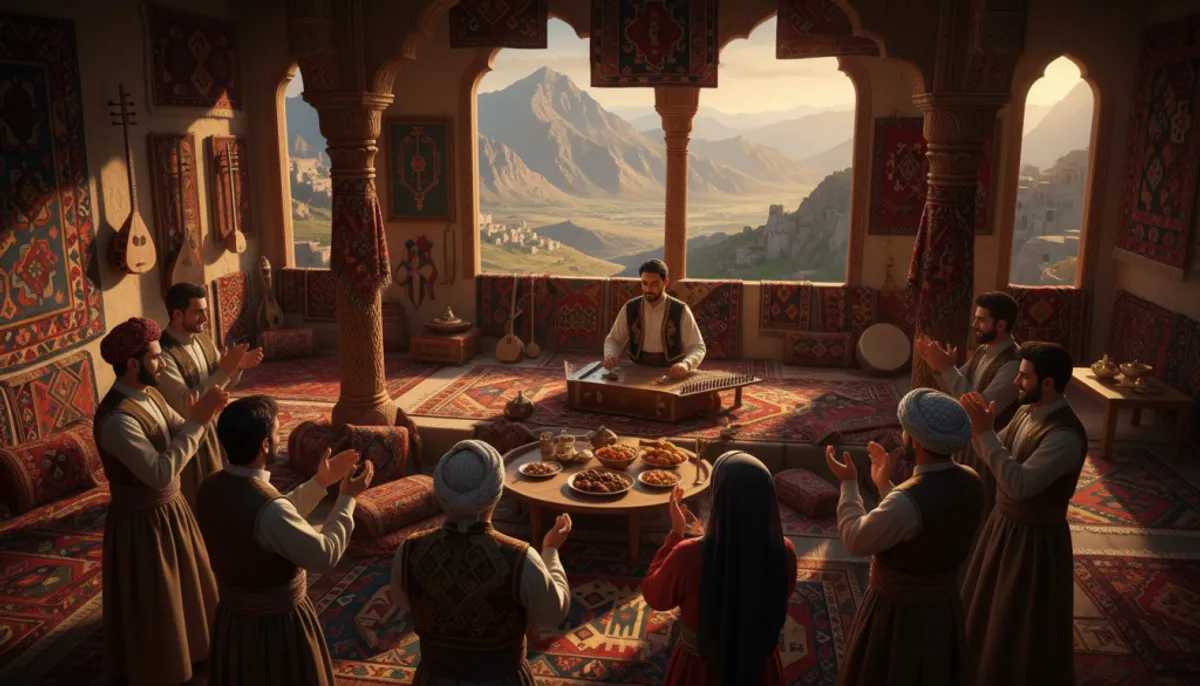
Primarily spread across several countries in the Middle East, this community constitutes one of the largest nations without a sovereign state. Their territory spans mountainous regions that have shaped their unique identity.
This complex history has given rise to remarkable artistic expressions. Music, visual arts, and oral traditions testify to a living heritage that continues to evolve.
Despite political challenges, artistic creations transcend modern borders. They tell stories of resistance, love, and hope that resonate universally.
Throughout this article, we will discover how these ancient traditions interact with contemporary influences. We will see how identity reinvents itself while preserving its deep roots.
Key Points to Remember
- The Kurdish people represent a significant community without a sovereign state
- Their territory spans several countries in the Middle East
- The millennia-old history has forged a unique cultural identity
- Music and arts express a rich living tradition
- Artistic creations transcend political borders
- Cultural heritage combines ancient and modern traditions
- Identity continues to evolve while preserving its roots
Introduction
Let’s dive into the heart of a fascinating community with millennia-old traditions. This Kurdish people represents one of the most significant nations without internationally recognized sovereign status.
Their population is estimated to be between 35 and 48 million individuals. They are primarily spread across four countries in the Middle East.
| Country | Estimated Population (in millions) | Approximate Percentage |
|---|---|---|
| Turkey | 15-18 | 40-45% |
| Iran | 6-9.2 | 15-20% |
| Iraq | 5-7 | 12-17% |
| Syria | 2.5-2.8 | 6-7% |
Kurdistan refers to a geographical and cultural region rather than a political entity. This land extends over the Zagros Mountains and east of the Taurus Mountains.
The culture is the main cement of this community's identity. It transcends political and religious boundaries.
This ethnic group has played an important role in the history of the Middle Eastern world. Their participation in major regional events is significant.
Understanding this rich culture requires exploring its millennia-old past and its contemporary manifestations. Our journey through its various facets begins here.
Origins and Ancient History
The mountains of Kurdistan house millennia-old remnants that testify to an ancient human presence. This history dates back to fascinating civilizations that have marked the region.
The Halaf culture appears as early as the 6th millennium BCE. It represents the first manifestation of a distinct social organization in these mountainous territories.
In the 23rd century BCE, the Hurrians dominated a vast territory. Their influence extended well beyond the Zagros and Taurus Mountains.
The Lullubis inhabited the Sharazor plain at the same time. They fiercely resisted Akkadian invasions, establishing a tradition of territorial defense.
Greek geographers referred to these populations as “Carduchians.” Xenophon, in his Anabasis, describes around 400 BCE a people fiercely defending their native mountains.
These ancient civilizations lay the foundations of what will become Kurdish identity. Their continued presence in this geographical area testifies to remarkable permanence.
The continuity between these ancient peoples and modern communities is striking. It highlights the antiquity of human occupation in this part of the world.
The Role of the Medes and Cultural Renaissance
In the 7th century BCE, a new power emerged in the mountains of the Middle East. The Medes formed an empire considered the direct ancestor of the modern Kurdish people.
In 612 BCE, this civilization achieved a major conquest. The Medes defeated the powerful Assyria, extending their dominance throughout the region.
| Historical Event | Date | Significance |
|---|---|---|
| Formation of the Median Empire | Beginning of the 7th century BCE | Birth of a regional power |
| Conquest of Assyria | 612 BCE | Peak of Median dominance |
| End of Political Reign | Mid-6th century BCE | Transition to other influences |
The date of 612 BCE holds particular symbolic importance. For some, it marks the beginning of the modern Kurdish era.
The Median Empire covered an impressive territory. It extended over present-day Iran and central Anatolia, demonstrating real power.
Even after several years, the legacy of the Medes persisted for a long time. Their civilization influenced the region until the time of Alexander the Great.
This period represents a foundational creation for contemporary identity. It nurtures national pride and claims a distinct millennia-old history.
Kurdish Culture: Identity and Traditions
The customs and rites of this community testify to a rich synthesis of ancestral influences. This heritage represents a unique blend from various ancient peoples, ancestors of the current populations.
Like many other groups in the Middle East, this culture has undergone reciprocal influences with neighboring peoples. However, it remains closer to Indo-Iranian traditions, particularly those of the geographically nearby Persians and Lors.
The celebration of Norouz on March 21 offers an emblematic example of these cultural ties. This New Year festival shared with other Iranian peoples illustrates the persistence of ancestral traditions.
The identity of this community rests primarily on language and traditions rather than religion. This particularity has allowed for cohesion despite religious diversity and geographical dispersion.
This cultural resilience in the face of historical challenges demonstrates remarkable strength. The traditional heritage has survived centuries and pressures of assimilation, thus preserving a distinct and vibrant identity.
Kurdish Languages and Dialects
The language is a fundamental pillar of collective identity. This Kurdish language belongs to the Indo-European family, specifically to the Northwestern Iranian group.
The linguistic complexity reflects a fragmented political history. Different alphabets are used depending on the regions – primarily Arabic and Latin.
Kurmanji: Main Linguistic Expression
The Kurmanji represents the main linguistic set. Spoken by the majority of the population, it particularly dominates in Turkey and Syria.
This dialect also extends into the northern Iraqi and Iranian territories. Its widespread use makes it the most prevalent language.
Sorani and Other Dialects
The Sorani constitutes the second major dialect. Written in Arabic script, it dominates the southern territories.
Other dialects enrich this linguistic diversity. Zazaki, Lori, Laki, and Gorani complete the panorama.
| Main Dialect | Dominant Regions | Alphabet Used |
|---|---|---|
| Kurmanji | Turkey, Syria, Northern Iraq/Iran | Latin |
| Sorani | Southern Iraq, Iran | Arabic |
| Zazaki | North Kurdistan | Latin |
Despite these differences, mutual understanding generally exists. This fundamental unity testifies to common linguistic roots.
The languages and dialects thus form the main identity cement. They unite a people geographically dispersed for centuries.
Kurdish Music and Folk Singing
The dengbêj, true modern troubadours, carry the musical tradition from generation to generation. These itinerant artists play a fundamental role in preserving a unique sound heritage.
The popular music of this region is characterized by its monodic style. Instrument and voice unite in unison, creating an emotional harmony.
Traditional Instruments and Vocal Expression
The dengbêj compose works that are essentially vocal. Instruments simply accompany their singing as they move between villages.
An interesting distinction exists between musical traditions. The mountain dwellers, of nomadic origin, prefer wind instruments like the dûdûk.
The sedentary people of the plains use string instruments instead. The tenbûr, a six-string lute, represents their emblematic instrument.
This instrumental diversity reflects geographical and historical differences. Yet, the whole maintains a remarkable stylistic coherence.
Music accompanies all important occasions of community life. Ceremonies, celebrations, and daily moments resonate with these ancestral melodies.
For the people concerned, these songs constitute much more than entertainment. They convey history, values, and collective identity through the ages.
Kurdish Folklore and Mythology
For centuries, wonderful stories have spread orally through the villages. This oral tradition represents a living literature that has preserved an exceptional narrative heritage.
Traditional Tales
Storytellers traveled from community to community, particularly appreciated during the long winter months. They conveyed varied tales about nature, love, heroes, and mythological creatures.
This oral literature served both as entertainment and as an educational vehicle. It taught moral values while reinforcing collective identity.
Recurring Symbols and Myths
The fox embodies the most frequent character in these tales. This animal symbolizes cunning and intelligence that triumph over adversity.
The Jews of Sakho developed a unique narrative tradition. Their storytellers were respected throughout the region for their distinctive art.
| Folklore Theme | Main Characteristics | Transmission |
|---|---|---|
| Anthropomorphic Animals | The fox as a central figure | Oral until the 20th century |
| Heroes and Epics | Tales of courage and resistance | Songs and stories |
| Mythological Creatures | Fantastic beings and chimeras | Varied regional tales |
Some stories were universal while others remained specific to a part of the territory. This diversity reflects the internal richness of the narrative tradition.
The Role of Women in Kurdish Society
Female participation in collective activities challenges regional conventions. This social particularity has attracted attention for decades.
Major Soane, a British officer during World War I, noted this uniqueness. He observed that women and men participated together in dances during celebrations.
This mix contrasted with the practices of other neighboring Muslim groups. It already revealed a different approach to gender relations.
In the arid mountains, agricultural work required everyone's contribution. Men and women shared the same responsibilities to survive.
Role in Traditions and Modern Conflicts
This practical equality has nourished progressive ideas within the community. Solidarity became essential in the face of daily challenges.
In 2004, the Women's Protection Units (YPJ) were established. This female branch gathers between 7,000 and 24,000 fighters.
Their commitment to the fight against Daesh demonstrates their determination. These women actively defend their rights and protect their population.
This contemporary military role is part of a tradition of equality. Although variable by region, it remains a strong identity element.
The Religious and Spiritual Heritage
The religious landscape of the Kurdish people reveals exceptional diversity in the Middle East. This confessional plurality testifies to a rich history marked by different influences.
About 80% of individuals follow Sunni Islam, representing several millions of faithful. Their practice has distinct specificities compared to neighboring Arabs and Turks.
Diversity of Confessions: Sunni Islam, Yezidism, and More
Other Muslims are divided between Shiism and Alevism. This majority religion coexists with many other beliefs.
Notably, there are Yarsanism, Yezidism, and Zoroastrianism. Jewish and Christian minorities complete this spiritual picture.
Historically, about 25,000 Jewish people lived in 200 localities. The Christian population counts around 150,000 faithful in Iraqi Kurdistan.
The Yezidis represent 500,000 adherents in Iraq, 150,000 in Syria, and 100,000 in Turkey. This diversity reflects a crossroads of ancient civilizations.
Traditional tolerance allows for peaceful coexistence among different confessions. This openness characterizes the spiritual heritage of this community.
Unfortunately, some groups have experienced recent persecutions. The exile of Jews to Israel in 1949-1950 marks a painful chapter in this history.
Kurdish Arts and Literature
The twelfth century marked a decisive turning point for the written expression of this community. A significant literary production began to flourish in the vernacular language.
In 1596, Prince Chéref Khan completed his monumental work. The Chérefnameh or Chronicles of the Nation remains a cornerstone of regional historiography.
Intellectual centers shone during this period. The theological schools of Djezireh and Zakho gained international renown.
| Literary Figure | Century | Major Work | Contribution |
|---|---|---|---|
| Melayé Djaziri | 16th | Lyrical Poetry | Expression of identity pride |
| Ehmedê Khani | 17th | Mem-o-Zin | Call for political unity |
| Ismail Çelebi | 16th | Sufi Teaching | Spiritual and musical influence |
The city of Akhlat distinguished itself with its astronomical observatory. The teaching of natural sciences reached remarkable levels there.
Sufi masters like Gulsheni shone well beyond borders. Their musical and spiritual genius was recognized as far as Istanbul.
Every princely court hosted an intense artistic life. This period constitutes a true golden age for creation.
Literature played a crucial role in preserving identity. It transcended political divisions to assert cultural unity.
Political Influences and Kurdish Organizations
The creation of armed forces represents a crucial step in political affirmation. These military structures defend the aspirations of the Kurdish national movement against regional challenges.
The Peshmergas and the Kurdish Military Force
The Peshmergas constitute the oldest military organization. Founded in 1920, this force currently has over 350,000 active members.
It protects the regional government of Iraqi Kurdistan. Its role is essential for the security of this autonomous state.
Political Movements and Identity Claims
The PKK, created in Turkey, had about 5,000 members in 2013. This organization actively participates in the war for autonomy.
In Syria, the YPG and YPJ defend the Rojava project. Their commitment was decisive during the war against the Islamic State.
| Organization | Creation | Estimated Strength | Main Region |
|---|---|---|---|
| Peshmergas | 1920 | 350,000+ | Iraq |
| PKK | 1978 | 5,000 (2013) | Turkey |
| YPG | 2011 | 35,000-60,000 | Syria |
| YPJ | 2004/2016 | 7,000-24,000 | Syria |
These military organizations illustrate the diversity of political approaches. Each group contributes to building a viable autonomous state.
Traditional Celebrations and Festivities
Traditional festivities illuminate the annual calendar with vibrant colors and ancestral rituals. These joyful moments rhythmically mark social life and strengthen the sense of belonging.
Each celebration represents a unique opportunity to transmit fundamental values. They unite generations around age-old practices.
Norouz and Other Festive Traditions
Norouz, celebrated on March 21, marks the New Year and the arrival of spring. This festival shared with other Iranian peoples symbolizes rebirth and freedom.
The profound significance of Norouz goes beyond mere seasonal celebration. It embodies resistance and hope for an entire community.
| Celebration | Date | Significance | Main Regions |
|---|---|---|---|
| Norouz | March 21 | New Year, rebirth | All regions |
| Harvest Festival | Variable | Agricultural abundance | Rural areas |
| Marriage Ceremonies | All year round | Family union | Local communities |
| Religious Festivals | Lunar calendar | Spirituality | According to confessions |
Mixed dances during weddings illustrate an egalitarian approach. Women and men participate together in the festivities.
These traditions constitute a living example of cultural continuity. They preserve identity in the face of external pressures.
Celebrations are much more than entertainment. They are the living memory of a people.
Each region develops its festive specificities according to its local history. This diversity enriches the common heritage.
The Repercussions of the Ottoman Empire and World War I
The fate of Kurdistan dramatically shifted at the beginning of the 16th century. This region became the stake in rivalries between two powerful empires: the Ottoman Empire and the Persian Empire.
In 1514, the Turkish sultan inflicted a defeat on the Shah of Persia. The scholar Idrissi Bitlissi negotiated a historic agreement with Sultan Selim I.
This special status guaranteed nearly three centuries of relative peace. Seventeen principalities enjoyed significant autonomy within the Ottoman Empire.
The Partition of Kurdistan and Its Consequences
The First World War marked a decisive turning point. The Franco-British Sykes-Picot agreements of 1915 already envisioned the dismemberment of the territory.
| Treaty/Agreement | Date | Impact on Borders |
|---|---|---|
| Treaty of Sèvres | August 10, 1920 | Promise of an independent state (not implemented) |
| Treaty of Lausanne | July 24, 1923 | Main annexation to Turkey |
| Franco-Turkish Agreement | October 20, 1921 | Attachment of provinces to Syria |
| League of Nations Decision | December 16, 1925 | Annexation of Mosul to Iraq |
This world war and its aftermath had lasting consequences. By the end of 1925, Kurdistan was divided among four distinct countries.
Turkey, Iran, Iraq, and Syria thus shared the territory. This partition explains the contemporary challenges facing this community.
The Challenges of Unification and the Diaspora
The geographical dispersion represents a major challenge for community cohesion. This population faces assimilation policies in four distinct countries.
For a hundred years, the quest for independence has encountered opposition from the concerned states. Each government fears losing part of its national territory.
The Struggle for Cultural Identity
Assimilation policies aim for forced integration into dominant cultures. The cultural identity and traditional language face constant pressures.
Mass deportations have fragmented the community throughout history. The Safavid Empire displaced millions of people to Khorasan.
The USSR also organized transfers to Central Asia. These movements aimed to weaken territorial claims.
A significant diaspora is now emerging in Western Europe. Germany has over a million people, while France has about 300,000.
These communities abroad actively preserve the language and traditions. They play a crucial role in international awareness.
Despite these challenges, the cultural identity demonstrates remarkable resilience. The link between linguistic heritage and sense of belonging remains strong.
Perspectives for Evolution and Contemporary Issues
The question of autonomy takes on a new dimension in the current geopolitical context. Iraqi Kurdistan stands as a model with its remarkable economic development.
Since 1991, this region has enjoyed a de facto quasi-independence. The UN air protection has allowed for this exceptional stability.
After 2003, Iraqi Kurdish people obtained constitutional federal status. The regional government has a significant armed force and manages its oil resources.
In July 2014, Massoud Barzani announced a referendum for independence. According to the Kurdish Institute in Paris, this approach remains pragmatic.
| Political Model | Region | Strategic Approach | Key Resources |
|---|---|---|---|
| Federal Autonomy | Iraqi Kurdistan | Progressive negotiation | Oil, stability |
| Socialist Independence | Syrian Rojava | De facto autonomy | Agriculture, militias |
| Diplomatic | European Diaspora | International awareness | Education, rights |
The war against the Islamic State reinforces the military role of the Kurdish people. They have become key players in the region.
The preservation of the language and dialects remains a fundamental issue. The Kurdish Institute in Paris documents this linguistic richness.
Despite internal divisions, this community demonstrates its ability to create viable political structures. Cultural rights remain at the heart of their claims.
Conclusion
Despite historical and geopolitical challenges, the Kurdish people have managed to preserve a rich and dynamic identity. Their millennia-old history, dating back to the Medes, testifies to exceptional resilience.
This unique culture relies on language rather than religion. Music, literature, and traditions are essential vectors of transmission.
The autonomous regions of northern Iraq and Syria today offer spaces for flourishing. However, the quest for international recognition and self-determination persists.
The Kurdish people continue to enrich the heritage of the world. Their legacy represents an essential part of Middle Eastern diversity.
FAQ
What is the origin of the Kurdish people?
Their history is ancient, with roots tracing back to the Medes. They have developed a rich cultural identity over the centuries, particularly in the Kurdistan region.
What are the main languages spoken?
Kurmanji and Sorani are the two major dialects. These languages are a fundamental pillar of their heritage and literary expression.
How is traditional music characterized?
It uses instruments like the daf (frame drum) and the saz (lute). Popular songs often tell epics and express deep feelings.
What was the impact of World War I?
This event led to the partition of their territory after the fall of the Ottoman Empire. This division created persistent challenges for unity and recognition of their rights.
What is the role of women in society?
They play a crucial role, both in preserving traditions and in modern political movements. Their participation is essential to community life.
What are the main religions practiced?
There is great diversity, including Sunni Islam, Yezidism, and other confessions. This spiritual plurality enriches the overall cultural heritage.
What is the Norouz festival?
Norouz marks the Persian New Year and the beginning of spring. It is a major celebration, symbolizing renewal and identity resistance for millions of people.