
Nestled between Europe and Asia, this country of the Caucasus fascinates with its millennia-old cultural richness. The Georgian culture has been forged over the centuries, resisting invasions while absorbing external influences.
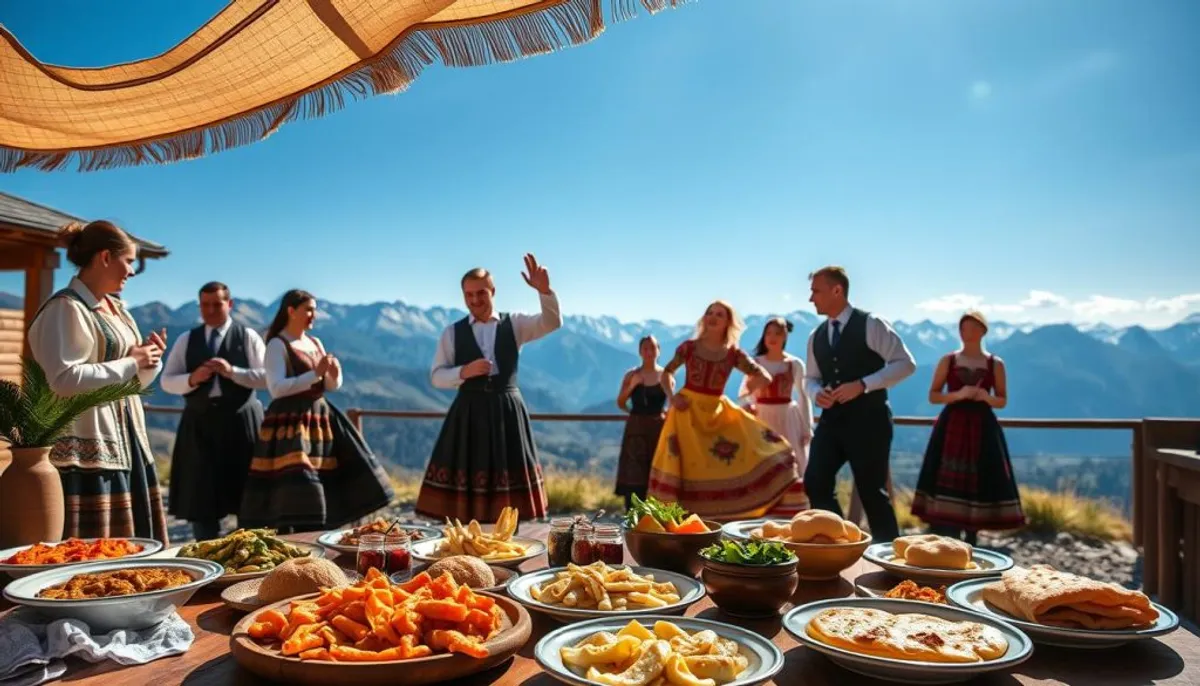
With nearly 4.7 million inhabitants, Georgia showcases remarkable diversity. The Georgian language, written with a unique alphabet of 33 letters, is spoken by 71% of the population. This nation is home to over a hundred different ethnic groups, reflecting the significant european influence in croatia that has shaped its cultural landscape.
Orthodox Christianity deeply permeates the local culture, representing 84% of the population. Despite its modest size, this country has developed a strong and distinct Georgian identity.
From ancestral traditions to contemporary artistic expressions, we will explore the multiple facets of this unique society. You will discover how the historical heritage continues to inspire modern life.
Key Points to Remember
- Georgia has a millennia-old culture between Europe and Asia
- The country boasts great ethnic and linguistic diversity
- The Georgian alphabet is unique with its 33 letters
- Orthodox Christianity is the majority (84%)
- Ancestral traditions remain vibrant today
- The mountainous geography influences regional cultures
- This culture has resisted invasions while assimilating influences
Introduction to Georgian Culture
Between the Black Sea and snow-capped peaks, the Georgian heritage has flourished for millennia. This guide invites you to discover this fascinating civilization, still relatively unknown in France. For those interested, a france culture listening guide can enhance your understanding of this rich history.
Context and Objectives of the Guide
Our exploration begins with the unique geographical framework of this nation. The country spans 69,000 km² with remarkable natural diversity. For those looking to navigate its offerings, a kadéos card usage guide can be invaluable.
Prehistoric sites dot these varied landscapes. Our goal is to decipher the cultural codes that are alive today.
Presentation of the Rich Georgian Heritage
The history has forged a resilient identity through the centuries. Medieval monasteries and musical traditions testify to this richness.
Several elements are listed as UNESCO heritage. This introduction opens a door to an exceptional cultural world.
We accompany you in discovering this authentic Georgian culture. Each aspect reveals the depth of a millennia-old civilization.
The Historical and Legendary Origins
At the heart of the Caucasus, Georgian lands preserve fascinating traces of the earliest human civilizations. This strategic region has seen many peoples pass through over the centuries.
The Evolution from Homo georgicus to Ancient Kingdoms
The history begins 1.8 million years ago with the discovery of Homo georgicus in Dmanisi. These early humans represent a crucial migration out of Africa.
In the 6th century BC, the Scythians arrived in this territory. Alexander the Great landed here in the 4th century, marking a new stage.
The kingdoms of Colchis and Iberia gradually formed. They laid the foundations for the current national identity.
The Foundational Myths and Legends
The legend of Prometheus chained to Mount Caucasus dates back to ancient times. It symbolizes resistance in the face of adversity.
Jason and the Golden Fleece resonate with the real practices of the mountain dwellers. In Svaneti, gold was collected on sheep skins.
These mythical tales reveal the deep origin of the collective imagination. They show how legends are rooted in tangible realities.
The Central Role of Christianity and Monasteries
The year 330 marked a decisive turning point in the history of this Caucasian nation. Under the influence of Saint Nino of Cappadocia, the Kingdom of Iberia officially adopted Christianity.
This conversion made the country the second nation in the world to establish Christianity as the state religion. The event radically transformed national identity.
The Adoption of Christianity and Its Impacts
The miraculous healing of the queen by Saint Nino hastened this spiritual revolution. The king followed his wife into this new faith.
By the 4th century, society organized itself around this religion. The social and political structures were profoundly altered.
“Spirituality became the cement of national identity, uniting the people in the face of successive invasions.”
The First Historical Churches and Monasteries
As early as the 5th century, the first religious buildings appeared. The Bolnisi Cathedral, erected at the end of this century, remains the oldest church still standing.
The Gelati Monastery, built in the 12th century by King David the Builder, symbolizes the cultural golden age. Under Queen Tamar's reign, these spiritual centers multiplied.
| Religious Site | Century of Construction | Historical Significance | UNESCO Status |
|---|---|---|---|
| Bolnisi Cathedral | 5th century | Oldest church | Not listed |
| Gelati Monastery | 12th century | Cultural golden age | World Heritage |
| Mtskheta Cathedral | 11th century | Spiritual center | World Heritage |
| Mother of God Ensemble | Middle Ages | Defensive capacity | Not listed |
These edifices also served defensive functions. Some complexes could shelter thousands of people during invasions.
The Traditions of “Georgian Culture”
The heart of Georgian identity beats to the rhythm of its collective celebrations. Evaluating a company's culture, the Georgians excel in the art of turning every occasion into a moment of sharing.
The supra represents the ultimate expression of this convivial tradition. This festive banquet brings family and friends together around a generously laden table.
A tamada leads the festivities with authority and eloquence. His role goes beyond that of a mere host. He guides the guests through a series of ritualized toasts.
“Drinking before the solemn toast is strictly forbidden. When the master of ceremonies raises his glass, everyone must empty it in one go.”
This practice symbolizes respect for ancestors and the unity of the group. Social life is organized around these gatherings where music and dance enliven the atmosphere, often taught at a certified dance school.
Dress codes and rules of politeness follow precise conventions. The Georgians uphold these customs with palpable pride.
Despite modernization, this tradition is passed down intact to younger generations. The community spirit always prevails over individualism in social relations.
These festivities naturally prepare one to understand family organization. The Georgians cultivate a unique art of living in the world.
Social and Family Organization
Daily life in Georgia is organized around ancestral family principles. The family constitutes the fundamental pillar of this society, where several generations often live under one roof.
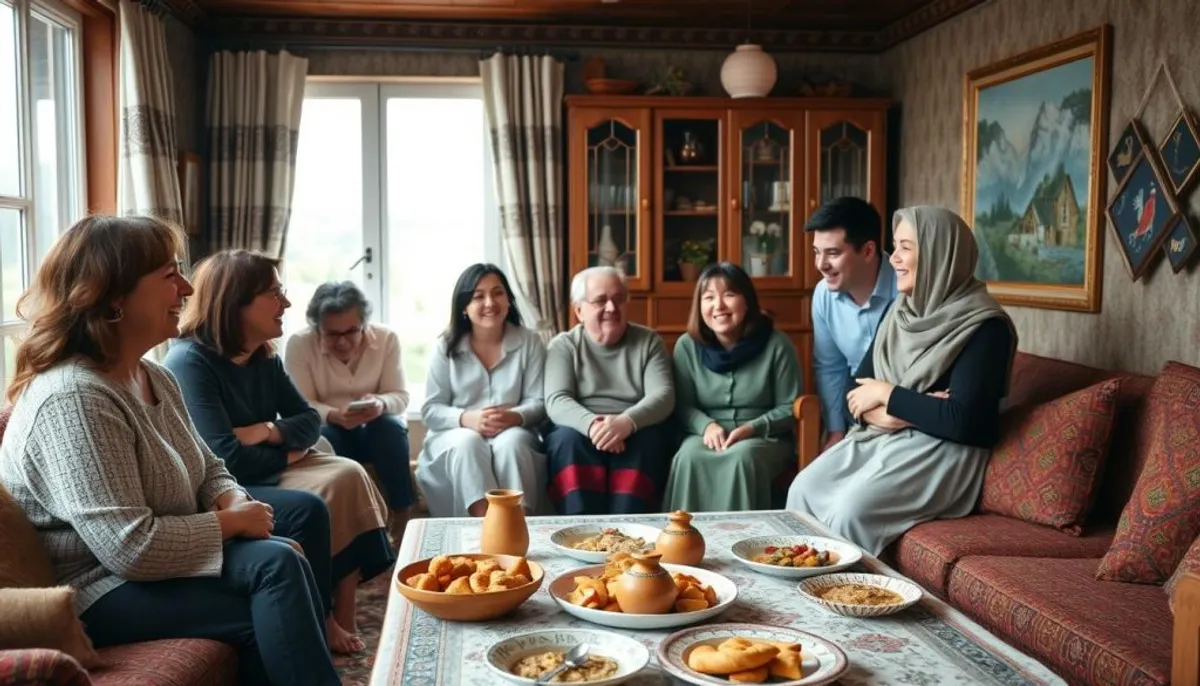
This multigenerational cohabitation promotes the transmission of traditional values. Grandparents play a crucial role in the education of the young.
Community Cohesion and Patriarchy
The patriarchal system persists with the father as a respected authority figure. The Georgians maintain a strong community cohesion that extends beyond the family framework, including places like livron-sur-drôme.
Solidarity extends to the village or neighborhood, creating effective support networks. Important decisions are made collectively.
| Family Role | Main Function | Authority | Transmission |
|---|---|---|---|
| Head of Family | Important decisions | Absolute respect | Patriarchal values |
| Elders | Traditional advice | Moral authority | Ancestral knowledge |
| Young Generations | Perpetuation | Active listening | Moderate innovation |
The Intergenerational Transmission of Values
The elderly are particularly respected in each family. Their words hold unquestionable moral authority.
This organization explains the resilience in the face of historical upheavals. The Georgians prioritize collective well-being in their social life.
The entire community thus participates in preserving a unique heritage. This family structure remains a model of social stability.
Georgian Hospitality and Way of Life
Upon your arrival, you will discover a generosity that exceeds mere social conventions. The Georgians consider welcoming visitors a sacred duty.
This tradition of hospitality dates back centuries. It is an integral part of their national identity.
The Rituals of Supra and the Art of Toasting
The supra represents the ultimate expression of this conviviality. This traditional banquet brings family and friends together around an abundant table.
The tamada skillfully leads the festivities. His role goes beyond that of a mere host.
The art of toasting holds particular importance. Each toast honors a specific theme such as family or homeland.
| Ritual | Meaning | Expected Conduct |
|---|---|---|
| Tamada's Toast | Respect for ancestors | Empty your glass in one go |
| Active Participation | Social integration | Listening and responding |
| Offering Chocolates | Mark of respect | Bring sweets |
| Prohibition of Wine | Respect for the host | Do not bring wine |
Social Codes to Respect in Georgia
Invited guests must know certain rules. Bringing wine would be seen as an insult to the host.
Communication may seem animated. The Georgians speak with passion and expressive gestures.
Well-groomed appearance reflects respect for others. For formal events, a sober outfit is essential.
These codes help people integrate harmoniously. They preserve millennia-old traditions.
The Linguistic and Artistic Wealth
The Georgian alphabet, with its 33 unique characters, symbolizes the cultural resilience of this nation. This distinctive writing system testifies to an identity preserved through the centuries.
The Georgian Language and Its Unique Alphabet
The Georgian language belongs to the family of South Caucasian languages. Its alphabet, mkhedruli, developed in the 5th century, consists of 33 letters perfectly suited to this language.
Nearly 71% of the population uses Georgian as their mother tongue. The country, however, presents remarkable diversity with Russian (9%), Armenian (6%), and Azerbaijani (3%).
The Artistic and Cultural Contributions
The Georgian literary tradition shines particularly with Shota Rustaveli. His epic The Knight in the Panther's Skin remains a masterpiece of medieval literature.
During the Soviet period, the language resisted attempts at Russification. This deep attachment has allowed the preservation of an exceptional linguistic heritage.
Today, Georgian continues to evolve while retaining its ancient roots. The unique alphabet remains a symbol of national pride and cultural identity.
Key Periods in Georgian History
Georgian history unfolds like an epic marked by cycles of power and resilience. This strong narrative includes the history of kazakhstan, and the medieval period sees the emergence of a unified kingdom under Bagrat III in the 10th century.From Independence to Invasions and the Soviet Era
The 12th century represents the peak under David the Builder and Queen Tamar. This brilliant period experiences a decline with the Mongol invasions in the 13th century.
The fragmentation into three kingdoms at the end of the 15th century weakens the country for a long time. The Russian protectorate begins in 1783, preceding the official annexation in 1813.
A brief independence in 1918 shows national aspiration. But the Soviet invasion of 1921 establishes 70 years of Soviet regime.
World War II costs the lives of 300,000 soldiers. During the years 1950-1980, an underground nationalism persists despite repression.
The independence of 1991 opens a new tumultuous period. This eventful history testifies to resilience in the face of various wars and occupations.
The Soviet Union profoundly transforms society over seven decades. The dissolution of this union allows a return to national sovereignty.
These various wars and political transitions have forged contemporary identity. The country continues to evolve while preserving its millennia-old heritage.
Iconic Personalities of Georgia
Many exceptional talents have emerged from this Caucasian land, shining far beyond national borders. These figures illustrate how the Georgian heritage has produced remarkable individuals.
Political and Revolutionary Figures
Joseph Stalin, born Ioseb Dzhugashvili in 1878, represents the most well-known Georgian political figure. His Georgian origin contrasts with his role as a Soviet leader.
Other personalities like Lavrenti Beria and Anastas Mikoyan also influenced the communist apparatus. These men marked the crucial years of the 20th century.
Cultural and Artistic Icons
The poet Vladimir Mayakovsky, born in Imereti, became the spokesperson for Russian futurism. His talent crossed borders to conquer the literary world.
Contemporary artists like pianist Khatia Buniatishvili continue this excellence. Choreographer George Balanchine revolutionized ballet on an international scale.
These creators demonstrate the Georgian impact on the global artistic scene. Their legacy continues to inspire the world today.
Cuisine and Gastronomic Traditions
Around a generously laden table, Georgian cuisine reveals its authentic essence. This gastronomy is an integral part of national identity and reflects a millennia-old history.
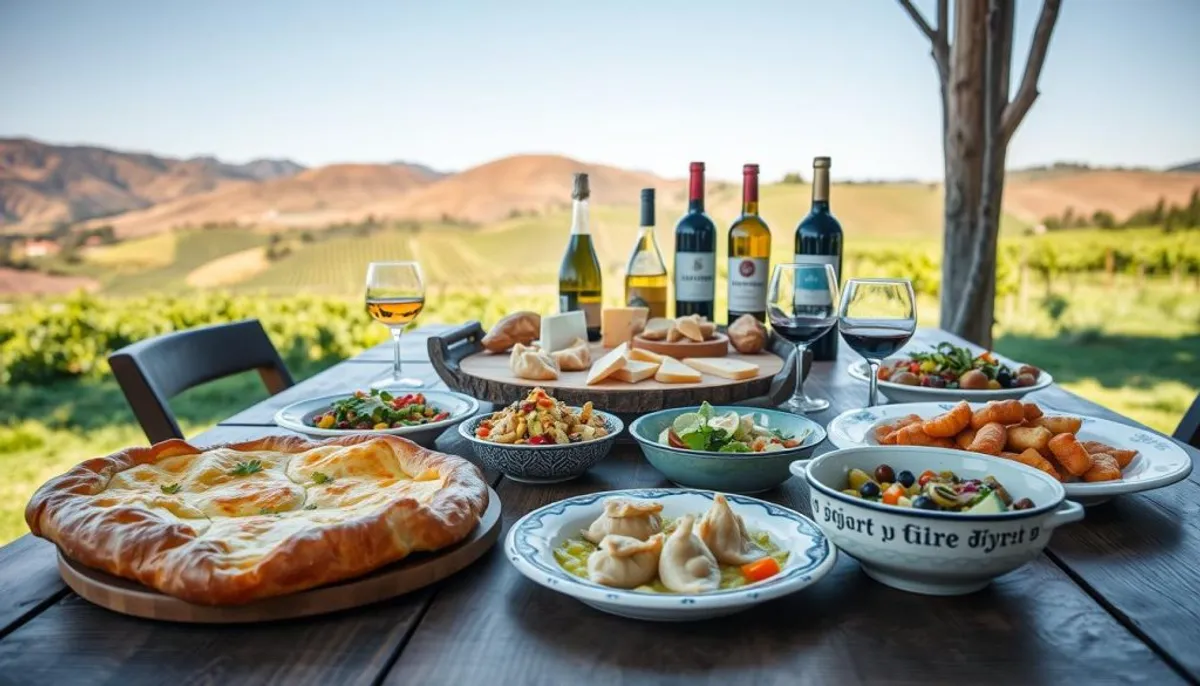
Each region offers its own specialties, creating a mosaic of unique flavors. The diversity of dishes reflects the richness of the local terroir.
Must-Try Specialties Like Khachapuri
Khachapuri alone symbolizes this culinary tradition. This cheese-filled bread exists in multiple variants depending on the region of origin.
The Adjarian khachapuri is distinguished by its egg in the center, while khinkali delight with their juicy filling. Mtsvadi, grilled meat on vine branches, offers a characteristic smoky flavor.
| Specialty | Description | Typical Region |
|---|---|---|
| Khachapuri | Cheese-filled bread | All regions |
| Khinkali | Juicy meat dumplings | Mountains |
| Satsivi | Turkey with walnut sauce | West |
| Mtsvadi | Grilled skewers | East |
The Particularities of the Traditional Banquet (Supra)
The supra represents much more than a simple meal. It is a social ritual where food, wine, and conviviality intertwine harmoniously.
The tamada orchestrates the festivities around the table. Each thematic toast may be followed by a traditional song, creating a unique atmosphere.
The guests honor these toasts by emptying their glasses in one go, once the master of ceremonies has spoken. This immersive experience reveals the deeply rooted values of hospitality.
The Wine Sector and Traditional Beverages
The Georgian terroir is home to one of the oldest winemaking traditions in the world, dating back eight millennia. This ancestral practice is an essential part of national identity.
Indigenous Grape Varieties and Ancestral Processes
The Kakheti region represents the heart of production, but other regions also cultivate vines. Winemakers use indigenous grape varieties like saperavi for reds and rkatsiteli for whites.
The qvevri method, using buried clay amphorae, is listed as UNESCO heritage. This unique technique gives wines their distinctive character.
The Importance of Wine in Daily Life and Traditions
Almost every family produces its own artisanal wine. Hospitality is systematically expressed through the offering of homemade wine to visitors.
This beverage transcends mere nutritional role to become a spiritual element. It unites generations during social rituals.
| Traditional Beverage | Type | Characteristics |
|---|---|---|
| Qvevri Wine | Natural wine | Fermentation in amphora |
| Chacha | Brandy | Distilled grape pomace |
| Kakhouri | Orange wine | Low alcohol and tannic |
The chacha and kakhouri complete the palette of Georgian beverages. These artisanal productions testify to the craftsmanship passed down through the centuries.
The Natural Heritage and Exceptional Landscapes
From the snow-capped peaks of the Caucasus to subtropical beaches, Georgia concentrates remarkable geographical wealth. This country of 69,000 km² offers exceptional diversity in a relatively compact territory.
Majestic Mountains to Subtropical Coastlines
The Greater Caucasus peaks over 5,000 meters with its glaciers and alpine meadows. To the west, the coastline of the Black Sea presents a unique subtropical climate.
Lush vegetation and palm-lined beaches characterize this coastal region. The landscapes vary from spectacular valleys to semi-desert expanses in the east.
Archaeological Sites and Prehistoric Discoveries
The region of Colchis along the Black Sea was a center of ancient civilization. The gold jewelry and pottery discovered testify to the refinement of ancient cultures.
The village of Ushguli in Svaneti, listed as UNESCO heritage, preserves unique medieval architecture. These sites reveal human occupation since the Stone Age.
The Influence of the Soviet Regime on Cultural Identity
February 1921 represents a dramatic turning point in the modern history of the country. The Soviet invasion ends the brief independence and establishes a communist regime for 70 years.
Political and Social Transformations
Joseph Stalin, hailing from the country, severely represses local nationalism. Paradoxically, he favors certain members of the Georgian communist party.
Industrialization transforms the traditionally agricultural economy. Forced collectivization disrupts ancestral social structures.
World War II costs 300,000 lives. This sacrifice leaves a lasting mark on collective memory.
“The de-Stalinization of 1956 leads to a period of repression for the country associated with the dictator.”
| Period | Major Event | Cultural Impact |
|---|---|---|
| 1921-1953 | Stalinist Reign | Nationalist Repression |
| 1956-1980 | De-Stalinization | Clandestine Resistance |
| 1980-1991 | Glasnost | National Renaissance |
The Soviet regime attempts to Russify culture. But the inhabitants resist by preserving their language and traditions.
The glasnost allows the emergence of a nationalist movement. The members of the Soviet Union prepare for independence.
This cultural resilience testifies to identity strength. Despite seven decades of authoritarian regime, national essence survives.
The Political Evolution and Its Impacts on Tradition
The post-Soviet period was marked by a rapid succession of determining political events. This transition to independence was accompanied by major challenges for society.
The Revolutions and Regional Conflicts
On April 9, 1991, the proclaimed independence immediately triggered a conflict with South Ossetia. This first territorial conflict heralded a tumultuous decade.
In December 1991, a coup d'état overthrew President Zviad Gamsakhurdia. The country then plunged into a civil war that lasted until January 1992.
| Event | Date | Consequence |
|---|---|---|
| Independence | April 9, 1991 | South Ossetia Conflict |
| Coup d'État | December 1991 | Civil War |
| Rose Revolution | November 2003 | Regime Change |
| August War | August 2008 | Border Crystallization |
Contemporary Adaptations
The Rose Revolution in November 2003 brought about a peaceful change. Mikheil Saakashvili came to power with ambitious reforms.
The conflict of August 2008 with Russia still feels its consequences. Despite these upheavals, traditions have shown remarkable resilience.
“Society has managed to preserve its heritage while adapting to new political realities.”
The tensions of October and recurring crises have not diminished national identity. This capacity for adaptation is the strength of the people in the face of challenges.
Intercultural Exchanges and International Influence
Paris becomes a privileged stage to discover Georgian musical traditions, including somali music. This city hosts a dynamic community that keeps the heritage of the Caucasian country alive.
The Georgian Association in France structures the cultural life of the diaspora. It regularly organizes traditional events.
The Georgian Diaspora in France and Beyond
Katie Melua, a singer of Georgian descent, has conquered the world with her music. Her international success showcases the radiance of this country.
The Marani association in Paris teaches polyphonic singing to the French. Master singers from Georgian villages come to share their art.
The Harmonie Géorgienne ensemble brings together Georgian students living in Paris. They perpetuate musical traditions far from their homeland.
| Organization | Main Activities | Cultural Impact |
|---|---|---|
| Georgian Association in France | Traditional events | Heritage preservation |
| Marani Paris | Polyphonic singing workshops | Intercultural bridges |
| Harmonie Géorgienne | Student concerts | Transmission to youth |
The journey to Georgia attracts more and more French visitors. These exchanges mutually enrich both countries.
The global Georgian community contributes to raising awareness of this small country. The cultural journey thus transcends geographical boundaries.
Artistic and Musical Expressions
Georgian music conquered the space long before captivating international stages. In 1977, the Voyager spacecraft carried the traditional song Tchakrulo as an ambassador of humanity.
Polyphony and Traditional Music
UNESCO classified this tradition in 2001 as a masterpiece of intangible heritage. Polyphony combines archaic and modern harmonies in three distinct voices.
The main voice leads the melody, while the high voice follows in parallel. The bass adds volume and depth to the whole.
This vocal art has been transmitted orally for centuries in villages. The Georgians thus perpetuate an exceptional musical heritage.
The Influence of Visual Arts and Ballet
George Balanchine revolutionized ballet in the 20th century with his choreographic genius. The son of a founder of the local opera, he influenced the whole world.
Filmmaker Otar Iosseliani represents the excellence of auteur cinema. His work enjoys remarkable international recognition.
| Artist | Field | Major Contribution |
|---|---|---|
| Shota Rustaveli | Literature | Epic “The Knight in the Panther's Skin” |
| George Balanchine | Ballet | Modern choreographic revolution |
| Otar Iosseliani | Film | Award-winning auteur cinema |
The local culture places fundamental importance on creative expression, including the rich traditions of serbian art and craft. These artists illustrate the radiance of national talents.
Conclusion
Exploring this unique heritage demonstrates how a small country can preserve its identity in the face of time's challenges. The richness of this millennia-old civilization makes Georgia an exceptional destination.
The ancestral traditions, such as the supra and polyphony, still structure social life. They testify to remarkable resilience and are part of the rich tapestry of new zealand traditions.
A journey in this country of the Caucasus offers an authentic immersion. The legendary hospitality and magnificent landscapes create unforgettable memories.
In any case, understanding the Georgian soul requires appreciating the importance of the collective. This guide serves as a gateway to a fascinating world.
We hope this discovery will inspire you to personally explore this hidden gem. Contemporary Georgia successfully combines modernity with centuries-old traditions.
FAQ
What is the importance of family in Georgian society?
The family is at the heart of social life. It represents a strong unit where several generations often live together. The transmission of values and cohesion among members are fundamental to maintaining traditions.
What is a *supra* and why is it so important?
A *supra* is a traditional banquet, a pillar of local hospitality. Led by a *tamada* (toastmaster), it punctuates the meal with speeches. It is a key moment to strengthen community bonds and celebrate.
How has Christianity marked the history of the country?
The adoption of this religion in the 4th century profoundly shaped national identity. The first churches and monasteries became spiritual and cultural centers, influencing art, architecture, and festivals throughout the year.
What culinary specialties should one absolutely try?
One must try the *khachapuri*, a delicious cheese bread, as well as the *khinkali*, stuffed dumplings. The cuisine uses a lot of fresh herbs, nuts, and grilled meats, reflecting the generosity of the table.
What is the role of wine in daily life and traditions?
Wine is much more than a beverage; it is a cultural symbol. With its unique grape varieties and ancient production methods, it is omnipresent during celebrations, family meals, or to welcome a guest, embodying a living tradition.
How does the Georgian language stand out?
It has its own alphabet, one of the oldest in the world, with very distinctive writing. This unique language is a major pillar of national identity and the pride of the people.
What natural landscapes can be discovered in Georgia?
The country offers incredible diversity! From the majestic mountains of the Caucasus to the subtropical beaches of the Black Sea, including lush valleys. There are also fascinating archaeological sites testifying to very ancient settlement.