
Welcome to the fascinating universe of an ancient agricultural technique born in the Sahel. In this part of the world, water is a rare and precious resource.
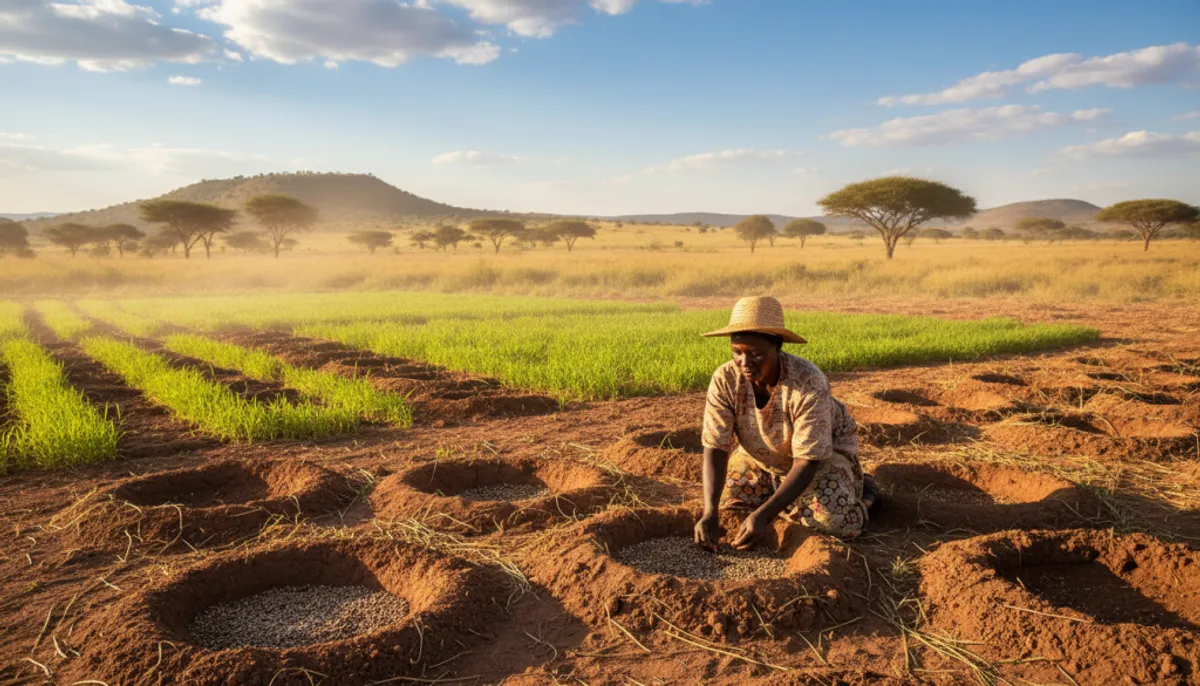
Local farmers have developed ingenious methods to cultivate the land. The zaï is much more than just a simple practice. It is a precious heritage passed down from generation to generation.
The term “zaïégré” means “to rise early to prepare one’s land.” It perfectly illustrates the determination needed for this resilient agriculture.
Today, this ancestral knowledge is of great interest to the international scientific community. It offers solutions to address current climate challenges.
Let us discover this remarkable approach that combines tradition and innovation.
Discovering the context of zaï and water conservation
Astrophysicist Hubert Reeves reminds us of a striking truth about this precious aquatic resource. “On a cosmic scale, liquid water is rarer than gold,” a reality particularly acute in the Sahel.
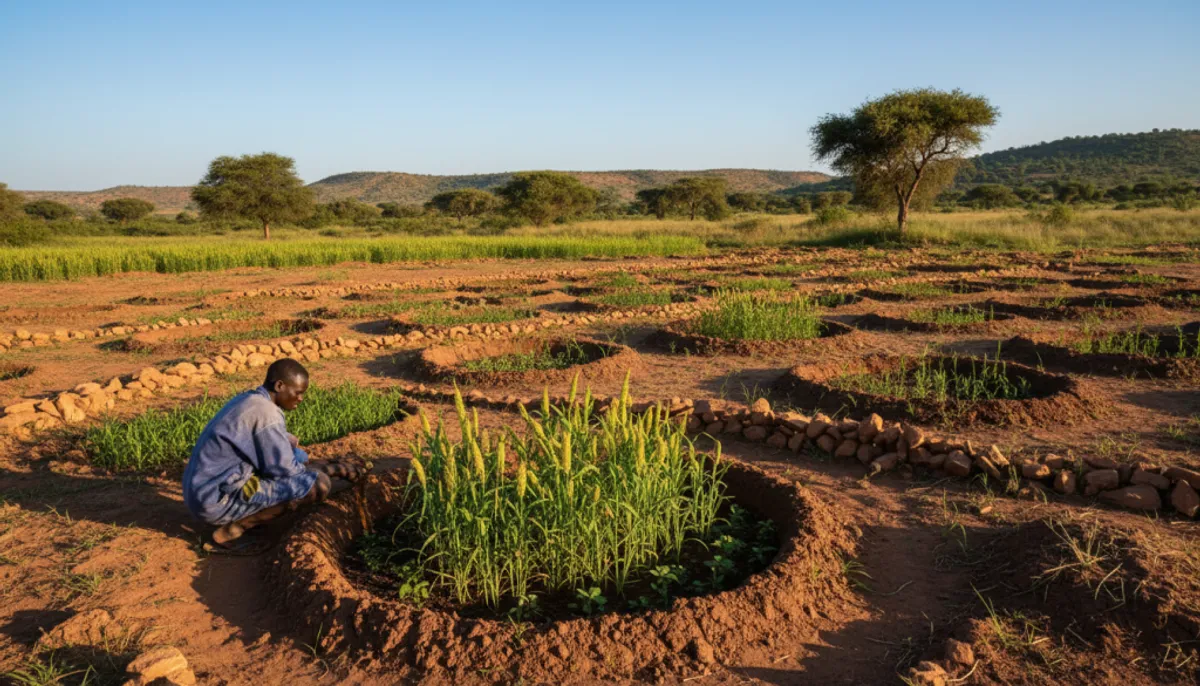
This vast arid band stretches across Africa from east to west. The peoples of the region have been deploying treasures of imagination since the 3rd millennium BC to master this water that is so rare.
Sahelian heritage and water scarcity
In Yatenga, in the north of Burkina Faso, the great drought of the 1970s and 80s disrupted the ecosystem. The unstable ferruginous soils were stripped away by erosion.
They became so poor that torrential rains run off without infiltrating. This degradation of land has created a vicious cycle.
Environmental challenges in Africa
Sub-Saharan Africa faces major challenges. Progressive desertification and loss of fertility threaten food security.
The rainwater becomes destructive rather than beneficial. These extreme constraints have paradoxically stimulated local innovation.
The zai technique represents an ingenious response to these challenges. It shows how adversity can foster creativity.
Traditional and modern techniques of zaï
The concrete implementation of the zaï technique relies on meticulous preparation of poquets. This work must begin during the dry season, between November and June.
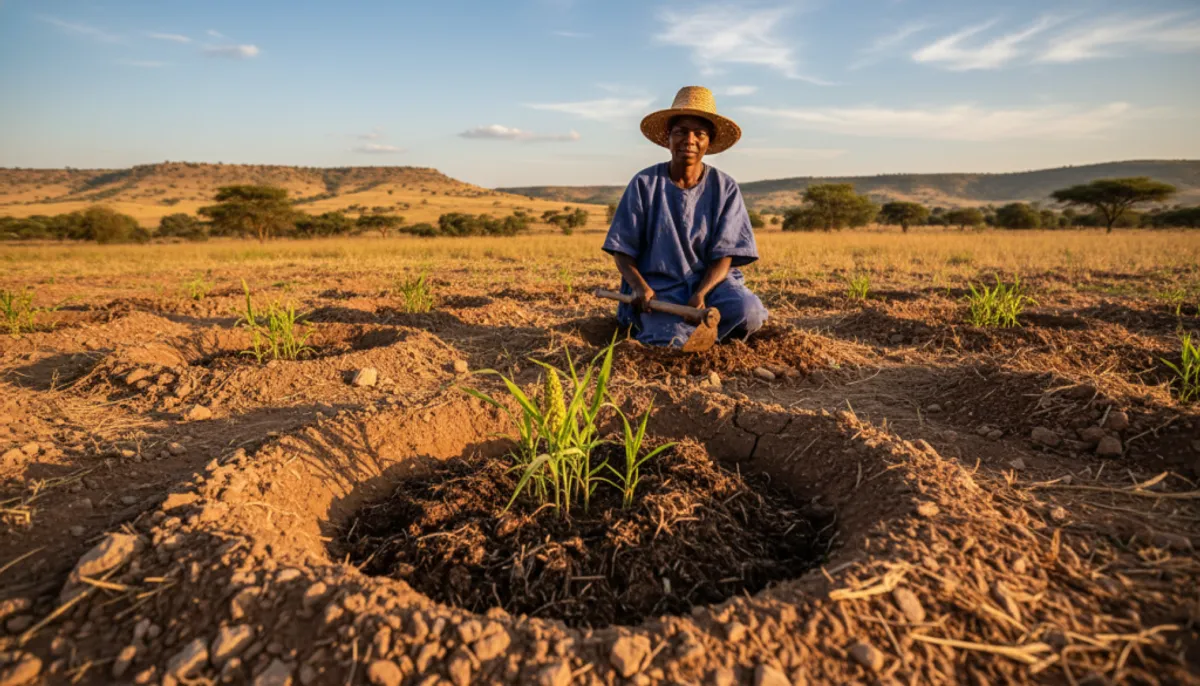
The process of creating and amending poquets
Farmers dig holes 10-15 cm deep. The diameter ranges from 20 to 40 cm in the red soil. The strategic spacing is 70 to 100 cm.
Each poquet receives 300 to 600 grams of organic matter. This represents about 3 tons of manure per hectare. This organic matter effectively enriches the soil.
After the first rains, termites are attracted by the nutrients. They dig galleries that enhance water infiltration. This natural collaboration boosts fertility.
Comparison: manual vs. mechanized method
The traditional method uses the daba, a local hoe. A man digs 100 to 120 holes per day. This requires about 380 hours of work per hectare.
| Method | Working time | Tools | Efficiency |
|---|---|---|---|
| Manual | 380 hours/hectare | Daba | 100-120 poquets/day |
| Mechanized | 50 hours/hectare | Mechanical auger | Increased speed |
| Semi-mechanized | 150 hours/hectare | Animal-drawn tooth | Cost/efficiency balance |
Recent innovations are game-changers. INERA has developed animal-drawn teeth. In Senegal, mechanical augers facilitate the work.
This technique reduces the time required from 380 to 50 hours. Farmers gain productivity while preserving their land.
Zaï cultivation: impact on agriculture, soils, and fertility
In the heart of the arid lands of the Sahel, a silent transformation is reviving degraded soils. This ancestral method demonstrates impressive results for local agriculture.
Adaptation to climate change
The poquets created by this technique effectively capture runoff water during torrential rains. They form protected micro-environments where moisture persists for a long time.
In Burkina Faso, Yacouba Sawadogo has regenerated 27 hectares of sterile land. His success earned him the title of “Champion of the Earth” from the United Nations.
| Aspect | Traditional method | With the zaï technique | Improvement |
|---|---|---|---|
| Millet/sorghum yield | 500 kg/hectare | 1500 kg/hectare | +200% |
| Carbon stock | Baseline level | +52% | Significant |
| Water infiltration | Low | Optimized | Reduced runoff |
| Tree regeneration | Limited | Spontaneous | Increased biodiversity |
Benefits for yields and biodiversity
The termites Trinervitermes play a crucial role. Attracted by organic matter, they dig galleries that improve the fertility of the soils.
The poquets naturally trap seeds carried by the wind. This encourages the return of trees alongside cereal crops.
This approach creates a balanced ecosystem where plants benefit from optimal growth. It represents a sustainable solution for arid regions, addressing the discontent within culture that arises from agricultural challenges.
The challenges and limits of the zaï technique
The application of zaï faces significant material and human constraints for local farmers. This technique requires considerable investment in labor and resources.
The manual preparation of one hectare requires about three months of intensive effort. A man digs 100 to 120 poquets per day during the dry season.
Labor constraints and required investments
Farmers must produce or purchase three tons of organic matter per hectare. This amount represents a major economic challenge in areas where livestock is limited.
The lifespan of the installations is only one to two years. Farmers must re-dig the poquets regularly.
In northern Burkina Faso, the Fair Sahel project is testing innovative solutions. Researchers from INERA are partially substituting manure with microdoses of mineral fertilizers.
This approach within the project aims to reduce costs for degraded lands. It represents a promising advancement for this ancestral technique.
Conclusion
In a world facing water scarcity, the techniques developed by Sahelian farmers inspire new approaches. The zaï represents much more than an agricultural method: it is a philosophy of resource management, akin to the rich traditions found in nigerian literature.This approach is part of a rich arsenal of traditional knowledge, including austrian traditions. Half-moons, stone bunds, and other techniques follow the same logic of concentrating water and nutrients in reduced spaces.
In the face of increasing drought, these ancestral solutions are becoming more relevant. They offer tailored responses to the extreme conditions that many Mediterranean areas will experience.
Farmers are constantly innovating, as seen in Fatick where recycled tires concentrate manure and water. This creativity contrasts with intensive irrigation, which poses environmental risks.
The zaï and its derivatives show that resilient agriculture comes from listening to local knowledge. They pave the way for sustainable food systems for all regions of the world.
FAQ
Where does the zaï technique come from?
This traditional method emerged in northern Burkina Faso. Farmers developed it to combat land degradation and capture runoff water in very dry regions.
How does this method improve soil fertility?
By digging holes and adding manure or organic matter, zaï enriches the soil. Termites also help mix these elements, creating an ideal environment for plant growth.
What are the main benefits for farmers?
The benefits are numerous! This approach increases crop yields, reduces erosion, and allows cultivation on degraded lands. It enhances resilience against droughts.
Does implementation require a lot of work?
Yes, the initial manual work is significant, especially for digging the poquets. However, the time invested pays off over several seasons due to the sustainable improvement of productivity in the cultivated area.
Can machines be used for this agricultural practice?
Absolutely. Modern projects are testing mechanization to dig the holes. This reduces working time, but the manual method remains very widespread and effective for many farming families.
Is this technique suitable for irregular rains?
Perfectly. By concentrating water and nutrients at the root level, zaï is an intelligent solution to address the irregularity of rains, a major challenge of climate change.