
Imagine an invisible force that guides every decision and creates a unique atmosphere at work. This energy is the organizational culture. Much more than a list of rules, it represents the DNA of your company.
Concretely, this living ecosystem influences how teams collaborate and perceive their mission. Shared values become daily benchmarks, while adopted behaviors shape the customer experience.
Visionary leaders know that a strong culture acts as a performance accelerator. It allows companies to stand out in saturated markets and attracts talent seeking meaning.
This guide reveals why 78% of French employees consider this factor crucial for their engagement*. Together, we will explore how to build this collective legacy that transcends the boundaries of a simple work environment, by integrating cultural measurement methods.
Ready to discover the secrets of a company identity that withstands the test of time? Let’s start by deciphering its key components.
Introduction to Company Culture
The beating heart of an organization lies in its shared values and daily practices. These elements shape a unique identity, far beyond internal policies or marketing slogans. They determine how employees interact, make decisions, and perceive their collective contribution.
Overview of the Concept and Stakes
In a market where 63% of professionals prioritize meaning over salary*, organizational DNA becomes a decisive criterion. Current challenges – accelerated digitalization, varied generational expectations – require solid foundations. An aligned culture serves as a compass in the face of economic and social changes.
High-performing companies transform their principles into concrete levers. They create rituals that reinforce desired behaviors while allowing for adaptability. This dynamic directly influences the ability to retain talent and maintain a high engagement rate.
The Importance of a Strong Culture for Business Success
When teams understand and embody the strategic objectives, productivity naturally increases. A recent study shows that companies with a coherent culture achieve 2.5 times more successful innovation. Mutual trust allows for calculated risks without fearing failure.
This stimulating environment also impacts the customer experience. Fulfilled employees build more authentic relationships, boosting loyalty. It is this virtuous circle that positions organizations as leaders in their sector.
Definition and Components of Company Culture
The identity of a company is forged through intangible pillars that transcend business strategies. These constitutive elements act as an organizational genetic code, influencing every professional interaction.
Values, Beliefs, and Traditions
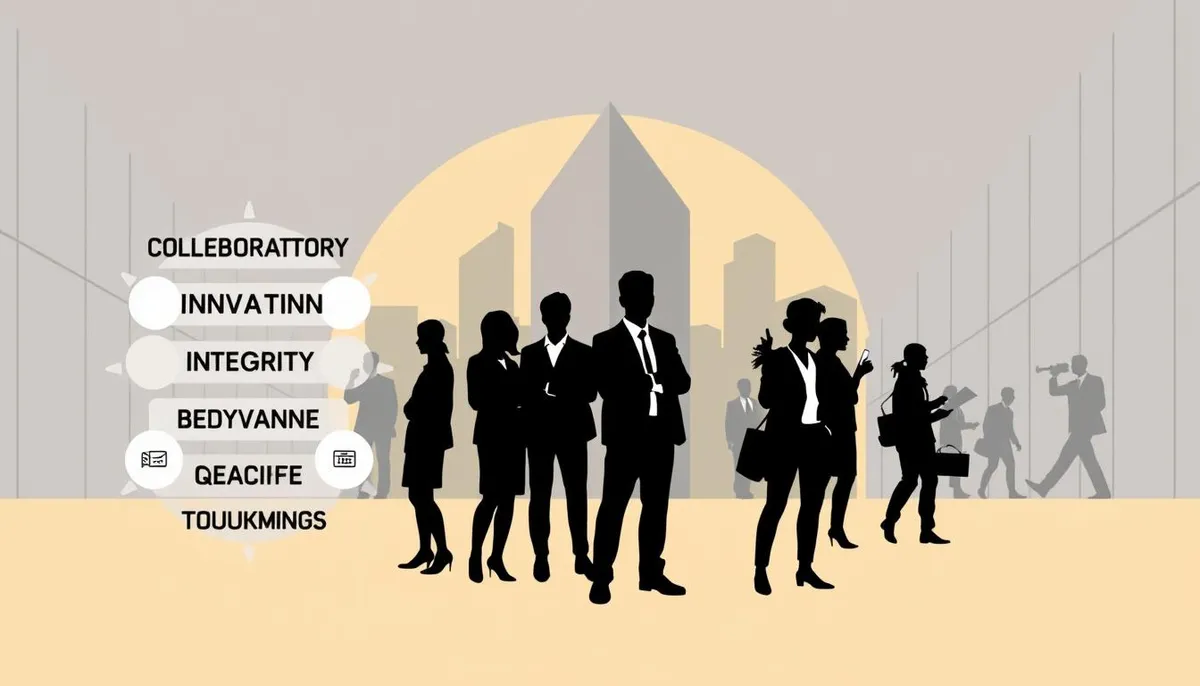
The core of a strong culture rests on concrete guiding principles. Innovation or ethics are not just buzzwords, but daily decision-making filters. Rituals such as creative team meetings or mentoring programs become meaningful traditions.
The history of the organization plays a key role. Past choices – successes as well as failures – shape current behaviors. A company born in a garage will often retain that start-up mentality, even after growth.
Norms, Communication, and Work Environment
Implicit norms dictate interactions. A casual dress code or flexible hours send clear signals about real priorities. The way of communicating – formal emails or informal discussions – reveals the invisible hierarchy.
| Aspect | Traditional | Modern |
|---|---|---|
| Communication | Hierarchical | Cross-functional |
| Decision-making | Centralized | Collaborative |
| Physical Space | Closed offices | Modular open space |
A work environment aligned with values stimulates engagement. Relaxation areas or collaborative project rooms concretely embody the company philosophy. These features become attractive arguments for new talent.
Decoding: What is Company Culture and Its Implications
The roots of a company influence its choices like a lighthouse guides a ship. This historical imprint determines strategic reflexes and modes of collaboration, often without teams being fully aware of it.
The Historical and Organizational Foundations
The initial DNA of a structure permanently marks its processes. A recent study shows that 68% of leaders acknowledge that their early successes still shape their current priorities. Inherited rituals – Friday morning meetings or feedback systems – become identity markers.
Here’s how the past shapes practices:
| Historical Element | Current Impact | Adaptation |
|---|---|---|
| Creation Mode (start-up vs corporate) | Decision-making flexibility | +35% in young structures |
| Major Crisis Overcome | Culture of calculated risk | 2x more experimentation |
| Visionary Founder | Transmission of values | 87% talent retention |
These legacies guide teams in gray areas. A salesperson will naturally prioritize client relationships over quotas if it is ingrained in the collective history. Employees then innovate in harmony with the original spirit.
Identifying a healthy culture is seen in the details: fluidity of inter-departmental exchanges, spontaneous initiatives aligned with the mission. These signals reveal an ecosystem where the past and present interact with agility, and where it is essential to qualify a company culture to ensure its effectiveness.
The Different Types of Company Culture
Each organization develops a unique cultural signature that guides its strategic choices. This mosaic of models directly influences productivity and team well-being.

Performance, Innovation, and Collaboration: Three Key Models
The performance culture focuses on measurable indicators. Individual rewards and dashboards dominate here. An example: a software company that evaluates its salespeople based on monthly sales.
On the opposite end, the collaborative culture prioritizes cross-functional projects. Open spaces and idea-sharing tools are common. A study shows a 40% time gain in these structures.
Innovative companies create internal incubators. They accept failure as a step towards progress. Their R&D budgets often exceed 15% of revenue.
Traditional Hierarchy vs. Modern Approaches
Let’s compare two opposing philosophies:
| Aspect | Hierarchical | Horizontal |
|---|---|---|
| Decision-making | Top-down | Collective |
| Communication | Formal reporting | Direct exchanges |
| Flexibility | Fixed processes | Rapid adaptation |
Rigid structures suit regulated industries. Horizontal models thrive in tech startups. The choice depends on strategic objectives and the business sector.
Identifying the dominant type helps recruit compatible profiles. A bank will opt for stability, while a creative agency will prioritize flexibility. The essential thing? To remain consistent with its primary mission.
Unifying Teams Around Common Values
The unity of an organization is measured by the alignment of its members around a common vision. Concrete tools transform abstract principles into daily actions, creating an invisible cement between individuals and strengthening team cohesion.
Creating a Team Charter
Involving employees in drafting a charter strengthens their commitment. This living document specifies expected behaviors and priority values, serving as a reference during complex decisions.
A tech company boosted its engagement by 40% by co-creating its charter through participatory workshops. Employees included clauses on work-life balance.
Organizing Internal Events to Strengthen the Sense of Belonging
Informal meetings unleash creativity and weave lasting bonds. A themed escape game or a professional hackathon stimulates collaboration far better than a managerial speech.
A French SME organizes “discovery Fridays”: each month, an employee presents their passion. The result? Increased trust and innovative ideas transferable to work.
These practices create a work environment where everyone feels invested. They attract new talent while retaining active forces, ensuring a sustainable and authentic culture.