
A treasure from the Pacific has found a new home in France. Far from its archipelago of origin, this millennia-old tradition thrives thanks to exchanges and an active diaspora.
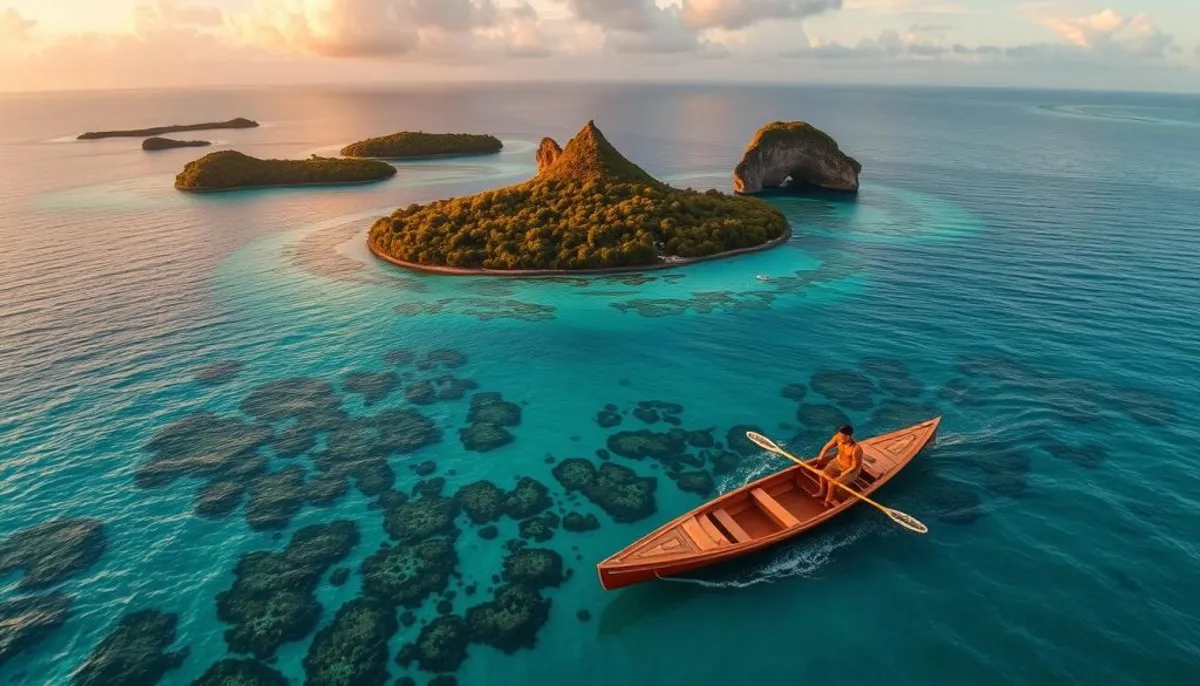
The Republic of Palau is a small country. It consists of 26 islands and over 300 islets in the western Pacific. Despite a population of about 18,000 inhabitants, this people has preserved a heritage of exceptional richness.
Why does this world fascinate in France? Its values of deep respect and unique customs resonate with our modern concerns for heritage preservation. This article guides you to understand this intercultural encounter.
Key Points to Remember
- The Palau Islands are an archipelago in Micronesia with over 300 islands.
- The population is about 17,700 inhabitants, with a very high literacy rate.
- The Palauan cultural heritage is remarkably preserved despite its small size.
- The diaspora in France helps to promote these traditions.
- The values of respect and the unique language resonate with contemporary issues.
- This encounter enriches the understanding of diversity on a global scale.
Introduction to Culture and Traditions
Discover how a small island nation has shaped its unique identity. This story dates back over four millennia of human occupation.
Historical and Cultural Context
The first waves of migration came from Indonesia and New Guinea. These groups were followed by Filipinos and Polynesians from Polynesia and Micronesia.
This composite population developed distinctive practices. It merged Malay, Melanesian, and Polynesian influences.
The archipelago has experienced several successive colonial periods. Each domination has left lasting marks on the local traditions.
Objectives and Scope of the Article
Our exploration aims to reveal the multiple dimensions of this society. We will examine its historical roots to its contemporary radiance.
You will understand how these islands keep their ancestral practices alive while simultaneously adapting to the realities of the modern world.
This intercultural encounter enriches our understanding of human diversity. It shows how a culture can travel and flourish far from its original cradle.
Palauan Culture: Traditions and Values
At the heart of this island society, speech constitutes the true pillar of collective memory. Knowledge is passed down from generation to generation without written support, often through engaging activities like general knowledge games for children.
Oral Transmission and Ancestral Legends
As Dee Antonio, Miss Palau 2023-2024, explains: “Everything we know about our environment today comes from language.” This oral transmission preserves family legends and environmental knowledge.
The elders teach the young the precise names of animals and plants. They distinguish those that are edible, medicinal, or used in rituals.
The Importance of Respect and Proverbs
Proverbs represent capsules of essential wisdom. They guide behaviors and teach life lessons.
The term “ruhala” (my child) illustrates this collective approach. All adults use it to address young people, regardless of their family.
Dee Antonio emphasizes: “We speak to each other with a lot of respect, heart, and passion.” This mutual consideration permeates every social interaction.
The Linguistic Heritage and Language Preservation
The tekoi ar belau, the official language of Palau, constitutes a unique linguistic treasure in the world. This Austronesian language belongs to the western Malayo-Polynesian group.
About 66.8% of the inhabitants speak Palauan fluently. This represents nearly 13,800 people in the entire population.
The Role of Language in Cultural Identity
The language goes beyond its simple communicative function. It embodies the very soul of this island culture.
Palauan serves as the primary vehicle for transmitting ancestral knowledge. Children learn it naturally within the family home.
This practice creates a strong intergenerational linguistic bond. It structures learning throughout society.
The Commitment of Iconic Figures like Dee Antonio
Dee Antonio, Miss Palau 2023-2024, highlights the vital importance of this preservation. She uses her platform to encourage younger generations.
“Our language is simple, very clear, it gets straight to the point, but it also expresses a lot of feelings. We say things simply, but people generally understand that we are saying a lot.”
However, she notes a major contemporary challenge. English is gradually taking precedence over Palauan among the youth.
| Age Group | Use of Palauan | Use of English | Language Preference |
|---|---|---|---|
| 60 years and older | 95% | 5% | Palauan |
| 30-59 years | 75% | 25% | Mixed |
| 15-29 years | 45% | 55% | English |
Despite this trend, understanding of the native language remains high. The commitment of figures like Dee Antonio shows the way to keep this precious heritage alive.
Customs and Rituals of Daily Life
The simple gestures of daily life reveal the very essence of Palauan identity. These ordinary practices weave the backdrop of a society where every interaction has meaning.
From Greetings to Affectionate Expressions
The greeting “alii” occupies a central place in social life. As Dee Antonio explains: “In general, we don’t greet in English. As soon as we see another Palauan, we go to them to say alii.”
This linguistic reflex goes well beyond mere politeness. It is an act of identity affirmation that instantly creates a bond of recognition.
The term “ruhala” illustrates this collective approach. All adults use it to address children, regardless of their family.
| Type of Interaction | Expression Used | Social Meaning | Context of Use |
|---|---|---|---|
| Greeting among adults | Alii | Mutual recognition | Daily encounters |
| Addressing children | Ruhala (my child) | Collective parenting | Community education |
| Reunions abroad | Introduction in native language | Identity comfort | International diaspora |
Respect permeates every exchange, creating a warm social atmosphere. Palauans abroad find great comfort in these encounters.
These customs show how a culture is transmitted through the simplest gestures. They preserve the heritage across generations.
The Islands and the Environment: A Haven of Traditions
With over 300 islets scattered over 650 kilometers, the geography of Palau sculpts an exceptional environment. This archipelago stretched in the western Pacific forms a true natural haven where traditions are deeply rooted.
The Geography of Palau and Its Impact
The Republic comprises 26 main islands spread over a total area of 458 km². The largest, Babelthuap, extends over 368 km². However, the majority of the population resides on Koror, a small island of only 8 km².
This human concentration on a limited territory influences social organization. The new capital, Melekeok, established in 2006 on Babelthuap, symbolizes this particular distribution.
The Deep Link Between Nature and Culture
The Palauans demonstrate remarkable environmental commitment. In 2015, they created a marine sanctuary the size of California. It is the sixth largest protected area in the world.
The “Palau Pledge” initiative requires every visitor to sign a charter of respect. This innovative approach protects the fragile ecosystem while honoring local heritage.
Despite their modest size, these islands inspire the entire world with their conservation model. They prove that a small population can have a significant global impact.
Historical and Demolinguistic Data
The demographic history of Palau reveals a fascinating human mosaic. This current population is the result of centuries of mixing and external influences.
Multiple Origins and Influences
The ethnic composition shows remarkable diversity. Indigenous Palauans represent 66.8% of the inhabitants.
There are also 16.9% English-speaking Palauans and 9.9% Filipinos. Smaller communities complete this picture: Sonsorolese (3%), Americans (2.4%), Angaurans (0.7%), and Tobians (0.1%).
| Ethnic Group | Percentage | Main Origin | Language Status |
|---|---|---|---|
| Indigenous Palauans | 66.8% | Ancient migrations | Palauan language |
| English-speaking Palauans | 16.9% | American influence | Dominant English |
| Filipinos | 9.9% | Recent immigration | Tagalog/English |
| Sonsorolese | 3% | Neighboring islands | Sonsorol language |
Key Stages in Societal Evolution
These islands have experienced several successive colonial dominations. The Spaniards discovered them in the 16th century and administered them until 1899.
Germany then purchased them, followed by Japan taking control in 1914. The Japanese period deeply marked the local society.
The United States conquered the archipelago in 1944. In 1978, Palau refused to join the Federated States of Micronesia. They achieved full independence on October 1, 1994.
The Impact of Palauan Culture on French Society
France is now discovering the unsuspected riches of Palauan heritage. This influence manifests through various channels of exchange and sharing.
Intercultural Encounters and Contemporary Exchanges
Communities of the diaspora play a central role in this rapprochement. They organize cultural events and facilitate academic exchanges.
Interest in Oceanic knowledge is growing in French academic circles. Researchers collaborate on projects for the preservation of intangible heritage.
| Field of Exchange | Impact in France | Main Actors | Concrete Results |
|---|---|---|---|
| Marine Protection | Inspiration for ecological policies | Environmental NGOs | Adoption of sustainable practices |
| Oral Transmission | New pedagogical methods | Educators and trainers | Promotion of traditional narratives |
| Responsible Tourism | Development of ethical charters | Industry professionals | Improvement of hospitality practices |
The conference “Our Ocean 2020” demonstrated Palau's environmental commitment. With 410 commitments for $16.35 billion, it inspires French actions.
These exchanges create enriching mutual understanding. They open new perspectives on the role of traditions in modern life.
Conclusion
Dee Antonio, Miss Palau, carries an essential message about cultural transmission. She emphasizes the vital importance of preserving the language to keep this precious heritage alive and provides information on culture checks to ensure that these traditions are maintained effectively.
This exploration reveals an extraordinary immaterial richness. Exchanges with our country mutually enrich our perspectives on community life and environmental respect.
Despite its modest size, this island nation offers valuable lessons to the entire world. Everyone can contribute to valuing this unique cultural diversity.
By taking an interest in these czech traditions, you participate in the preservation of an irreplaceable human heritage. This approach builds a world more respectful of all identities.
FAQ
What are the most important traditions in Palau?
How is the Palauan language preserved today?
Language preservation occurs through education, local media, and the work of figures like Dee Antonio. This linguistic heritage is essential for maintaining the identity and values of this unique community.
What is the link between nature and Palauan culture?
The link is very strong. The environment, particularly the sea and the islands, influences customs, art, and daily life. Nature is considered a sacred element of their world.
How is respect manifested in Palauan society?
Respect is manifested through specific gestures, such as greetings, and through attentive listening to elders. It is a central value that guides interactions and strengthens social cohesion.
Does Palauan culture have an influence in France?
Yes, through cultural exchanges, the diaspora, and a growing curiosity for this heritage. These encounters enrich the French cultural landscape and allow for a better understanding of this island world.