
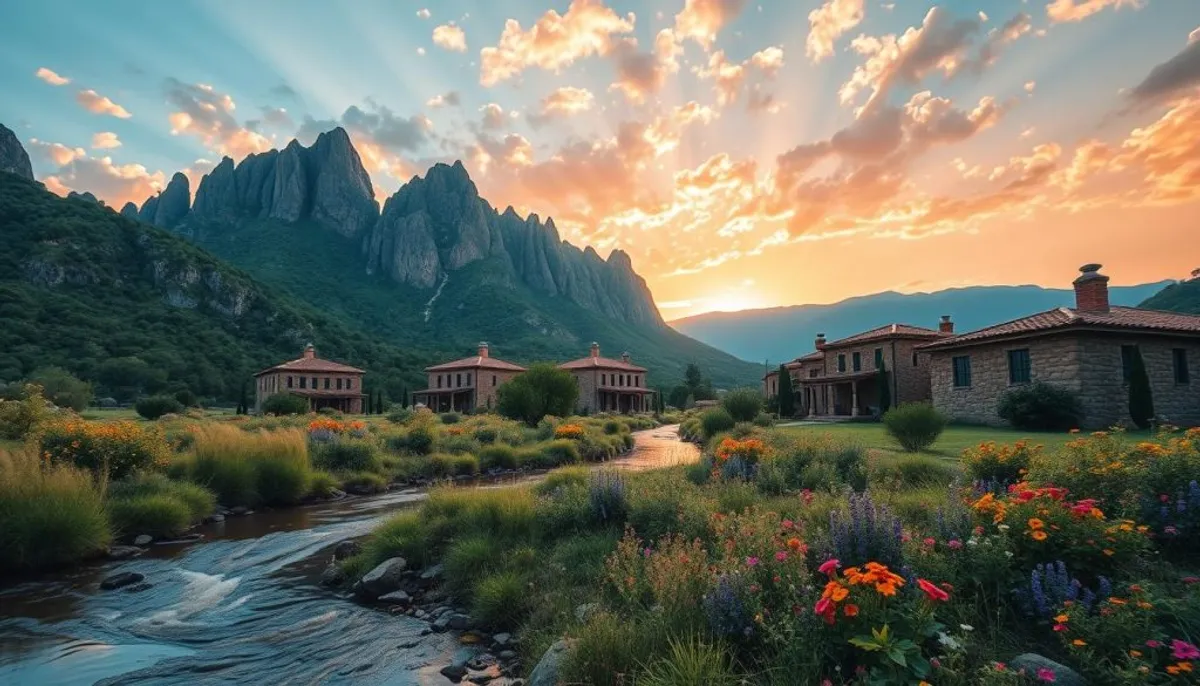
Welcome to a journey into the heart of a millennial heritage, nestled in the majestic Djurdjura mountains and cradled by the Mediterranean. This region, rich in a deep history, is a historical and cultural Berber land where traditions remain alive.
The Imazighen of this land, an ethnic group of about seven million people, are known for their spirit of resistance. A significant community, estimated at 800,000 people, lives in France, reflecting the influence of this guiding identity well beyond its borders.
Understanding this culture and seeking cultural advice is essential to grasp the dynamics of contemporary North Africa. Its history, language, and unique values offer an exciting key to understanding.
We will explore together the origins, foundations, and extraordinary vitality of this heritage. Pride is summed up in the motto “Ad nerrez wala ad neknu” (Rather break than bend), a symbol of strength in the face of oppression. Get ready to discover a universe of exceptional richness.
Key Points to Remember
- Kabylie is a historical Berber region located in northern Algeria.
- Its population is around 7 million people, with a significant diaspora.
- The Kabyle language, part of the Berber family, is a central pillar of its identity.
- The spirit of resistance and the preservation of traditions are notable traits.
- Understanding this culture helps to grasp the identity issues in North Africa.
- Craftsmanship, music, and oral traditions constitute a living heritage.
- The motto “Rather break than bend” illustrates unwavering pride and determination.
General Introduction to Kabyle Culture
The term “Kabyle” itself tells a fascinating story of external designation and self-identity. Derived from the Arabic qabāʾil meaning “tribes,” this name became popularized with the French administration in the 19th century. The local populations traditionally referred to themselves as Izwawen.
This historical region in the north of Algeria operated according to an ancestral tribal social organization. The tribes formed confederations where each village maintained its autonomy through local assemblies, the tajmaât.
Context and Historical Issues
The traditional society maintained its autonomy in the face of successive empires. The mountainous terrain and the cohesion of the Kabyles formed natural barriers against Roman, Arab, Ottoman, and French dominations.
This resistance made Kabylie a stronghold for preserving Amazigh identity and cultural identity in africa in North Africa. Contemporary Berber claims find their deepest roots here.
Presentation of Main Themes
We will explore several fundamental aspects of this rich culture. Historical origins, language, and oral traditions form the identity foundation. Music, craftsmanship, and resistance movements complete this panorama.
The diaspora and contemporary preservation challenges highlight the relevance of this heritage. Each theme reveals a guiding line: the persistence of a unique identity at the heart of the Maghreb.
Origins and Historical Evolutions in Kabylie
The historical roots of this land trace back to powerful tribal confederations, long before the arrival of the Romans. This region was an integral part of the Kingdom of Numidia as early as the 3rd century BC.
From Antiquity to the Roman Era
The Romans named the local tribes Quinquegentiens and Bavares. Among them, the Ifnaien and Aït Irathen formed strong alliances.
After the annexation of Numidia, Rome divided the territory among its African provinces. Roman control remained limited in the mountains, a zone of constant resistance.
As early as the 4th century, the revolt of the leader Firmus illustrated this line of defiance against the occupier. The Kabyles maintained their autonomy in the mountain ranges.
The Contemporary Period and Revolts
In the 8th century, Islam gradually established itself. The Great Berber Revolt of 743 confirmed independence against the Umayyads.
The Fatimids established their dynasty in the 10th century in Little Kabylie. Then the region resisted the Ottomans before French colonization.
The conquest was not completed until 1857, after the heroic resistance of Fatma N'Soumer. The Mokrani insurrection in 1871 marked a final surge before submission.
The Foundations of Kabyle Culture
The traditional social organization of this mountainous region is based on a unique democratic structure. Each village (taddart) forms an autonomous unit managed by a local assembly.
The Kabyle society is structured around tribes grouped into confederations. This hierarchical social organization ensures the cohesion of the entire community.
The villages operate through the tajmaât, an assembly where families make collective decisions. The amusnaw, a respected elder, plays a crucial mediating role.
Core values include honor (nnif) and solidarity (tiwizi). Hospitality and participatory democracy complete this balanced system.
| Structural Element | Function | Geographical Scope |
|---|---|---|
| Arch (confederation) | Alliance of several tribes | Entire region |
| Taqbilt (tribe) | Intermediate social unit | Mountain area |
| Taddart (village) | Autonomous basic cell | Specific locality |
Women ensure the transmission of heritage through craftsmanship and education. Their economic role strengthens the stability of the society.
The traditional architecture of the villages reflects this guiding identity line. Stone houses symbolize the connection to the homeland.
This unique culture persists thanks to its strong institutions. It represents a remarkable model of community organization.
Oral Traditions and Heritage Transmission
Oral transmission is the backbone of identity preservation in this mountainous region. This immaterial heritage unites generations around common values.
Songs, Tales, and Poetry
Poetry holds a place of honor with the isefra, these philosophical poems still recited today. Si Mohand U Mhand, in the 19th century, embodies this tradition with his mystical quatrains.
The tales timucuha, often told by the elders, teach wisdom through symbolic animals. The jackal and the ogress become moral characters.
| Oral Type | Traditional Bearer | Social Function |
|---|---|---|
| Poetry (isefra) | Traveling poets | Philosophical expression |
| Tales (timucuha) | Older women | Moral education |
| Songs (ahellil) | Entire community | Collective cohesion |
Living Memory and Intergenerational Transmission
Mouloud Mammeri played a crucial role in preserving this heritage in the 20th century. His work allowed for the written fixation of a centuries-old tradition.
The ahellil, a polyphonic chant recognized by UNESCO, represents an exceptional vocal ensemble. This practice unites an entire community around its memory.
The Berber language finds its most authentic expression here. Each proverb and lullaby reinforces this precious heritage.
Resistance Movements and Kabyle Identity
In the face of successive conquerors, this population developed a remarkable tradition of combat. This line of defiance runs through its entire history, from the Romans to the contemporary period, and is deeply intertwined with the history of the czech republic.
The Struggle Against Colonization
The French colonization in the 19th century met fierce resistance. Fatma N'Soumer mobilized the tribes against the French army in the 1850s.
The Mokrani insurrection in 1871 was the most significant revolt. Led by Mohamed El Mokrani, it demonstrated the strong opposition of the Kabyles.
In the 20th century, the society continued its struggle. The Berberist crisis of 1949 marked an initial assertion of identity.
The Berber Spring of 1980 and the Black Spring of 2001 illustrated this persistent line. These events mobilized the population on several occasions.
Figures like Hocine Aït Ahmed with the FFS and Ferhat Mehenni with the MAK carried these claims. Their actions in the 2000s kept this spirit of resistance alive.
This combative tradition remains a fundamental identity pillar, supported by accepted culture checks. It continues to shape relations with the central power today.
The Influence of Dynasties and Regimes in Kabyle History
Kabylie has served as a cradle for several great Muslim dynasties that have marked North Africa. In the 10th century, the Fatimid dynasty was born in Little Kabylie when Abou Abdallah al-Chii recruited the Ketama tribe.
After the fall of the Fatimids, power passed to the Zirids and then to the Hammadids. The latter founded the Kalâa Béni Hammad before transferring their capital to Béjaïa. Their reign lasted two centuries.
During the Ottoman era, the Belkadi family governed the region from Koukou. Ahmed Ibn Belkadi called upon the Barberousse brothers to liberate Spanish ports. This alliance led to the creation of the regency of Algiers.
Kabylie maintained relative autonomy under three semi-independent kingdoms. The local tribes formed an important military body for the regency of Algiers. They actively participated in its defense.
- Fatimid dynasty: Kabyle origin in the 10th century
- Kingdom of Koukou: alliance with the Ottomans
- Three autonomous entities under the regency of Algiers
- Military participation in regional conflicts
This historical line shows how the region was an active part of major events. Its military and political role was decisive in the history of North Africa.
Geography and the Impact of Relief in Kabyle Culture
The mountainous landscape of Kabylie is a fundamental element of its identity. This region in northern Algeria stretches between Algiers and Constantine, bordered by the Mediterranean.
The rugged terrain has always played a protective role for local communities. The mountains were nicknamed “el aadua” (the enemy) by the conquerors.
The Djurdjura Mountains and Their Role
The Djurdjura massif dominates the landscape with the peak Lalla Khedidja (2,308 m). This limestone chain represents a major identity symbol for the population.
The Djurdjura forms the guiding line of the Great Kabylie. Its importance goes beyond mere geography to touch the collective soul.
Great Kabylie vs. Little Kabylie
The Great Kabylie mainly covers the wilaya of Tizi Ouzou. It includes maritime Kabylie and the Agawa massif, the most densely populated.
Tizi Ouzou is the main city of this part of the territory. Larbaâ Nath Irathen represents the highest urban center at 1,000 m altitude.
Little Kabylie revolves around Béjaïa, the former Hammadid capital. This region encompasses the Soummam valley and the Babors mountains.
The perched villages (taddart) characterize the traditional spatial organization. Their stone architecture perfectly adapts to the terrain.
With about 8 million inhabitants and a density of 248 inhabitants/km², this mountainous region is among the most populated in Algeria. This human distribution follows the line of the mountain ranges.
The Kabyle Language: Expression and Vitality
With about seven million speakers, Kabyle stands out as the main Berber language in Algeria. This Kabyle language, called taqbaylit by its speakers, maintains remarkable vitality in daily life.
Oral and written transmission follows a guiding line preserving its authenticity. It is actively used in literature, music, and contemporary media.
Language Issues and Dialectal Diversity
Several dialectal variants enrich this language. The western dialects of Great Kabylie and the eastern dialects of Little Kabylie are distinguished.
Variants like the chaoui of the Amouchas and the tasahlite of Babors complete this diversity. Each dialectal name reflects a specific local identity.
| Writing System | Main Use | Current Status |
|---|---|---|
| Latin Alphabet | Daily use and media | Majority |
| Tifinagh | Symbolic and cultural | Growing |
| Arabic Alphabet | Historical use | Marginal |
Linguists like Si Amar u Said Boulifa have pioneered the study of this language. Jean-Marie Dallet published the first Kabyle-French dictionary in 1982.
Official recognition in 2016 marks an important victory. However, the struggle to preserve this millennial heritage continues in every region and beyond borders.
The Kabyle-French dictionary remains an essential tool for learning. Salem Chaker continues the standardization efforts today.
Kabyle Music, Poetry, and Oratory Art
Kabyle music represents a true living treasure, skillfully blending ancestral traditions and modern creations, including influences from bolivian art. From work songs to contemporary rhythms, it forms an artistic ensemble of exceptional richness.Iconic Figures and Musical Heritage
Among the most famous artists, Idir has conquered the whole world with his hit “A Vava Inouva.” Matoub Lounès remains the eternal symbol of freedom through his committed songs.
Lounis Aït Menguellet captivates with his philosophical poetry. Slimane Azem and Cheikh El Hasnaoui marked their era. Taos Amrouche was a remarkable pioneer.
The group Les Abranis revolutionized the musical scene with its Amazigh rock. This artistic line continues with Takfarinas and Massa Bouchafa.
Mouloud Mammeri played a crucial role in preserving traditional poetry. His work created a bridge between ancient orality and modernity.
These artists form a coherent ensemble that defends Berber identity. Their influence transcends borders and touches the whole world.
Kabyle music continues to evolve while respecting this guiding line. It remains a fundamental pillar of contemporary culture.
Mouloud Mammeri has traced an essential line for future generations. His legacy still inspires today's artists.
Kabyle Craftsmanship and Traditional Know-How
The skilled hands of Kabyle artisans have sculpted identity for centuries. This material heritage forms an essential guiding line of cultural transmission, including traditional rwandan art. Women play a central role in this living preservation.Weaving Techniques and Local Craftsmanship
The village of Aït Yenni represents a renowned center for silver jewelry. Artisans create enameled adornments in vibrant colors. Red, green, and blue illuminate the fibulae and necklaces.
Enameled and chiseling techniques require great precision. The geometric patterns are inspired by Amazigh symbols aoucham. This technique follows a well-defined artistic line.
The weaving aẓetta produces rugs and blankets akhlil. Women decorate these fabrics with meaningful patterns. Protection and fertility are expressed through these creations.
Each village develops its artisanal specialty. Pottery uses traditional shapes like jars. Geometric painted decorations adorn plates and oil lamps.
This creative line unites generations. Know-how is mainly transmitted through women. Aït Yenni remains a dynamic center of this tradition.
The aoucham symbols appear in all artisanal supports. Crosses, diamonds, and triangles express a strong identity. This symbolic line runs through all material heritage.
Historical Figures and Leaders of Kabylie
The journey of iconic leaders reveals a constant tradition of defending freedoms and identity. These personalities have marked different eras of regional history.
Hocine Aït Ahmed and Other Notable Leaders
Hocine Aït Ahmed (1926-2015) was one of the most famous leaders of the FLN. He founded the FFS in 1963 to defend democracy. This political line characterizes his commitment.
Krim Belkacem signed the Évian agreements in 1962. Fatma N'Soumer fiercely resisted in the 19th century. Mohamed El Mokrani led the insurrection of 1871.
Matoub Lounès became a symbol of freedom of expression. His assassination in 1998 caused immense emotion. These figures follow a common line of resistance.
| Historical Figure | Period | Main Contribution |
|---|---|---|
| Hocine Aït Ahmed | 20th century | Foundation of the FFS and democratic defense |
| Fatma N'Soumer | 19th century | Resistance against French colonization |
| Matoub Lounès | 20th century | Committed song for freedoms |
| Massinissa | Antiquity | Unification of the Kingdom of Numidia |
The legacy of Hocine Aït Ahmed still inspires today. These leaders have traced a guiding line for future generations. Their struggle continues to feed the collective memory.
The Kabyle Diaspora and Its International Influence
The Kabyle presence in France represents an important chapter in North African migratory history. This community counts about 800,000 people in this country, forming the heart of the global diaspora.
Emigration to France began in the early 20th century. Workers sought jobs in industry and construction. After 1945, this migration intensified significantly.
Communities in France and Abroad
The Kabyles mainly settled in the Paris region and industrial centers. Neighborhoods like Belleville and La Courneuve became important reception hubs. Lyon and Marseille also have supportive communities.
Beyond the Hexagon, the diaspora extends across the world. There are 70,000 people in Belgium and 60,000 in the United Kingdom. Canada hosts more than 25,000 people from this region.
This migratory line has created a bridge between Kabylie and other regions of the globe. The diaspora maintains close ties with its homeland. It actively participates in political and cultural life.
Figures like Ferhat Mehenni illustrate this transnational engagement. The community supports identity causes from abroad. Its role remains essential for the future of this region of North Africa.
Cultural associations and online media perpetuate traditions. This transmission line ensures the vitality of the heritage. The diaspora thus represents a major asset for international influence.
Festivals, Celebrations, and Cultural Events
The annual calendar of this mountainous region rhythms social life through vibrant celebrations. These events form a coherent ensemble that unites communities.
Traditional Celebrations and Rituals
The celebration of Yennayer, the Amazigh New Year, opens the year on January 12. Families share a couscous with seven vegetables to mark the beginning of the agricultural cycle.
The villages also honor the harvests with olive or cherry festivals. These moments follow a guiding line related to the seasons.
Weddings are rich in rituals. The henna ceremony and the bride's procession are accompanied by ahidous songs and dances.
| Celebration | Period | Central Element |
|---|---|---|
| Yennayer | January 12-13 | Traditional meal (couscous) |
| Agricultural Festivals | According to harvests | Community cohesion |
| Wedding Rituals | All year round | Songs and dances (ahidous) |
The tiwizi, a tradition of mutual aid for fieldwork, concludes with communal meals. This solidarity strengthens ties in the villages.
Modern festivals, like the Song Festival, now enliven the region. They complement this festive ensemble and follow a new line of promotion.
These events preserve a precious heritage. They draw an essential line for transmission to younger generations.
Contemporary Challenges in Heritage Preservation
The safeguarding of ancestral heritage faces major obstacles today related to modernization. Rural exodus empties traditional villages while urbanization threatens stone architecture.
Oral transmission declines in the face of modern media. Young people abandon tales in favor of the Internet. This evolution weakens a millennial guiding line.
The Algerian education system has undergone strong Arabization since independence. This linguistic pressure marginalizes the Berber language in administration. French and dialectal Arabic are gaining ground.
The region also experiences recurrent political tensions. Cultural movements face prohibitions on several occasions. Arrests of activists marked the 2000s.
| Main Challenges | Consequences | Response Initiatives |
|---|---|---|
| Massive Rural Exodus | Depopulation of villages | National parks (Djurdjura) |
| Linguistic Erosion | Loss of oral transmission | Media in Berber language |
| Political Pressure | Censorship of symbols | Cultural associations |
| Accelerated Modernization | Abandonment of traditional architecture | Ecotourism projects |
Fortunately, solutions are emerging to trace a new line of preservation. National parks protect biodiversity and historical sites. Associations teach the language and organize festivals.
Civil society is mobilizing through specialized media. Channels like Berbère TV broadcast programs in the original language. This region shows remarkable resilience in the face of challenges.
These efforts follow a coherent line of valuing heritage. They ensure transmission to future generations. The local society proves its attachment to its unique heritage.
Economic Impact and Tourist Development in Kabylie
The economy of this mountainous region combines tradition and modernity with remarkable potential. Ancestral activities now coexist with dynamic industries.
Agriculture remains fundamental with its characteristic olive and fig trees. Traditional craftsmanship and financial transfers from the diaspora complement this economic landscape.
Tourist Attractiveness and Local Initiatives
Tourism represents an underexploited sector despite exceptional assets. National parks like Djurdjura offer magnificent landscapes.

The wilaya of Tizi Ouzou concentrates most of the economic activity. Béjaïa forms a second important pole with its Mediterranean coastline.
Ecotourism projects are emerging to promote the natural heritage. The creation of lodges and guesthouses follows this development line.
Economic Dynamics and Cultural Projects
Industry has developed with groups like Cevital founded by Issad Rebrab. Danone Djurdjura and Général Emballage illustrate this diversification.
The Kabylie Sports Youth (JSK) embodies regional pride since 1946. This club with 7 African cups mobilizes passionate supporters.
| Economic Sector | Main Activities | Development Potential |
|---|---|---|
| Traditional Agriculture | Olive, fig, cherry | Promotion of local products |
| Tourism | National parks, historical sites | Ecotourism and beach tourism |
| Industry | Agribusiness, packaging | Innovation and export |
The urban center of Tizi Ouzou radiates throughout the Great Kabylie. This strategic city attracts investments and cultural projects.
Regional festivals and museums complement this dynamic. These initiatives create jobs while preserving local identity.
The region thus shows its ability to innovate while honoring its roots. Its economy diversifies to meet contemporary challenges.
Conclusion
The resilience of this unique identity offers a model of cultural preservation for the whole world. Despite contemporary challenges, this guiding line of resistance and pride continues to inspire.
The official recognition of the language in 2016 marks an important victory. Yet, the struggle to preserve this millennial heritage continues in every region and beyond borders.
The diaspora plays a crucial role in keeping this rich history alive. New generations of artists and associations ensure transmission to the youth.
This Amazigh cultural land remains an essential pillar of North African diversity. Its ability to unite tradition and modernity draws a line of hope for the future.
We invite you to discover and support this exceptional heritage. Everyone can contribute to celebrating this unique contribution to the world.
FAQ
What are the most famous symbols of local craftsmanship?
The silver jewelry from Aït Yenni and the rugs with geometric patterns are recognized symbols. These crafts are passed down from generation to generation and represent pride for the villages of the region.
How has Kabyle society organized itself in the face of French colonization?
The social organization, based on village assemblies called “tajmaât,” played a key role. Figures like Hocine Aït Ahmed embodied structured resistance, particularly through political and armed movements to defend the identity of this North African region.
What is the importance of language in heritage preservation?
The language is the main vehicle for tales, poetry, and songs. Works like the Kabyle-French dictionary by Mouloud Mammeri have been essential for its preservation. Today, its vitality is a central issue for new generations, in Algeria and in the diaspora.
What recent events have marked life in Algeria, particularly in Great Kabylie?
The Black Spring of 2001 is a significant event, a period of demonstrations for the recognition of rights. More recently, the sports and civic movement led by the Kabylie Sports Youth shows the ongoing commitment of the population to its development and uniqueness.
What major historical sites can be visited today?
The Kalâa des Béni Abbès, an ancient stronghold, and the Roman ruins testify to a rich history. The Djurdjura massif, with its villages perched on the mountains, offers a unique landscape that has shaped the life and traditions of its inhabitants.