
Welcome to this article that invites you to discover the fascinating universe of one of the richest civilizations in West Africa. Its influence extends far beyond the borders of Nigeria, Benin, and Togo.
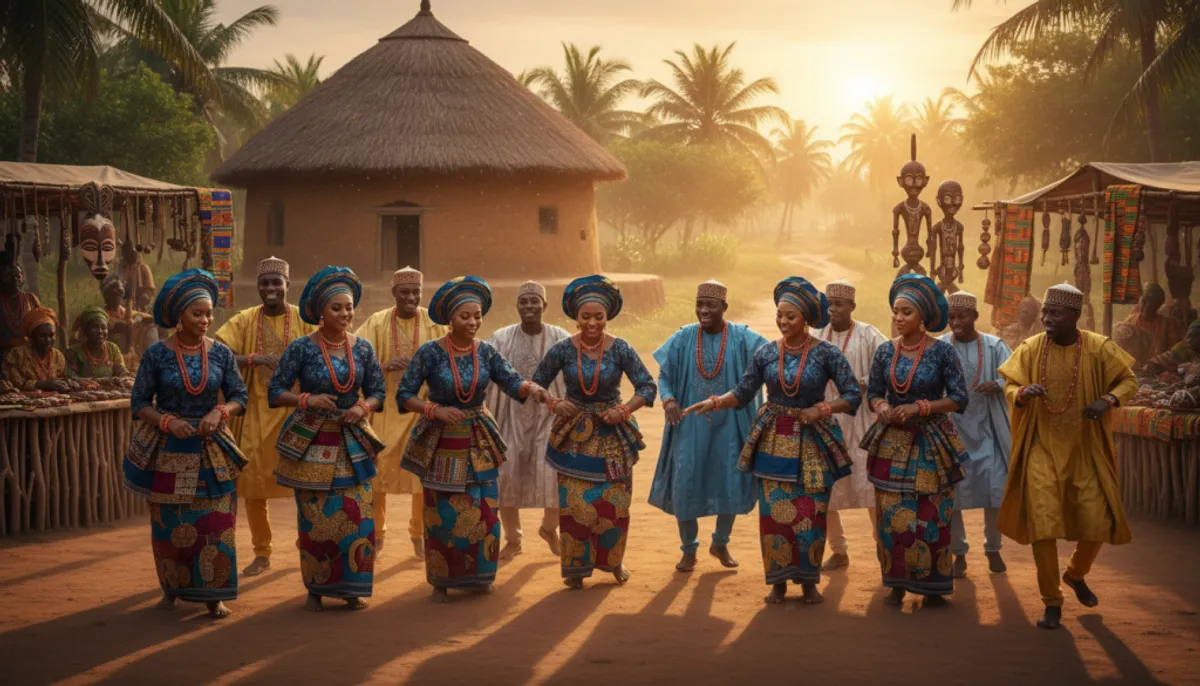
The Yoruba people developed a sophisticated urban civilization as early as ancient times. Dozens of flourishing cities testify to a remarkable social and political organization.
You will discover the multiple dimensions of this tradition: its complex cosmology, its ancestral religious practices, its refined art. The enchanting music and the customs still alive today complete this picture.
This introduction lays the foundations for understanding how this system of beliefs, values, and practices permeates all aspects of daily and spiritual life.
We will also see how this heritage has survived and transformed over the centuries. It has withstood historical trials while adapting to contemporary realities.
The goal is to provide you with a comprehensive and accessible view of this extraordinary civilization and its traditional history. We will combine historical, anthropological, and cultural perspectives to reveal its richness.
Key Points
- Ancient and sophisticated civilization of West Africa
- Extensive influence beyond national borders
- Remarkable social and political organization
- Multiple dimensions: cosmology, religion, art, music
- Belief system integrated into daily life
- Historical resilience and contemporary adaptation
- Multidisciplinary approach for a complete understanding
Introduction to the Yoruba Universe
Let us explore together the deep roots of this remarkable West African civilization. Their presence spans several nations, creating a unique cultural network.
General Overview and Historical Context
This people is one of the major ethnic groups in the region. Their geographical origin primarily covers Nigeria, but also Benin, Ghana, and other neighboring countries.
The history of the name “Yoruba” is fascinating. Emerging in the 16th century, this term meant “sly” in Hausa languages. Speakers only adopted this designation at the end of the 19th century.
This adoption was the work of Samuel Ajayi Crowther. An ex-slave who became a bishop, he was the first translator of the Bible into this language.
Contemporary Importance in the World
Today, the influence of this group far exceeds its place of origin. Their diaspora is present on all continents.
This expansion shows how their identity has managed to radiate on a global scale. Their heritage profoundly influences modern societies.
Origins and Ancient History
The origins of this civilization trace back to captivating myths that recount the birth of the world. This fascinating history begins with stories explaining the origin of the people on earth.
The Beginnings of the Yoruba Civilization
According to tradition, at the beginning of creation, Obàtálá was sent by Ọlọrun to transform the wet earth into a habitable place. He used a mollusk containing soil and winged beasts to create the first mound of dry land.
He named this place Ife, meaning “cradle of existence.” This sacred site became the starting point of all life according to local cosmology.
The Legacy of Ancient Empires and Cities
The documented history of the Yoruba reveals an exceptionally developed urban civilization. The Oyo empire politically dominated for several centuries as a major kingdom.
As early as 1826, explorer Hugh Clapperton noted dozens of flourishing cities. Several towns then had populations exceeding 20,000, demonstrating a rare level of urban development.
This foundational period established social and political structures that still influence today. The ancient history shows how sixteen city-states formed a sophisticated interconnected network.
The history of the Yoruba thus testifies to a remarkable heritage that unites mythical past and historical realities. These prestigious beginnings continue to inspire current generations.
The Fundamental Elements of Yoruba Culture
Let us decode the fundamental principles that animate this traditional society. At the heart of this worldview lies the concept of aṣẹ, this universal life force.
According to Professor Jacob K. Olupona, aṣẹ represents “the empowered word that must be realized”. This energy governs all movements in the universe, creating a link between the physical world (Aiyé) and the spiritual realm (Orun).
Another essential pillar is the concept of Ìwà, which denotes personal character. Its improvement constitutes one of the most important human efforts, transcending mere religious doctrine.
This tradition particularly values the balance between civic, social, and spiritual domains. Every thought and action participates in a complex network of interactions with supreme forces and nature.
The social organization reflects this cosmic order through extended family structures. Material elements include sophisticated artistic forms and a rich oral heritage.
This integrated vision of life allows the cultural system to maintain its coherence. Each element reinforces the others in a harmonious and resilient whole.
The Ancestral Traditions and Rituals
Let us dive into the heart of the rituals that keep the link between generations alive. These practices constitute the backbone of spirituality, creating a sacred bridge between the visible and invisible worlds.
Ceremonies and Ritual Practices
The Egungun ceremonies represent one of the most spectacular manifestations. Elaborate costumes physically embody the spirits of the ancestors who revisit the community.
These celebrations are accompanied by drums, dances, and songs that can last several days. They strengthen the bonds within the family and the entire group.
Rites of Passage and Ancestor Worship
Each stage of life is marked by specific rituals. From birth to death, these practices integrate individuals into the social fabric.
The worship of ancestors occupies a central place in this tradition. The deceased continue to play an active role in the lives of their families.
The belief in Atunwa illustrates this cyclical conception. A spirit can return within the same lineage through the birth of a child.
Names like Babatunde testify to this profound tradition. They affirm the spiritual continuity between generations.
The Yoruba Religion and Its Deities
The Yoruba belief system combines monotheism and the veneration of intermediary spirits. This unique religion relies on a subtle balance between a supreme god and more accessible divine entities.
Pantheon, Cosmology, and Theological Principles
The term Ìṣẹ̀ṣẹ denotes this sophisticated spiritual tradition. It rests on Ọlọrun, the supreme creative force that holds absolute authority.
This Yoruba religion adopts a form of diffuse monotheism. The main god remains distant, while the intermediary deities facilitate contact with humans.
The pantheon symbolically counts 400 plus 1 deity. This organization reflects the complexity of creation and cosmic forces.
Role and Importance of Orishas in Worship
The orishas represent specialized divine spirits. Each deity controls specific natural elements and aspects of human existence.
The worship of these entities involves elaborate rituals and precise offerings. This practice allows the faithful to obtain guidance and protection.
Among the major figures are Obàtálá (pure creation) and Shangô (justice). Their influence transcends original borders through the diaspora.
UNESCO recognized the Ifá system as intangible heritage in 2005. This distinction highlights the global importance of this religion and its ancestral worship.
The Language, Identity, and Ethnic Groups
The collective identity of this people finds its most powerful expression in its mother tongue. This linguistic tradition unites millions of speakers despite political borders.
Yoruba as a Vector of Identity
The language serves as the main cement of unity for this community. It transmits ancestral wisdom and oral history from generation to generation.
This complex tonal language shines through its poetic proverbs. It serves as a receptacle for religious knowledge and traditional values.
Within the community, several dialectal variations exist. Each region has developed its particularities while maintaining mutual understanding.
Related ethnic groups include Edos, Nupe, and Fon. They form an interconnected whole in West Africa.
The number of speakers has seen remarkable growth. From about 14 million in 1971, it likely exceeds 30 million today.
For each individual, mastering this language means much more than communication. It is access to a millennia-old heritage and participation in a dynamic community.
The Diaspora and Global Influence
From West Africa to the Americas, this tradition has managed to cross oceans and centuries. The dispersion of peoples has created a unique network of influence on a global scale.
Migration and Cultural Expansion
The slave trade forced the displacement of a large number of people to the New World. This involuntary migration paradoxically spread their spiritual heritage to new lands.
Communities formed in many Latin American countries. Brazil, Cuba, and Trinidad have embraced ancestral traditions.
Impact on American and European Cultures
The influence of this diaspora manifests in several cultural domains. Syncretic religious systems like Candomblé and Santería testify to this.
In Europe, influential figures contribute to spreading this heritage. Artists and politicians carry this rich tradition onto the international stage.
| Region | Religious Influence | Notable Personalities | Cultural Impact |
|---|---|---|---|
| Brazil | Candomblé, Umbanda | Traditional Communities | Strong in music and rituals |
| Cuba | Santería | Local Artists | Preservation of traditions |
| Europe | Academic Interest | Kemi Badenoch, Sade Adu | Contemporary Dissemination |
| United States | Urban Communities | 21 Savage, Intellectuals | Modern Musical Influence |
This presence around the world demonstrates exceptional resilience. The heritage continues to enrich host societies while preserving its essence.
Arts, Crafts, and Cultural Expression
At the heart of collective identity lies a remarkable artistic heritage, where each object tells a sacred and everyday story, including elements of traditional botswana cuisine. This visual tradition unites formal beauty and deep meaning.Sculptures, Textiles, and Art Objects
Wooden sculptures represent divine figures with a unique stylization. They combine naturalism and symbolic abstraction in an exceptional manner.
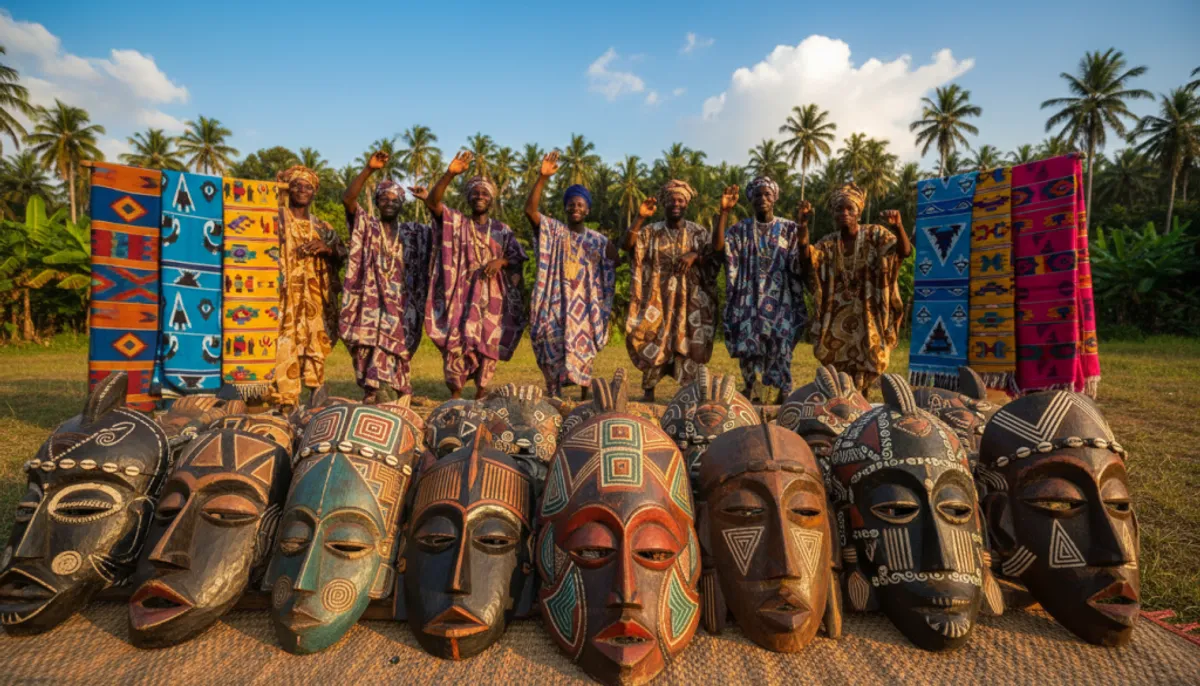
The adire textiles and agbada costumes express social status through their complex patterns. These creations have been passed down within artisan families for generations.
Symbols and Aesthetics in Daily Life
Aesthetics never separates from function in everyday life. Each object carries symbols linking the user to their cosmic origin.
Spirals and geometric shapes constitute a sophisticated visual language. They communicate philosophical concepts through traditional craftsmanship.
| Type of Art | Famous Examples | Meaning | Contemporary Use |
|---|---|---|---|
| Sculptures | Bronze Heads of Ife | Divine Representation | Museum Preservation |
| Textiles | Adire Tapestries | Social Identity | Modern Ceremonies |
| Ritual Objects | Opon Ifá Trays | Spiritual Communication | Traditional Practices |
| Masks | Gèlèdè Masks | Homage to Femininity | Cultural Performances |
This artistic expression continues to evolve while preserving its essence. Contemporary artists create a bridge between past and present on their native land.
Music, Dances, and Sacred Rituals
Communication with the divine occurs through a complex dialogue of percussion, chants, and codified dances. These artistic expressions are not mere entertainment but sacred tools that establish direct contact with spiritual entities.
The Drums, Dances, and Traditional Chants
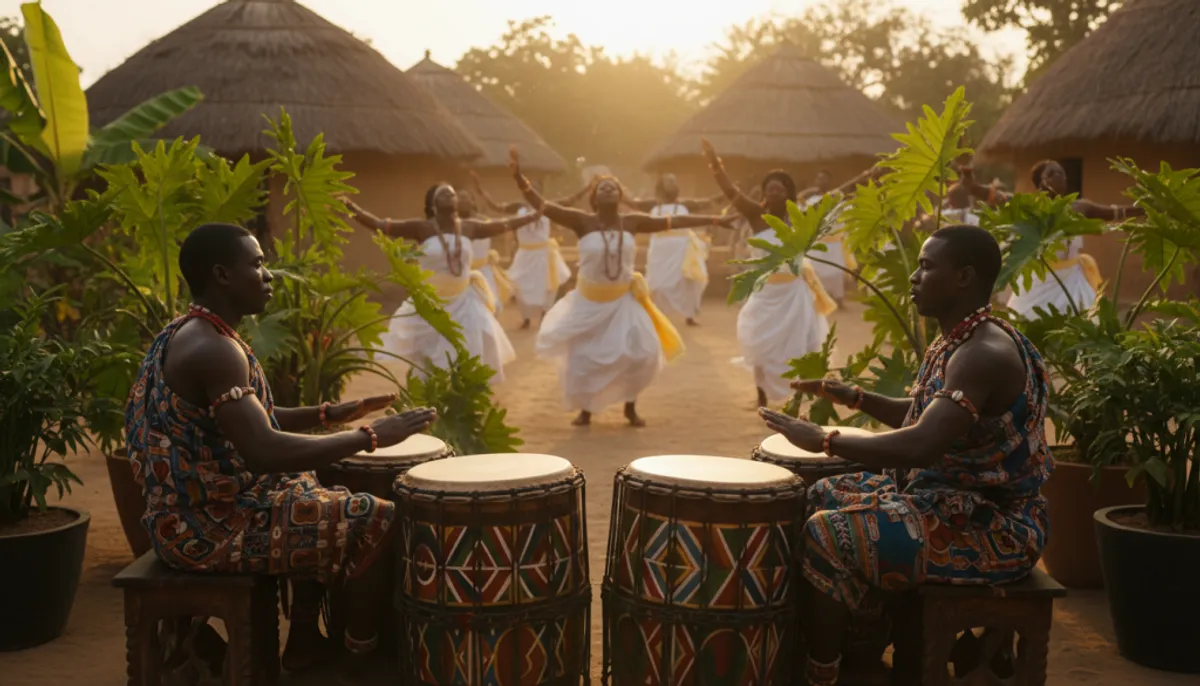
The bààta drums represent the sound soul of this religious practice. This family ensemble includes three instruments: Iyá (the mother), Itótele (the father), and Okónkolo (the child).
In the hands of the Olubatá, specialized initiates, these drums become instruments of speech. They recite prayers and transmit messages during the worship.
The dundun, nicknamed “talking drum,” faithfully reproduces the tones of the language. Its hourglass shape allows it to imitate any musical instrument.
Each deity has its own musical repertoire. Specific hymns and characteristic rhythms are performed according to the circumstances of the worship.
The sacred dances embody the characteristics of the deities. Each movement is codified with rigorous precision, reflecting the strength and personality of the honored spirit.
During ceremonies, this combination of sounds and movements can induce trance states. The faithful then become living vessels for the spiritual entities.
This musical and choreographic tradition continues to evolve while maintaining its sacred essence. It also adapts to contemporary social celebrations.
The Yoruba Culture in the Modern World
The encounter between modernity and age-old traditions today defines the identity of this dynamic community. This millennia-old civilization demonstrates remarkable adaptability in the face of contemporary challenges.
Contemporary Challenges and Evolutions
The contemporary Yoruba people present significant religious diversity. About 50% practice Islam, 40% Christianity, and 10% maintain the ancestral orisha tradition.
This plurality has not erased cultural identity. Individuals often integrate traditional elements into their daily lives, creating unique syncretisms.
Rapid urbanization poses challenges to the transmission of knowledge. Younger generations sometimes disconnect from ancestral practices within their families.
Interactions Between Tradition and Modernity
Family ceremonies now combine ancestral rituals and modern religious practices. This harmony demonstrates the resilience of the heritage on this rich land.
Fascinating demographic peculiarities persist. The twin birth rate reaches 45-50 per 1000, well above the global average.
The Yoruba culture shines through figures like Wole Soyinka and Fela Kuti. Their influence transcends borders, contributing to the modern world.
Throughout the 21st century, this civilization proves that tradition and innovation coexist harmoniously. The dynamic nature of this heritage ensures its longevity.
Conclusion
This exploration has allowed us to grasp the essence of a multifaceted civilization. The people we have discussed have created a remarkable legacy that continues to inspire.
From its mythical origins to its global influence, this tradition demonstrates exceptional resilience. The Yoruba religion permeates all aspects of daily life.
The ancestors play a central role in this worldview. Every individual within their family forms an essential link.
Art and music testify to an exceptional artistic creation. These expressions transcend borders and touch other peoples.
The term “Yoruba” illustrates the dynamic nature of this heritage. It has managed to integrate external elements while preserving its distinctive spirit.
This article reveals how a civilization, including the songhai empires, can preserve its essence while radiating globally. The heritage of the ancient kingdoms continues to enrich our human understanding.FAQ
What is the origin of the Yoruba people?
The origins of this civilization trace back to ancient West Africa, with founding narratives centered around the sacred city of Ife. The early kingdoms, such as Oyo, marked its ancient history.
What are the main elements of the Yoruba religion?
Spirituality is based on the belief in a supreme being, Olodumare, and a pantheon of deities called orishas. These forces of nature play a central role in worship and daily life.
How has the diaspora spread this tradition?
Through the transatlantic slave trade, practices and ancestral spirits traveled. They influenced religions like Candomblé in Brazil and Santería in Cuba, showing remarkable adaptation.
What role does language play in Yoruba identity?
The language, including the hausa language, is an essential vector of identity and cohesion. It carries the values, history, and philosophy of the group, uniting individuals within the community and beyond borders.
What are the most well-known forms of art?
Craftsmanship is famous for its terracotta and brass sculptures, notably the heads of Ife. Textiles, beads, and drums used during ceremonies are also very important.