
In the heart of the Sahara, a fascinating nomadic people carries a millennia-old history. The Tuaregs, who call themselves Kel Tamajeq, are the guardians of unique knowledge. Their presence extends across five countries in Africa.
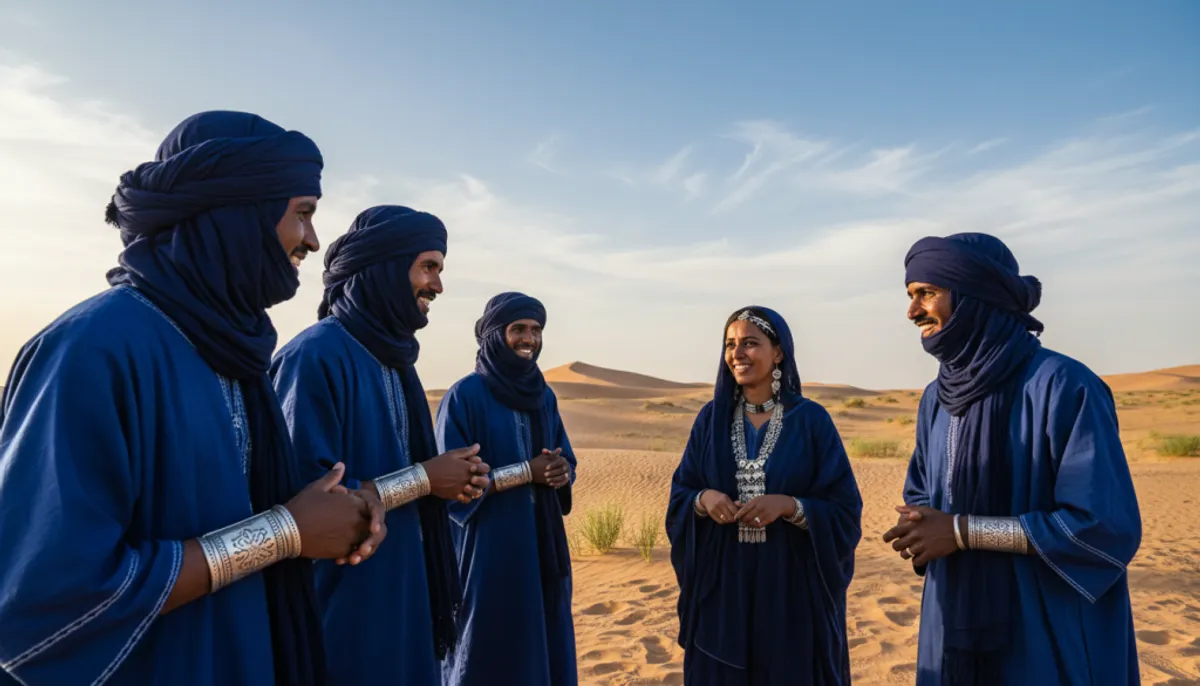
This Tuareg people embodies freedom and resilience. Despite modern challenges, they preserve a deep and authentic identity. Their way of life is perfectly adapted to the desert.
Their heritage is extraordinarily rich. It encompasses an ancient language, Tamajeq, vibrant traditions, and renowned craftsmanship. Their social structure is based on confederations and tribes.
This journey invites you to explore the origins, social organization, and contemporary challenges of this community. Discover how these "blue men" continue to shine a light on their culture.
Key Points to Remember
- The Tuaregs, or Kel Tamajeq, are a nomadic Berber people from the central Sahara.
- Their population is spread across five African countries: Niger, Mali, Algeria, Burkina Faso, and Libya.
- They are famous for their strong identity and their nickname of "free men" of the desert.
- Their rich culture includes a language (Tamajeq) and a unique alphabet (Tifinagh).
- They have managed to preserve their traditions and way of life despite modern upheavals.
- Their history and resilience in the face of a hostile environment are remarkable.
Introduction to Tuareg Culture
The name "Tuareg" conceals a reality more complex than one might imagine. Indeed, this term is an exonym of Arabic origin. The people themselves use very different self-designations.
Definition and Geographical Context
The Kel Tamajeq, as they call themselves, are spread across five African countries. Niger hosts the largest population, followed by Mali, Algeria, Burkina Faso, and Libya.
Their traditional territory is vast. It is known as Tinariwen, which means "the deserts." It includes iconic regions such as Ténéré, Hoggar, and Tassili n'Ajjer.
They can be found in key Saharan cities, such as Tamanrasset and Djanet in the Algerian Sahara, or Agadez in Niger.
The Origins of the Term and Its Evolution
The origin of the word "Tuareg" is fascinating. According to the explorer Léon l'Africain, it derives from the region of Targa in Libya.
They often refer to themselves as Imuhagh or Imajaghen, meaning "free men." Other names like "Kel Tagelmust" emphasize the importance of their veil.
Sub-Saharan populations sometimes call them "Souraka." This term means "the people of the north."
Origins and Founding Myths
The legend of Tin Hinan constitutes the central pillar of the mysterious origins of this people. These fascinating tales, deeply rooted in saharan folklore, date back to ancient exchanges that shaped their identity.
Tin Hinan, the Legendary Founding Mother
According to tradition, Tin Hinan lived between the 4th and 5th centuries. This charismatic queen is said to have come from the north with her servant.
Her monumental tomb in Abalessa was discovered in 1925. Archaeologists found exceptional treasures dating back to the 4th century.
Among the funeral objects were fourteen precious bracelets and a statue of Venus. A gold leaf bore the imprint of a coin from Constantine I.
Symbols and Ancestral Legends
The inscriptions in Tifinagh on the sepulcher testify to the antiquity of this writing. Herodotus already mentioned the Atlanteans in Hoggar.
| Legendary Figure | Period | Symbolism | Social Importance |
|---|---|---|---|
| Tin Hinan | 4th-5th century | Matriarchal foundation | Original ancestor |
| Atlanteans | Antiquity | Mythological link | Historical reference |
| Female Ancestors | Oral tradition | Lineage through women | Social structure |
These founding myths illustrate a society where women occupy a central place. The journey south of Tin Hinan symbolizes the movements of early peoples.
Historical Evolution of the Tuaregs
The extraordinary longevity of this ethnic group dates back to prehistory, with a continuous presence in the Saharan desert. Their fascinating history spans approximately 7000 years before our era.
From Antiquity to the Middle Ages
As early as the 11th century, powerful kingdoms emerged. Tigidda in Aïr and Tadmakkat became major trade centers.
In the 15th century, the Sultanate of Aïr was founded to pacify tribal conflicts. Arab travelers documented this rich history as early as the 10th century.
The Colonial Period and Resistance
French colonization in the early 20th century met with fierce resistance. The battle of Tit in 1902 marked a turning point.
Moussa Ag Amastan, a charismatic leader, sought to preserve his people's interests through diplomacy. The territorial division into five nations fragmented their traditional territory.
The rebellion of 1916-1917 is a testament to the ongoing resistance against occupation. This period profoundly disrupted their ancestral way of life.
The Strategies of Rezzous and Economic Organization
The rezzous, strategic raids, formed the heart of a sophisticated economic organization. This system relied on the protection of trade caravans crossing the Sahara.
The Raids and Their Role in Trans-Saharan Trade
The noble tribes ensured the security of trade routes. They collected tolls for this essential service.
The rezzous began after the first rains. This timing ensured enough food for the camels. Targets were carefully chosen.
Remote groups were preferred to limit counterattacks. The main loot consisted of camels and other transportable goods.
| Strategic Aspect | Ideal Period | Preferred Targets | Main Loot |
|---|---|---|---|
| Choice of Targets | After first rains | Remote groups | Camels |
| Protection of Caravans | All year round | Trade routes | Tolls |
| Post-Raid Negotiations | Immediately after raid | Victims | Partial recovery |
A successful raid brought profit and social recognition. These exploits were celebrated in traditional poetry. The economic role of these practices was fundamental.
In the 19th century, vassals also participated in the raids. This evolution changed access to property. The French definitively banned rezzous after 1920.
Political and Social Organization in Tuareg Society
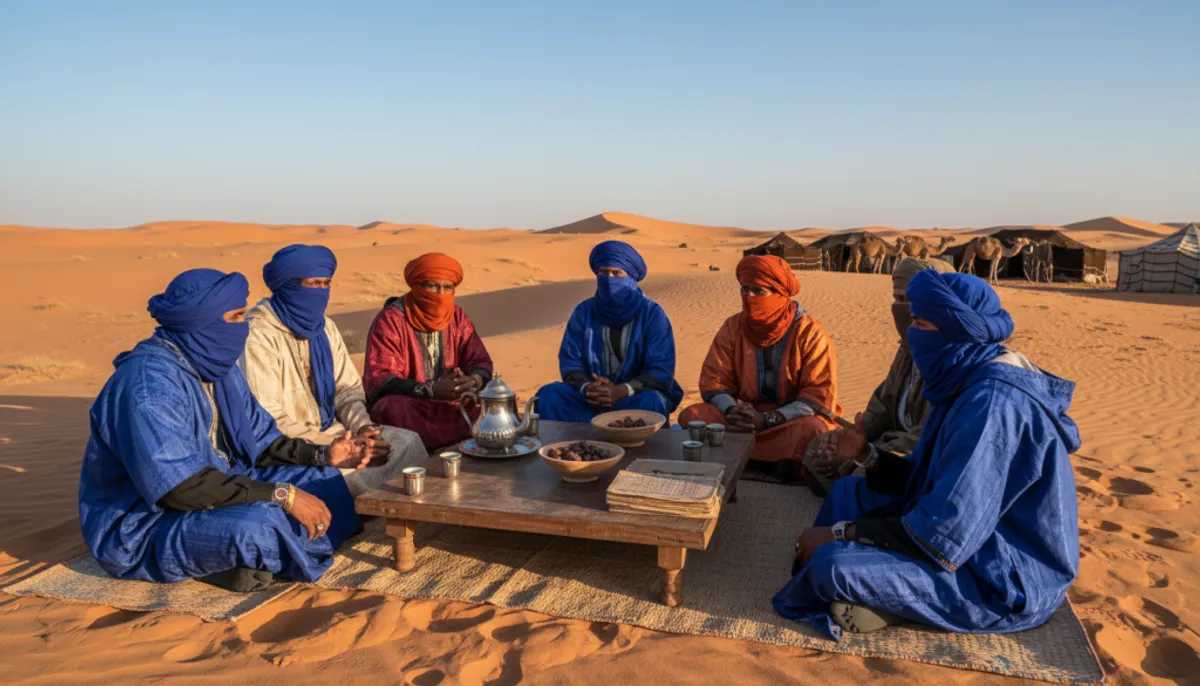
At the top of the social hierarchy are the noble warriors, guardians of ancestral traditions. This Tuareg society maintains a remarkably organized hierarchical structure.
Tribal Structure and Formation of Confederations
The fundamental organization is based on tribes called tawsit. Each tribe is led by an amghar and divided into family fractions.
Seven major historical confederations structure the territory. These tribes unite in ettebel such as Kel Ahaggar and Kel Aïr.
The Role of Leaders, Amenokals, and Amghars
The amenokal holds the supreme power over a confederation. His election follows rules of matriarchal heredity.
This leader assumes a crucial role in Tuareg society. He receives the t'bala, a symbolic drum of royal power.
His main function is to protect the community. The assembly can revoke him if he neglects his responsibilities.
Craftsmanship, Rituals, and Ancestral Traditions
The skilled hands of Tuareg artisans transform simple materials into exceptional works of art. This creativity expresses a rich culture that has been perpetuated for centuries, influenced by various elements, including scandinavian cultures.
Artisanal and Textile Techniques
The Inhadhen, blacksmith-artisans, master unique know-how. They create finely crafted silver jewelry and traditional weapons.
Weaving produces carpets with symbolic geometric patterns. Leatherwork gives rise to utilitarian and decorative objects.
| Type of Craftsmanship | Materials Used | Main Techniques | Symbolism |
|---|---|---|---|
| Jewelry | Silver, copper | Chiseling, engraving | Social status |
| Textiles | Wool, cotton | Hand weaving | Protection |
| Leather | Animal hides | Traditional tanning | Nomadic utility |
Ceremonies and Rituals at the Heart of the Desert
The tea ceremony represents a fundamental social moment among Tuaregs. It includes three successive servings with profound meanings.
The tagelmust, a male veil, measures five to six meters. Dyed with indigo, it colors the skin of men, creating the label "blue men."
Unlike usual dress codes, women do not wear veils. This peculiarity illustrates the uniqueness of local traditions.
Languages and Writings: Tamasheq and Tifinagh
Tamasheq and Tifinagh represent two fundamental pillars of identity transmission. This linguistic richness goes beyond mere communication.
Linguistic Diversity Among the Tuaregs
The communities speak Tamasheq, a Berber language with multiple variants. Three main dialects are distinguished according to the regions.
Tamahaq in the north, Tamasheq in the center, and Tamajaq in the south. All derive from the same original term, tamazeq.
The self-designation "Kel Tamajeq" means "those of the Tamajeq language." This word illustrates the inseparable link between identity and verbal expression.
The Importance of the Tifinagh Alphabet
Tifinagh is among the oldest writings in humanity. This consonantal alphabet offers extraordinary flexibility.
It can be written in all directions: vertically, horizontally, and even spirally. This peculiarity among Tuaregs demonstrates great graphic creativity.
Father Charles de Foucauld created a Tuareg-French dictionary. His work remains a valuable reference for these ancestral languages.
Women play a crucial role in transmission. They teach Tifinagh to children, thus preserving this unique heritage.
Nomadic Lifestyle and Daily Life in the Desert
Mobility represents the very foundation of their ancestral way of life in this extreme environment. Constant movements with herds rhythm the existence of nomads across the sandy expanse.
Adaptation to Climate and Arid Environment
Their deep knowledge of the desert allows for precise navigation. They read the stars to orient themselves at night and manage water with remarkable economy.
Animals are the central element of their daily life. Milk forms the dietary base, while meat is reserved for special occasions. An old herder confides: "When the animals die, the nomads die."
The camp is organized around the tent, the exclusive property of the woman. This removable structure follows the movements of herds to pastures.
Each day includes caring for the animals, searching for food, and maintaining equipment. Craftsmanship occupies moments of rest, thus perpetuating traditional know-how.
Contemporary Tuareg Society
Contemporary challenges redefine the contours of Tuareg life. This ancestral nomadic society faces profound transformations.
The gradual abandonment of nomadism marks a historical break. Many have settled in cities like Tamanrasset or Agadez.
Changes Related to Sedentarization
The great droughts of the 1970s-1990s decimated herds. This ecological disaster forced many families to change their lives.
The policies of various countries accelerated this transition. The goal was to settle nomadic populations in urban areas.
| Main Cause | Period | Impact | Social Consequence |
|---|---|---|---|
| Repeated Droughts | 1970-1990 | Loss of Herds | Exodus to Cities |
| State Policies | 20th-21st Century | Forced Sedentarization | Cultural Break |
| Modern Economy | Contemporary | New Opportunities | Necessary Adaptation |
Challenges and Issues in the Modern World
Integration into the contemporary world poses many challenges. Access to formal education and monetary economy requires adaptation.
Political marginalization in the southern Saharan countries has caused tensions. Several rebellions have erupted since the 1990s.
These conflicts express a feeling of abandonment of Tuareg regions. They testify to the difficulties of integration into modern nation-states.
Tradition and Modernity: Tensions and Convergences
The encounter between millennia-old customs and contemporary realities generates significant transformations. This time of transition profoundly affects community organization.
The colonial borders imposed between 1958 and 1961 fragmented traditional territory. This geopolitical effect disrupts ancestral nomadic circuits.
The Impact of Socio-Economic Transformations
The traditional social hierarchy persists but evolves. Relations between classes become more egalitarian. Increased mobility characterizes this changing society.
Saharan tourism represents a growing economic share. The Kel Ahaggar and Kel Ajjer in Algeria particularly benefit from it. This activity creates new social functions.
State policies impose schooling and sedentarization. These changes transform modes of community organization. The cultural transmission to younger generations becomes crucial.
Coded joking systems persist between classes. They ensure cohesion and regulation of tensions. This society thus maintains its balance in a modernized context.
The Heritage and Transmission of Tuareg Culture
Women play a fundamental role in safeguarding an exceptional cultural heritage. They teach children Tifinagh writing and oral traditions. This transmission ensures the continuity of ancestral knowledge.
Cultural Initiatives and Traditional Festivals
The Sebiba festival in Algeria represents a key moment of sharing, showcasing not only the rich heritage of the Tuareg people but also elements of german cuisine. Tribal gatherings perpetuate songs, dances, and legendary tales. These events keep the rich heritage alive.
The Tassili Cultural Park provides local jobs while protecting rock heritage. Concerts by groups like Tinariwen spread this culture beyond borders.
Mechanisms for Preserving Ancestral Knowledge
Mothers teach the takarakit, a moral code defining essential values. This system includes politeness, respect for elders, and solidarity. Each family thus constitutes a primary transmission unit.
Specialized schools now offer Tamasheq teaching. Associations document oral tradition for younger generations. This educational function complements family work.
| Transmission Mechanism | Main Actor | Knowledge Transmitted | Impact |
|---|---|---|---|
| Family Teaching | Women/Mothers | Tifinagh, takarakit | Daily Transmission |
| Cultural Festivals | Community | Dances, Songs, Poetry | Collective Cohesion |
| Language Schools | Teachers | Tamasheq Language | Formal Preservation |
| Cultural Associations | Specialists | Heritage Documentation | International Valorization |
The family remains the most important part of this process. It transmits practical knowledge such as herding and craftsmanship. This approach ensures a natural continuity between generations.
The Influence and Radiance of Tuareg Culture
In a globalized world, Tuareg heritage shines with remarkable strength, particularly the amazigh culture in france. This community maintains strong ties despite the borders imposed by colonization.
Impact on the Diaspora and Beyond Borders
The Tuareg presence extends beyond the five main countries. Communities live in Chad, Sudan, Mauritania, and Nigeria.
These groups preserve their unique identity while integrating into host nations. Their craftsmanship becomes a valued cultural ambassador internationally.
Perpetuation in the Age of Modernity
Music plays a crucial role in this radiance. Groups like Tinariwen introduce this culture on stages around the world.
Academic and tourist interest contributes to preservation. However, this media exposure raises questions about authenticity.
Despite challenges, this community maintains its distinctive identity. Its heritage enriches the diversity of northern African regions and beyond.
The Representation of Tuaregs in Art and Media
The nickname "blue men" conceals a reality more complex than its poetic origin. This romantic appellation simply comes from the indigo of the tagelmust that stains the skin of men.
For an Authentic and Faithful Image
Henri Duveyrier created a lasting representation in his 1864 work. He depicted these men as mysterious "lords of the desert."
Western narratives have often idealized their nomadism. They saw freedom, wisdom, and simplicity in the sandy expanse.
Inspiration in Contemporary Art
This unique aesthetic inspires painters and photographers worldwide today. The artist Hocine Ziani contributes to a faithful self-representation.
Museums like the Saharan Museum near Montpellier preserve this visual memory. Historical photos show Moussa ag Amastan visiting Paris in 1910.
The blue men now transcend exotic clichés. Their true identity emerges thanks to their own artists and intellectuals.
The Socio-Economic Challenges of the Tuareg People
The traditional economic survival of the Kel Tamajeq relies on a fragile ecological balance. This Tuareg people faces profound transformations that call into question their ancestral way of life.
Drought, Sedentarization, and Economic Impacts
The great droughts of the 1970s-1990s decimated herds, the traditional economic base. These natural disasters forced many families to abandon nomadism.
Economic marginalization persists in northern Mali and northern Niger. Burkina Faso is also among the least developed areas.
"When the animals die, the nomads die" – this traditional wisdom illustrates the impact of droughts.
| Drought Period | Impact on Herds | Social Consequence |
|---|---|---|
| 1970-1975 | Massive Decimation | Exodus to Cities |
| 1980-1984 | Loss of 80% of Livestock | Forced Sedentarization |
| 1990 | Final Collapse | Economic Break |
Difficulties in accessing education and infrastructure in the southern Sahara complicate economic integration. This issue concerns local communities.
Marginalization fuels a vicious cycle of rebellions and insecurity. This lasting effect hinders the development of Tuareg regions.
Political tensions result from a feeling of abandonment by central governments. The Tuareg people believe their regions are neglected in favor of the south.
Recurring armed conflicts in Mali and Niger illustrate this fracture. The situation in Burkina Faso also remains concerning.
This complex issue requires a comprehensive approach to find sustainable solutions. Every part of society must be involved.
Travel Perspectives and Cultural Experiences
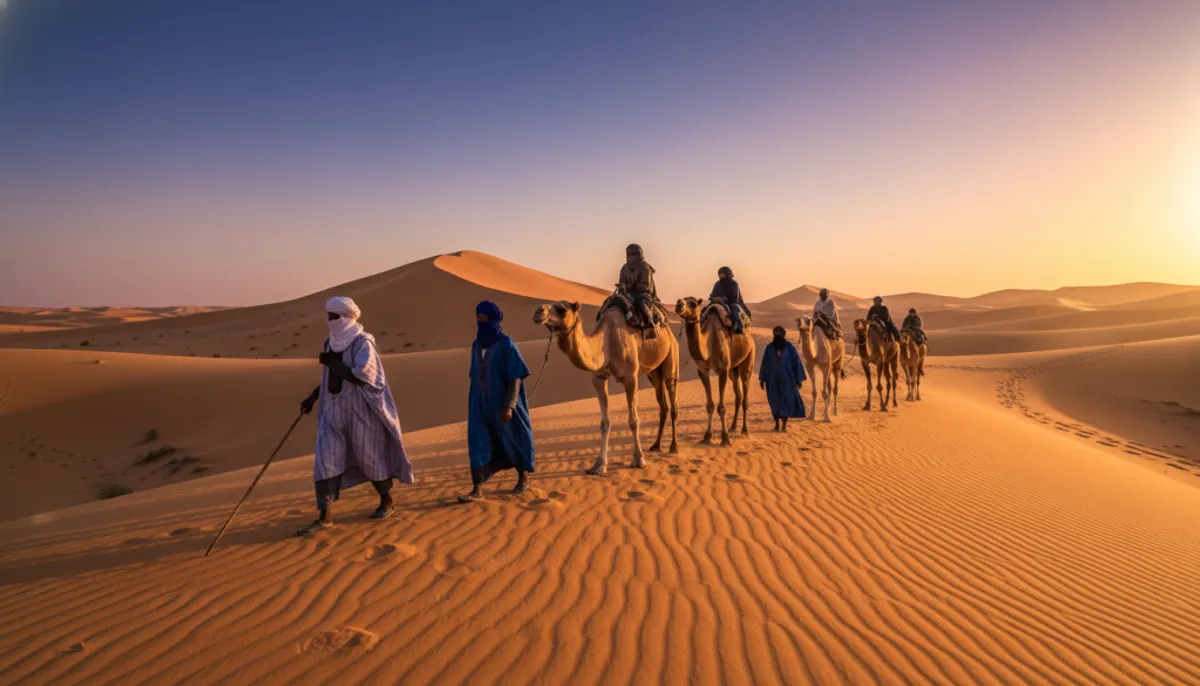
Responsible tourism in the Algerian Sahara allows for authentic encounters with nomadic communities in their natural environment. These journeys offer a deep immersion into a millennia-old way of life.
Camel Treks and Immersion in the Desert
Expeditions on camelback traverse the vast stretches of the desert. Guided by expert Tuaregs, they reveal breathtaking landscapes.
Nights camping under the stars create magical moments. The silence of the Algerian Sahara and the conviviality around the fire mark every traveler.
| Type of Experience | Typical Duration | Main Regions | Highlights |
|---|---|---|---|
| Camel Trekking | 3-7 days | Tassili n'Ajjer | Total Immersion |
| Staying with Locals | 2-4 days | Hoggar | Authentic Encounters |
| Rock Art Observation | 1-2 days | Djanet | Exceptional Heritage |
Authentic Encounters and Tourism Initiatives
Responsible initiatives promote respectful exchanges. Stays with the Kel Ahaggar and Kel Ajjer allow participation in daily activities.
"Living at the rhythm of the nomads transforms our worldview and sense of time."
Discovering local craftsmanship and culinary specialties enriches the experience of romanian literature. Tourism represents a vital source for these communities in the Saharan regions.
This type of travel with the Tuaregs preserves traditions while adapting to modernity. It creates lasting bonds between visitors and locals.
Conclusion
The cultural heritage of this Tuareg people represents a delicate balance between tradition and modernity. The evolution of corporate culture in the context of their millennia-old history testifies to exceptional resilience in the Saharan environment.
The Tuaregs define themselves above all as free men. This fundamental identity gives a profound meaning to their community belonging. Each man and woman negotiates this ongoing challenge.
Despite socio-economic challenges, Tuareg culture persists with pride. Festivals and preservation initiatives, along with creating a positive company culture, offer hopeful prospects. This issue deserves attention and international solidarity.
Responsible travel allows for an authentic discovery of this richness. Supporting these communities ensures transmission to future generations. The free men of the desert continue their narrative with a renewed meaning.
FAQ
Who are the Tuaregs, often called the "blue men"?
The Tuaregs are an emblematic nomadic people of the Sahara. The nickname "blue men" comes from their traditional clothing, the tagelmust, dyed with indigo that stains the skin. They have a rich history, including the history of the bahamas, and a strong cultural identity.
What is the origin of the word "Tuareg"?
The term "Tuareg" is of Arabic origin. It means "abandoned by the gods." However, they call themselves Kel Tamasheq, meaning "those who speak the Tamasheq language."
Where do the Tuaregs live today?
This people is spread over a vast territory covering several countries: the south of Algeria, the north of Mali and Niger, Burkina Faso, and the southwest of Libya. They are deeply connected to the desert.
How is traditional Tuareg society organized?
Tuareg society is structured around tribes and confederations. It is hierarchical with free men (Imajeghen), artisans (Inaden), and former captives (Iklan). Power is held by leaders, the amenokals.
Do the Tuaregs have their own writing?
Yes! They use the Tifinagh alphabet, a writing system several millennia old. It is mainly used for inscriptions and poetry, and it is experiencing a revival today.
What is the traditional lifestyle of the Tuaregs?
Their lifestyle was historically nomadic, based on caravan herding, trans-Saharan trade, and raids. They are perfectly adapted to life in the arid environment.
What are the main challenges facing the Tuaregs today?
They face many challenges: drought, forced sedentarization, political conflicts in certain regions, and the difficulty of preserving their culture and social organization in the face of modernity.
Is it possible to experience life with the Tuaregs during a trip?
Absolutely! Responsible tourism initiatives offer camel treks and authentic encounters for immersion in their world. It is a unique way to discover their legendary hospitality.