Welcome to the world of modern gardening! In the early 2000s, an innovative approach emerged in France. It aims to reconcile productivity and environmental responsibility. This approach is aimed at all gardeners concerned about preserving nature.
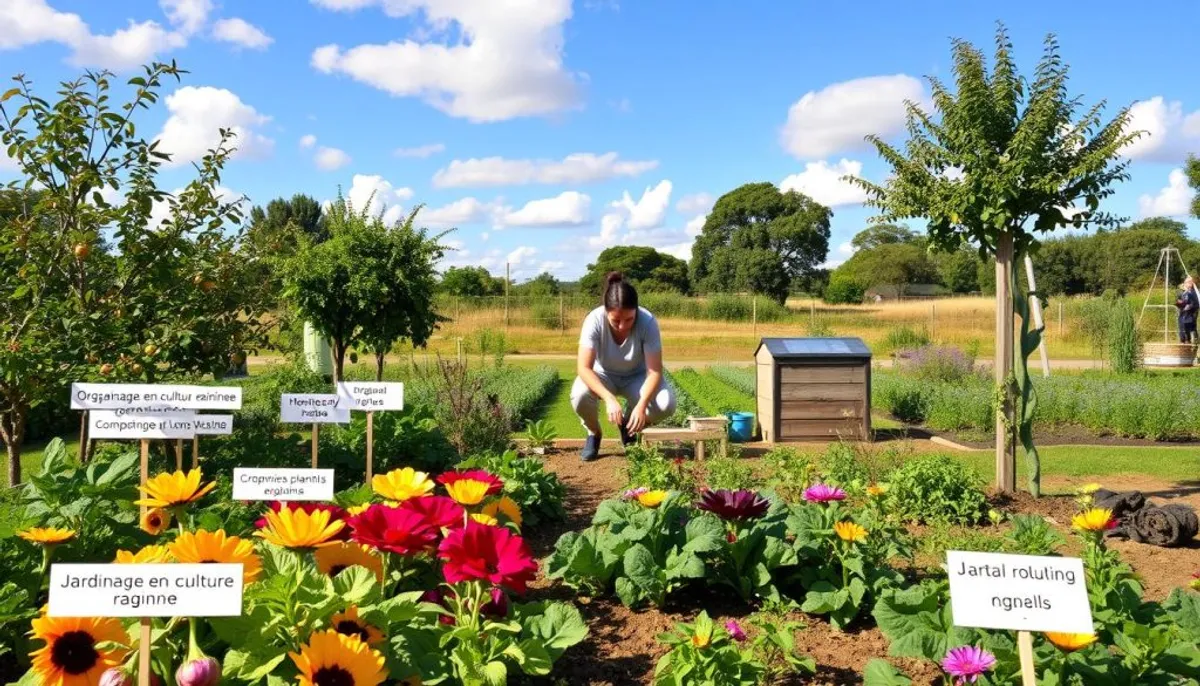
The fundamental principle is simple: to obtain beautiful harvests while controlling the use of resources. Results are optimized by intelligently limiting inputs. This method applies perfectly to vegetable gardens and ornamental gardens.
Reasoned agriculture rests on three essential pillars. The protection of the environment comes first. The well-being of living organisms is equally important. Finally, economic efficiency ensures the sustainability of production.
Whether you are an amateur or a professional, this approach allows you to adopt sustainable practices. You maintain a harmonious balance with local ecosystems. Without compromising the quality of your harvests!
Key Points to Remember
- Reasoned cultivation seeks a balance between productivity and respect for the environment
- This method intelligently limits the use of resources and inputs
- It is based on three pillars: environment, animal welfare, and economic efficiency
- Adaptable to amateur gardens as well as professional farms
- Allows for good harvests with sustainable practices
- Born in France in the early 2000s
- Addresses current environmental concerns
Understanding Reasoned Cultivation
The journey of reasoned agriculture begins well before its official recognition. The FARRE association laid the foundations as early as 1993.
The term was formalized by decree no. 2002-631 of April 25, 2002. This crucial text defines the qualification of agricultural operations under reasoned agriculture.
Definition and History
A national framework establishes 103 specific requirements. They cover traceability, fertilization, and crop protection.
The goal is to achieve a balance between production and respect for the environment. The system evolved in 2013 towards an environmental certification with three levels.
Environmental and Welfare Objectives
The goals are multiple: preserving soils, managing water, and protecting biodiversity. Controlling health risks is also paramount.
The welfare of animals is an integral part of this approach. Their diet and living conditions are rigorously regulated.
This comprehensive approach also includes workplace safety and illicado culture card usage locations. It represents a major advance for sustainable agricultural practices.
Methods and Practices for a Sustainable Garden
So, how can you apply these principles in your garden? Several simple techniques allow for good results while preserving the environment.
Fertilization Techniques and Input Management
Balanced fertilization starts with an analysis of your soils. Conduct a test every six years to understand their exact needs.
This approach avoids wasting inputs. You provide just what your crops need.
For crop protection, prioritize natural methods. Biological control agents are excellent against pests.
Mechanical weeding effectively replaces pesticides. Use phytosanitary products only as a last resort.
Implementation of Soil-Friendly Cultural Practices
Crop rotation preserves the natural fertility of your plots. For those who want to grow on a balcony, alternate leafy vegetables, roots, and fruits each year.
Install grassy strips along water points. They naturally filter runoff and protect biodiversity.
These cultural practices reduce the impact on the ecosystem. They maintain a satisfactory production without exhausting resources.
All of these methods form a coherent system. Your garden becomes more resilient and self-sufficient.
The Benefits of Reasoned Cultivation Gardening
The concrete benefits of this agricultural approach profoundly transform farms. They range from ecosystem protection to improved yields.
Positive Impact on Biodiversity and the Environment
This method actively promotes local biodiversity. It preserves natural habitats by limiting the impact of chemicals.
The reduction of pollution and responsible resource management sustainably protects the environment. Agricultural landscapes retain their natural beauty.
Benefits for Animal Health and Productivity
The welfare of animals is fundamental. Their diet precisely meets their specific needs.
Respectful breeding conditions improve their health. This attention translates into higher quality production.
The farmer benefits from better organization. A deep understanding of their system optimizes productivity.
Optimization of Water and Resource Use
Water is used with great precision. The actual needs of the plants guide its use.
This management avoids waste and preserves the resource. The savings made benefit the profitability of the farm.
Consumers show an increasing interest in these products. They seek foods that respect their health and the planet, emphasizing healthy nutrition.
| Aspect | Reasoned Agriculture | Organic Agriculture |
|---|---|---|
| Use of chemical products | Limited and controlled | Prohibited |
| Environmental objectives | Resource preservation | Total ecosystem protection |
| Flexibility of practices | Adaptation to local specifics | Strict and uniform framework |
| Production approach | Balance between yield and environment | Absolute environmental priority |
The growth of certified farms testifies to this enthusiasm. This agriculture places the farmer in a dynamic of continuous improvement.
Conclusion
The constant increase in certified farms since January 2023 confirms the importance of this approach. Reasoned agriculture represents a balanced middle ground between conventional methods and organic agriculture.
This pragmatic approach perfectly meets the expectations of modern consumers. It effectively reconciles production with environmental respect.
The system adapts to the specific needs of each farm. Each farmer can thus continuously improve their practices.
The future of sustainable agriculture lies in this reasoned cultivation. It offers a flexible model that preserves the environment while ensuring quality production.
FAQ
What differentiates reasoned agriculture from organic agriculture?
Reasoned agriculture seeks a balance between productivity and respect for the environment. It uses a holistic approach to the farm, reducing inputs like pesticides but not banning them entirely. Organic agriculture, on the other hand, follows a very strict set of specifications that prohibits the use of synthetic products.
How can I adopt more reasoned agricultural practices in my garden?
You can start by observing your garden to understand its needs. Then, prioritize methods such as mulching to protect the soils, crop rotation, and using natural fertilizers. The goal is to intervene only when necessary, respecting the natural balance.
What are the concrete benefits for biodiversity with this type of cultivation?
By limiting the use of pesticides and diversifying plantings, you provide habitat and food for many insects, birds, and small animals. This approach encourages the presence of natural allies that help protect your crops, creating a healthier and more balanced ecosystem.
Does reasoned agriculture require more work?
At first, it may require a bit more attention to observe and plan. But in the long run, a balanced system tends to be more self-sufficient. You spend less time correcting problems (like diseases) because you act preventively, taking care of the soil and the overall environment of your garden.
Is there an official qualification for farms practicing reasoned agriculture?
In France, there was an official certification defined by a decree (April 2002). Today, this specific qualification is no longer active. However, the principles of this approach remain a solid foundation for any farmer or gardener wishing to reduce their environmental impact.
RelatedRelated articles
- 30 Dec 2025·7 min readCultural Pass: How long can you use it?Articles
 You are young and you benefit from this exceptional scheme? A crucial question arises: what is the validity period of your allowance? Properly planning your expenses is essential to make the most of this opportunity.Excellent news has recently emerge...