
At the heart of our community life are two fundamental pillars. They guide our actions and shape our identity. These concepts, while interconnected, possess unique characteristics that are essential to grasp.
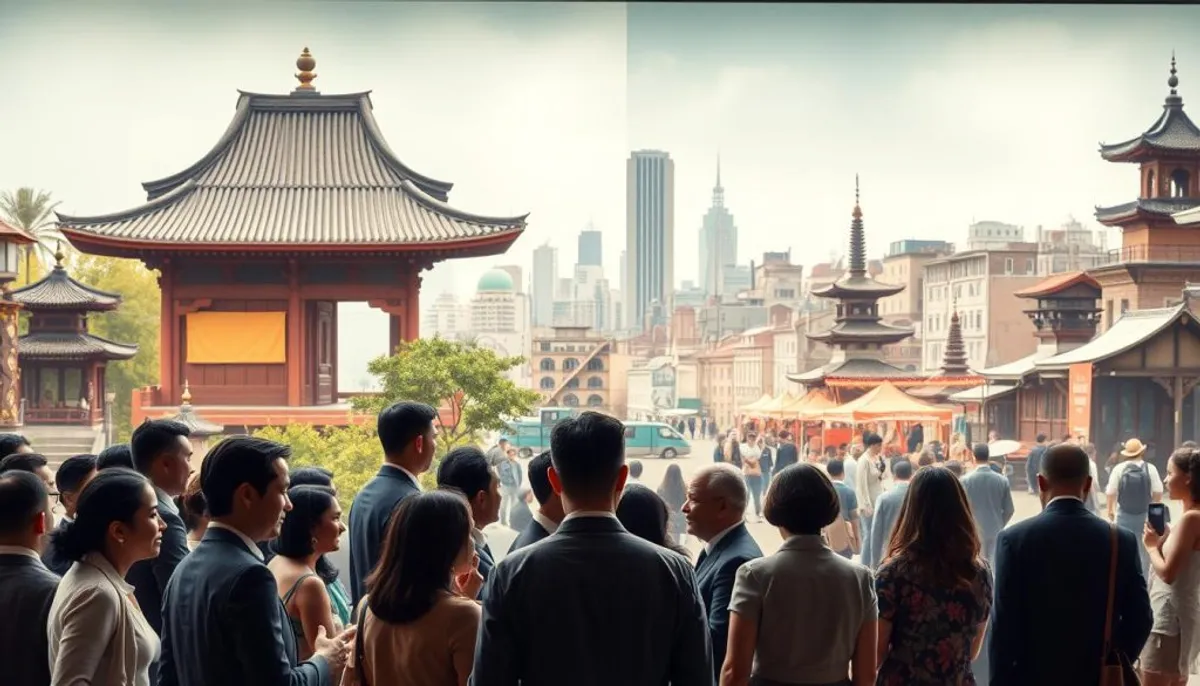
Understanding this distinction is crucial for navigating our modern societies. It sheds light on social dynamics and the processes of knowledge transmission. This knowledge helps us decipher human interactions across the world.
Our exploration will take you from the historical origins of these notions to their current manifestations. We will see how they influence our daily behaviors. This journey will provide you with keys to apprehend the complexity of our ever-evolving world.
Key Points to Remember
- Culture and tradition are distinct but interconnected concepts.
- Their understanding is essential for analyzing social dynamics.
- These notions profoundly shape our collective and individual identity.
- They evolve over time while retaining certain fundamental elements.
- Differentiating these terms allows for a better analysis of contemporary identity issues.
Introduction to the Concepts of Culture and Tradition
The social practices that surround us draw their roots from a complex heritage. This heritage consists of both stable elements and components that are constantly evolving.
Historical Context and Evolution of Practices
The history shows us that social practices are not fixed. They transform with time and adapt to the needs of each era. This dynamic process concerns both culture and tradition.
The historian Eric Hobsbawm revolutionized our understanding in 1983. His research demonstrates that many so-called ancestral traditions are, in reality, only a few decades old. This discovery challenges the idea of immutable stability.
Intergenerational Transmission of Knowledge
The transmission between generations is at the heart of the process. It allows knowledge, practices, and values to pass from one generation to another. This circulation ensures the continuity of a cultural whole.
This transmission is never passive. Each society reinterprets the heritage of the past according to its current context. The values thus evolve while maintaining a link to their origins.
The process creates a delicate balance between conservation and innovation. Our contemporary society must understand these mechanisms to preserve its living heritage.
Defining Culture: Aspects, Values, and Customs
Human societies develop reference frameworks that are their own. These systems organize thought and guide the actions of individuals.
Culture represents this complex whole that structures our relationship with the world. It includes the values, norms, and beliefs shared by a group.
The Constitutive Elements of Culture
This social construction has two fundamental dimensions. The material aspects concern art, architecture, and clothing.
The immaterial elements encompass language, systems of values, and social norms. The transmission of knowledge primarily occurs through speech.
Cultural Manifestations in Society
Cultural expressions are visible in many areas. Music, dance, and culinary practices are examples of this.
Each community develops its own way of expressing its identity. Customs govern behaviors in collective life.
These manifestations reflect the history and environment of a society. They evolve while retaining their fundamental essence.
Defining Tradition: Heritage and Ancestral Practices
The collective memory is embodied in rituals that traverse generations. These concrete manifestations form a bridge between our present and the history of our ancestors.
Tradition as a Link to the Past
Tradition represents a living heritage that connects us to our roots. According to Jean Pouillon, it is “a piece of the past shaped to fit the present.”
Each group actively chooses the practices it wishes to perpetuate. This transmission ensures a valuable identity continuity.
Rituals, Festivals, and Ceremonies
Traditions manifest through specific celebrations. Weddings, national holidays, and religious rites are striking examples of national traditions.
These ancestral practices evolve with time. Each generation adapts them while retaining their symbolic essence.
The role of these rituals goes beyond simple routine. They create moments of sharing and strengthen community bonds.
Difference Between Culture and Tradition
These two pillars of our social existence maintain complex and complementary relationships. Their articulation reveals fundamental mechanisms of identity construction.
Comparative Analysis of the Two Notions
Culture represents a general framework encompassing all values, beliefs, and behaviors of a society. It constitutes the soil in which collective practices take root.
Traditions, on the other hand, focus on specific elements transmitted across generations. As Gérard Lenclud emphasizes, a tradition is “a piece of the past shaped to fit the present.”
This quote highlights the selective nature of transmission. Each group makes conscious choices in perpetuating its practices.
Impact on Social Identity
The influence of these notions on identity construction is profound. Culture shapes the overall identity of a community by establishing its fundamental values.
Traditions, in turn, reinforce the sense of belonging. They provide concrete references and unifying rituals within society.
The role of these two dimensions is thus complementary. They work together to forge our way of being in the world.
Culture and Tradition Over Time: Evolution and Change
The acceleration of global exchanges profoundly redefines our identity markers. Our contemporary societies are experiencing a remarkable cultural transformation.
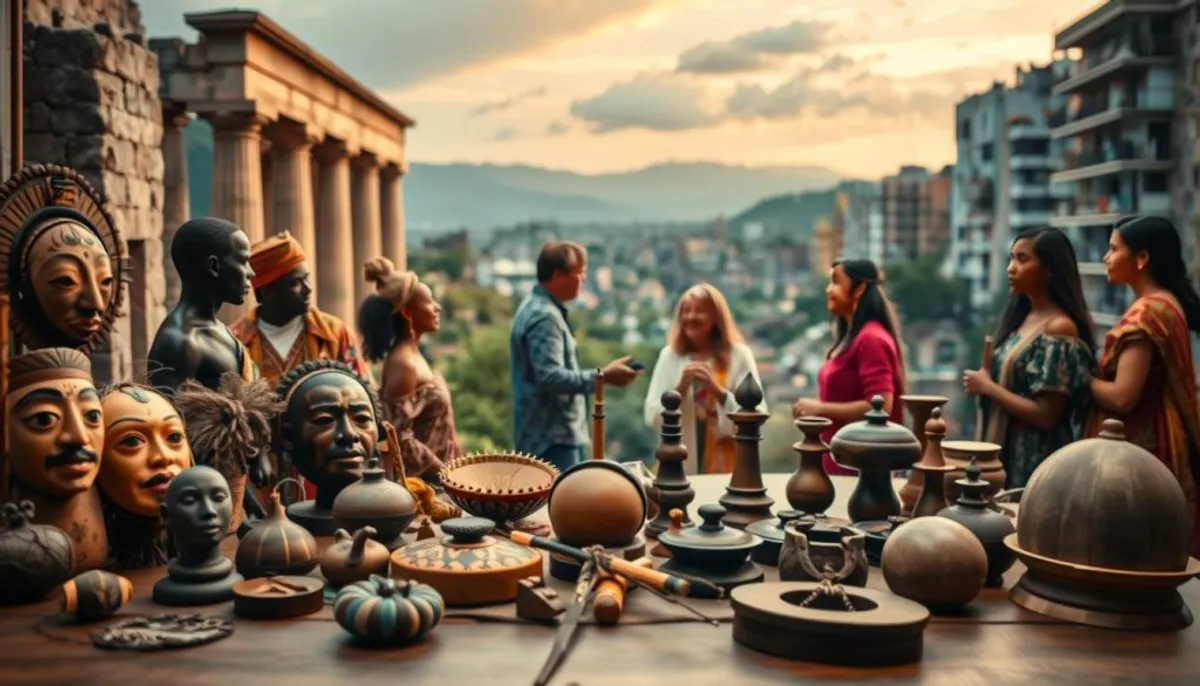
Influence of Globalization on Practices
Globalization exerts a powerful effect on cultural expressions. Migrations and technologies connect societies like never before.
This interconnectivity creates fascinating cross-influences. Younger generations often adopt a hybrid way of living their heritage.
| Factor of Evolution | Impact on Culture | Impact on Traditions |
|---|---|---|
| International Migrations | Enrichment through diversity | Adaptation of rituals |
| Digital Media | Accelerated dissemination | New forms of transmission |
| Commercial Exchanges | Hybridization of practices | Modernization of celebrations |
Adaptations and Changes Over Generations
The passage of time imposes necessary adjustments. Each generation reinterprets the heritage received.
Some traditions disappear when they lose their meaning. Others transform while retaining their fundamental essence.
This dynamic evolution maintains the vitality of our collective heritage. It allows societies to navigate between conservation and innovation.
Culture-Custom versus Culture-Tradition
A fine analysis of the term culture reveals important nuances in its use. This unique word actually covers two distinct meanings depending on social contexts.
Comparison Between Inertia of Customs and Symbolic Choices
Culture-custom operates on the principle of repeated habit. It follows the logic of “we have always done it this way.”
The weight of a custom comes simply from its repetition over time. It does not necessarily carry deep values.
Culture-tradition possesses an additional dimension. It adds a symbolic reason to the habitual practice.
| Aspect | Culture-Custom | Culture-Tradition |
|---|---|---|
| Foundation | Inertia of habits | Symbolic justification |
| Transmission | Automatic | Conscious and reflective |
| Social Value | Neutral | Meaningful |
Historical and Contemporary Examples
A striking historical example concerns Aztec sacrifices. This practice illustrates a custom maintained purely by inertia.
A contemporary example would be the dependence on automobiles in the United States. This habit persists despite its ecological impacts.
These examples highlight the importance of distinguishing practices. Some deserve conservation, others transformation.
The Contribution of Traditions in French Society
The bonds that unite the French find their cement in ancestral practices. These shared rituals constitute a living heritage that shapes our collective identity.
Reinforcement of the Sense of Belonging
Traditions play a fundamental role in social cohesion. They create bridges between generations and different communities.
The French people come together around common celebrations. These shared moments strengthen the sense of belonging to a shared history.
These practices transmit essential values to our society. They provide stable references in a constantly evolving world.
| Type of Tradition | Social Impact | French Example |
|---|---|---|
| Gastronomic | Creation of conviviality | Family meals on Sundays |
| Festive | Identity reinforcement | National holiday on July 14 |
| Artistic | Cultural transmission | Local music festivals |
France thus preserves a unique heritage. These traditions keep alive the values that unite our society.
The Role of Religion in Culture and Traditions
Beyond individual practices, religion shapes the symbolic frameworks that govern community life. It establishes fundamental values that guide behaviors within society.
Religious Rituals and Symbolic Practices
Religious celebrations structure social time. They mark important milestones in human life. These practices create moments of collective sharing.
Beliefs manifest through symbolic gestures. These rituals give meaning to daily events. They connect the material and spiritual dimensions.
Influence of Beliefs on Traditional Rites
Many popular traditions find their origin in religion. Over time, they have adapted to social contexts, including syrian popular festivals. This evolution shows the vitality of spiritual heritages.
Belief systems continue to influence our contemporary culture. Even when secularized, religious values permeate our behaviors. They shape our way of understanding the world.
The Link Between Art and Tradition
Human creations carry the living imprint of received heritages. Art maintains a permanent dialogue with tradition and traditional art, serving as a bridge between generations.
Artistic Expressions Rooted in the Past
Traditional forms of expression are multiple and varied. Folk music, ancestral dances, and craftsmanship are concrete manifestations of this.
These artistic traditions reflect the values and beliefs of communities. They transmit stories and emotions through time.
| Type of Traditional Art | Social Function | Concrete Example |
|---|---|---|
| Folk Music | Oral transmission | Regional work songs |
| Textile Craftsmanship | Technical preservation | Traditional embroidery |
| Ancient Ceramics | Collective memory | Historical utilitarian pottery |
The example of pottery shows how techniques are transmitted. Each generation adds its touch while respecting the foundations.
This constant evolution maintains the vitality of traditions. It allows forms of art to remain relevant today.
Transmission of Knowledge and Practices from Generation to Generation
The passage of knowledge from one era to another forms the living fabric of our collective heritage. This essential process maintains the vitality of our heritage.
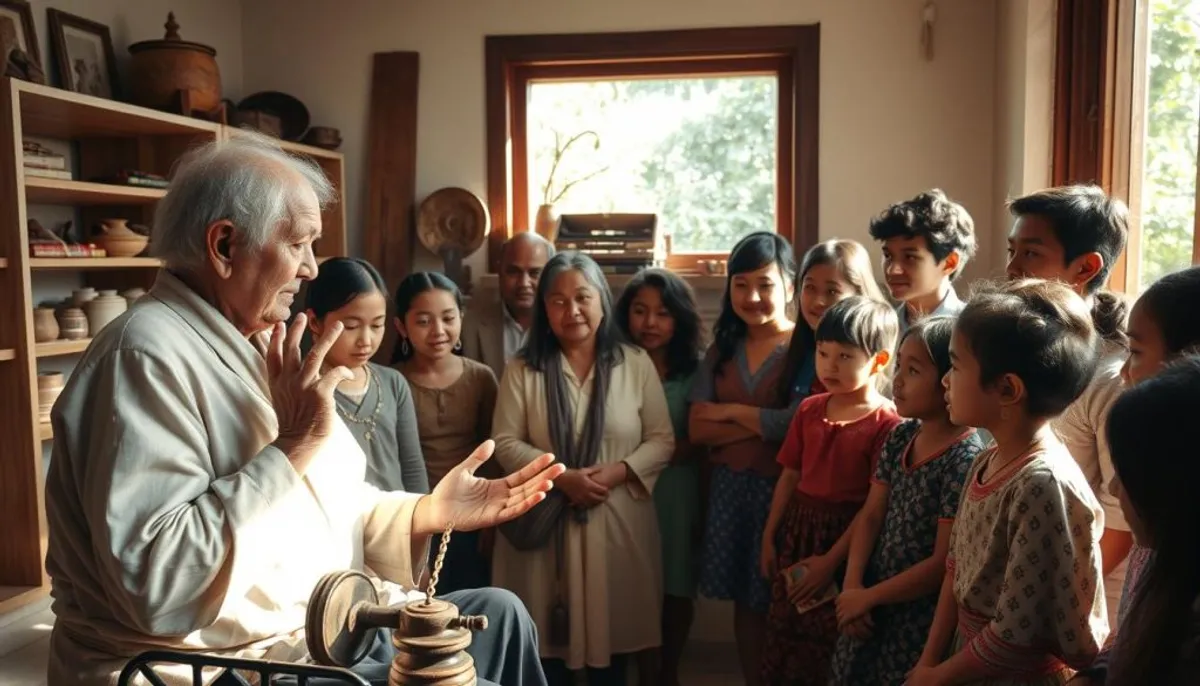
Methods of Conservation and Innovation
Education plays a central role in this transmission. It allows young people to acquire the codes of their community.
Traditional methods include oral transmission and learning by observation. Initiation rituals mark the passage of knowledge.
Each generation adapts the heritage received according to its context. This natural innovation enriches ancestral practices.
| Method of Transmission | Advantages | Concrete Examples |
|---|---|---|
| Oral Transmission | Living preservation | Traditional tales and songs |
| Practical Learning | Direct acquisition | Artisanal techniques |
| Modern Documentation | Sustainable conservation | Digital archives |
Daily social interaction constitutes an essential vector. Family and community exchanges naturally transmit practices.
The contemporary challenge is to find a balance. It is necessary to preserve faithfully while innovating to maintain relevance.
Customs and Their Impact on Daily Life
The way we interact daily obeys invisible but powerful social codes. These customs govern our behaviors without us always being aware of it.
The impact of customs on our lives is considerable. They structure social interactions and define norms of politeness.
Historical Evolution of Customary Behaviors
History shows that customary behaviors change profoundly. Fashion trends and rules of propriety evolve over time.
Societies adapt their customs according to their needs. This flexibility contrasts with the stability of traditions.
The example of marriage illustrates this evolution well. The white dress, once a specific symbol, has become a personal aesthetic choice.
This transformation reflects the changing values of our society. Customs serve as indicators of ongoing cultural mutations.
Representations and Symbols in Culture
Cultural symbols act as invisible bridges between individuals and their collective heritage. They allow for the communication of complex values without the need for lengthy explanations.
These representations, whether visual or conceptual, condense centuries of history and meaning into a single image. They create a common language that unites the members of a group.
Study of Symbols and Their Meaning
The analysis of symbols reveals how ordinary objects acquire a sacred dimension. A simple flag or monument can carry the entire soul of a society.
The label “traditional” transforms mundane practices into powerful identity markers. It gives profound meaning to gestures that seemed trivial.
| Type of Symbol | Social Function | Concrete Example |
|---|---|---|
| National Symbols | Create unity | French flag |
| Traditional Rites | Transmit values | Baptism ceremony |
| Religious Emblems | Express faith | Christian cross |
The meaning attributed to these representations evolves over time. Each generation reinterprets the symbols according to its context.
This flexibility ensures the longevity of culture while maintaining its fundamental essence. The values transmitted thus retain all their significance.
The Role of Media and Modern Influences
Screens have become the new guardians of our collective memory. They shape our vision of the past and influence our relationship with heritages.
Modern media create an open window onto the different cultures of the world. This constant exposure transforms our way of perceiving traditions.
Impact of Media on the Perception of Traditions
The effect of digital platforms is twofold. They can elevate ancestral practices while sometimes simplifying them.
Social networks rapidly disseminate the latest cultural trends. This speed of evolution modifies local traditions.
Television and the internet create an interconnected world. Constant exchanges between societies generate new forms of expression.
This media influence sometimes produces a homogenization of practices. Some international trends tend to replace regional specificities.
The discourse on “cultural identity” reflects these contemporary tensions. It shows the balancing act between preservation and openness to the world.
Practical Cases: Concrete Examples of Traditions and Customs
The observation of social practices throughout history offers us valuable lessons. These concrete examples illuminate how societies manage their heritage.
Case Studies in France and Beyond
France presents a rich mosaic of regional practices. Each community develops its own festivities and know-how.
On a global scale, the diversity of traditions is remarkable. Celebrations vary significantly from one country to another.
| Type of Practice | French Example | International Example |
|---|---|---|
| Traditional Festival | Nice Carnival | Diwali in India |
| Local Craftsmanship | Vallauris pottery | Japanese ceramics |
| Family Rite | Christmas Eve | Chinese tea ceremony |
Cultural Initiatives Valuing Ancestral Heritage
Many projects preserve traditional know-how. These efforts keep ancestral values alive.
Ethnographic museums and festivals play a crucial role. They allow the people to stay connected to their roots.
These initiatives show how modern societies can honor their past. They create a bridge between generations.
Conclusion
These two dimensions of our collective existence offer valuable keys to decipher modern societies. They prove to be complementary in many ways.
Culture represents this dynamic whole that evolves over time. Traditions, on the other hand, preserve a specific heritage. This conscious transmission gives meaning to our practices.
In our interconnected world, this balance can be a source of richness. The fundamental values guide this natural evolution. Each society thus finds its way.
Ultimately, culture and traditions forge our collective identity. They create bridges between generations. Their diversity can be celebrated while preserving their essence.
FAQ
How can we simply distinguish culture from tradition?
Culture represents the entirety of knowledge, values, and ways of life of a group. Tradition refers more to specific practices transmitted through history. An annual celebration like Christmas illustrates a tradition, while the French language is part of culture.
Can traditions evolve over time?
Absolutely! Ancestral practices naturally adapt to contemporary realities. Family celebrations, for example, today integrate new technologies while retaining their deep meaning.
What role does transmission play in preserving these notions?
Intergenerational transmission is fundamental. Elders share their heritage with the young, ensuring the continuity of know-how and beliefs. This transmission occurs through education, imitation, and participation in rituals.
How does globalization influence local customs?
International exchanges create mutual enrichment but can sometimes threaten certain regional specificities. However, many communities succeed in adapting their practices while preserving their essence.
Is there a link between art and traditional practices?
Art often constitutes a living expression of traditions. Folk music, regional dances, or craftsmanship perpetuate ancestral techniques while allowing for contemporary creativity.