
At the heart of West Africa, a fascinating ethnic group has developed a unique heritage, deeply influenced by burmese culture. These inhabitants settled over a vast territory, primarily covering Côte d'Ivoire, but also Liberia and Sierra Leone.
Their social organization, based on a lineage system, structures all community life. Established in forested areas, they have managed to preserve their traditions in the face of external influences.
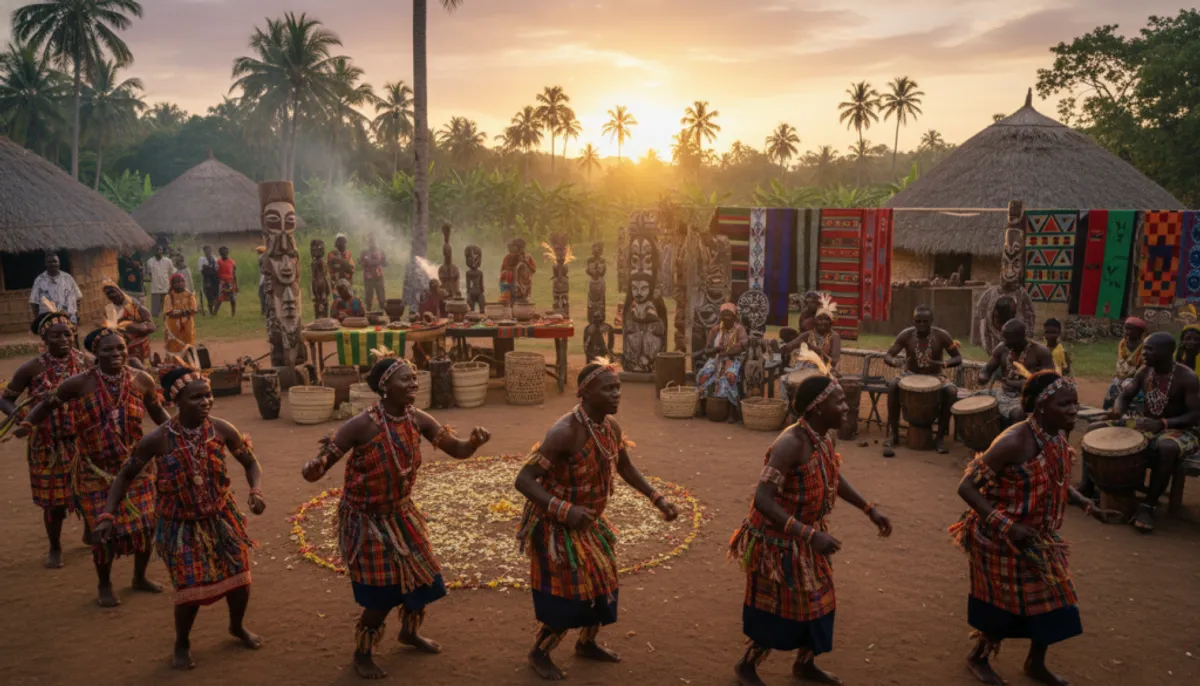
This universe is marked by masks, ritual dances, and vibrant ceremonies. The Cavally River connects these different communities between the mountains and the ocean.
Today, several million people in Côte d'Ivoire and the region continue this remarkable heritage. Let us explore together the foundations of these populations and the richness of the peoples of this land.
Introduction to Krou Culture
About seven centuries ago, migrations gave rise to an ethnic group with deep roots. These populations share a common linguistic background that unites them.
They settled in forested and coastal territories, straddling the current border between Liberia and Côte d'Ivoire. Unlike other communities, they have never formed a unified or federative state.
Their original social organization relies entirely on autonomous clans and a strong community life. This structure has forged a mosaic of communities where common values and local specificities coexist harmoniously.
The geography and history of this region have thus sculpted a heritage that is both ancient and vibrant. Let us discover how this unique Krou culture has flourished.
Historical Context and Origins
Traditional narratives point to desert regions as a distant cradle. The origin of these groups dates back to a major migration that occurred between the 13th and 15th centuries.
This period was marked by conflicts. The small Manding kingdoms practiced slave trading, forcing these communities to flee southward.
Their journey took them through mountainous valleys. They eventually found refuge in the vast forest of present-day Côte d'Ivoire. This choice of settlement was not by chance.
The dense vegetation provided crucial protection against raids. The populations were thus able to develop in safety. Over the centuries, the initial group diversified.
Some clans settled on the coast, while others remained inland. This history explains why their territory extends on both sides of the Cavally River. It transcends the borders of the country, established long after their origin.
Ethnonymy and Linguistic Diversity
The identity of a people is often reflected in the multiplicity of names that designate them. For this group, variants such as Crau, Kroo, Kroumen, or Krus can be noted.
This richness of terms reflects centuries of contact with travelers and colonizers. The term "kroumen" is particularly famous for referring to the sailors of the Gulf of Guinea in the 18th century.
Spelling Variants and Identification
A single border ethnicity may bear a different name depending on whether it lives in Côte d'Ivoire or Liberia. Yet, its members speak the same dialect.
This situation illustrates how external identification has complicated the map of appellations.
Complexity of Niger-Congo Languages
The languages of these populations form a Niger-Congo sub-group. They are renowned for their tonal complexity, one of the highest in Africa.
Each ethnicity, such as the Wés, Bété, or Dida, has its own dialectal variant. Thus, the Wés, Bété, Aïzi, and Dida can be found in Côte d'Ivoire.
This type of linguistic system requires a very fine ear. Despite this diversity, a relative mutual understanding exists, a sign of a common origin.
This unity in diversity still shapes the identity of this cultural country.
Social Organization and Clan Structure
Unlike many societies, this one functions without a state, without administration, and without formal courts. Its organization relies on a network of family ties.
The Lineage Society and Its Mechanisms
This society is of a lineage and patrilineal type. Descent and authority are transmitted through men.
Social units fit together like Russian dolls. One moves from the extended family to the clan, then to the tribe.
The absence of central power is remarkable. Each lineage maintains its autonomy within a segmentary system.
The elder of the lineage holds supreme authority. He arbitrates conflicts and manages communal lands.
Role of Marriage and Kinship
The role of kinship is absolutely central. Blood ties determine the rights and duties of each individual.
Marriage creates alliances between lineages. Polygyny is common and strengthens these networks.
Marriage compensation has a high rate. It is an economic and social pillar.
Women circulate between lineages through marriage. This weaves peaceful interdependence.
A certain number of strict rules govern these exchanges. They maintain balance and prevent conflicts.
| Social Unit | Main Functions | Authority |
|---|---|---|
| Extended Family | Daily production, education of children | Father or elder of the family |
| Clan | Land management, resolution of internal disputes | Elder of the main lineage |
| Tribe | Common defense, external alliances, major rituals | Council of elders of the clans |
This structure ensures cohesion and resilience. It has allowed the society to endure through the centuries.
The Different Branches and Krou Identities
Beyond a unique name, this world encompasses a diversity of ethnicities with well-defined identities. There are about twenty distinct peoples, such as the Wés, Bété, Dida, Godié, Aïzi, and Nyabwa.
They are spread between Liberia and Côte d'Ivoire. Each has its own history while sharing a common linguistic background.
In Côte d'Ivoire, around fifteen different ethnicities are recorded. The Wés, also known as Guéré, occupy the far west.
They are often considered the most intact linguistic heart. The Bété form the largest group.
They live in the central-western part of the country. The Dida, for their part, are located in the eastern foothills.
Their social organization sometimes shows external influences. This variety is a great wealth.
Each group has developed its particularities. Yet, close ties unite them. The lineages within these populations retain a precious memory.
Oral narratives recount their origin and migrations. These stories are passed down from generation to generation.
A strong sense of common belonging transcends local differences. It creates a united cultural family.
Modern national borders have not broken these ties. The lineages and families maintain intense relationships on both sides of the boundary.
This unity in diversity remains a pillar of their shared identity, rooted in a distant origin.
What is Krou Culture
The common traits of this heritage manifest in social organization, agricultural practices, and spiritual beliefs. This nomadic culture forms a coherent whole, perfectly adapted to its environment.It is primarily a forest civilization. The way of life among the Krou is shaped by the vast equatorial forest. Shifting cultivation, with rice as the base, structures the annual cycle.
On a social level, the society operates without a state. Authority rests on the patrilineal lineage and the consensus of the elders. Marital alliances weave a solid network of peace.
Rituals and sacred masks punctuate collective life. They maintain a vital link with the ancestors. A notable fact is the importance of wood carving for these objects.
On the spiritual level, a distant creator god coexists with many nature spirits. The Krou land shows remarkable continuity. This fact ensures the preservation of identity in the face of modernity.
| Cultural Aspect | Main Characteristic | Social Role |
|---|---|---|
| Social Organization | Patrilineal lineage, consensus | Regulation without central power |
| Subsistence | Shifting cultivation, rice, hunting | Adaptation to the forest environment |
| Spirituality | Intermediate spirits, ancestors | Community bond and rituals |
| Artistic Expression | Mask and figurine sculpture | Support for sacred ceremonies |
This culture thus possesses a deep unity. The Krou land is its resilient guardian through the ages.
Traditions and Ancestral Customs
The art of sacred masks transcends mere aesthetics to become a bridge to the invisible. These vibrant traditions structure community life.
Rituals, Dances, and Ceremonies
The ritual dances combine physical prowess and spiritual symbolism. The famous knife dance of the Wés demonstrates extraordinary courage.
These performances take place during initiations, funerals, or harvest festivals. They form total spectacles with music and songs.
The Importance of Masks and Art
The masks serve as intermediaries with the spirits and the ancestors. Their expressive power has fascinated artists like Picasso.
Each type of mask has a specific function. Women play a role in certain ceremonies, but the most sacred masks remain reserved for initiated men.
During funerals, they dance to accompany the ancestors to the beyond.
| Type of Mask | Main Function | Associated Ceremony |
|---|---|---|
| War Mask | Protect the village | Protection ritual |
| Female Mask | Celebrate fertility | Harvest festivals |
| Judicial Mask | Administer justice | Dispute resolution |
| Funeral Mask | Honor the deceased | Ceremony for the ancestors |
These ancestral traditions continue to thrive today. They testify to a rich and resilient heritage.
Artistic Expression and Craftsmanship
The creativity of Krou artisans is expressed with remarkable strength through wood carving. This artistic expression reaches its peak in the forested areas of the north and north-west of the region.
The Sculpture of Masks and Ritual Objects
Wè sculptors are internationally recognized for their exceptional mastery. They create masks with bold shapes and striking expressions.
These works are carved from hard woods like iroko or mahogany. They feature characteristic stylized traits: tubular eyes, toothed mouths, horns, or animal attributes.
Sculpture follows strict rules passed down from master to apprentice. Beyond masks, artisans produce ancestor figurines, ceremonial spoons, and carved seats.
Artisan craft varies greatly by region. It is highly developed in the north, more limited in the east among the Bété and Dida.
On the coast, European imported items have often replaced local production. Wood remains the preferred material, sometimes enhanced with ivory, fibers, or beads.
These creations have essential spiritual and social functions. Today, an artistic revival reinterprets these forms with fidelity to ancestral spirit.
Religious and Spiritual Practices
The forest is not just an environment for these populations; it is the seat of living and acting spiritual forces. Their religions acknowledge a supreme creator god, but he is considered too distant.
This distance has given rise to a large number of intermediaries. The spirits, nature spirits, inhabit trees, rocks, and ponds.
Traditional Beliefs and Secondary Deities
These spirits control vital aspects of life. They decide the fertility of the lands, success in hunting, and the health of people.
Seers occupy a central place. They communicate with these spirits and prescribe the necessary sacrifices to appease them.
When the spirits are satisfied, they protect the community. If they are displeased, they may allow sorcerers to harm people.
A notable fact is the modest place accorded to the ancestors. Unlike other traditions, the ancestors are not the subject of organized worship.
They are respected, but the active forces of the forest capture far more spiritual attention.
| Spiritual Entity | Main Role | Nature of Interaction |
|---|---|---|
| Creator God | Creation of the universe | Distant, no direct intervention |
| Spirits | Control of fertility, hunting, health | Daily intervention through sacrifices and taboos |
| Ancestors | Lineage memory | Respect, but no active organized worship |
Influence on Regional Culture in West Africa
The cultural heritage of the Krou peoples has radiated well beyond their traditional borders. This influence has profoundly marked the entire coastal region of West Africa, showcasing the global impact of american culture.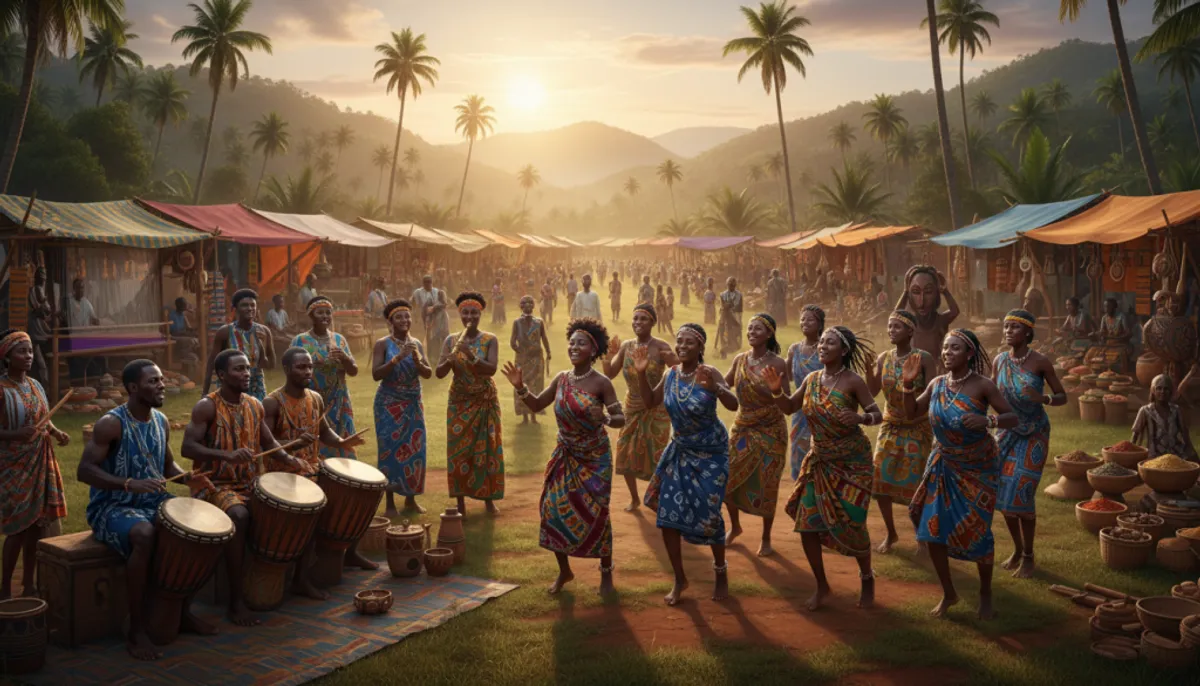
Impacts on Music and Dance
The coastal populations, the Kroumen, have served as cultural intermediaries for centuries. Their unique interface position between the forest and the ocean has created a hybrid culture.
This synthesis has then spread throughout the Gulf of Guinea. The art of masks has inspired neighboring peoples and even Western artists.
Linguistic traces are visible in creoles like "kru english pidgin." Navigation techniques have also spread along the coasts.
Today, this heritage lives on in popular music and festivals throughout the country and region. The history of jazz in france has influenced modern Côte d'Ivoire, drawing much of its vitality from this rich common heritage.Music and Dance: A Vibrant Heritage
On the Ivorian coasts, a unique musical fusion has emerged. It blends ancestral traditions with modern influences.
This sound heritage forms the beating heart of many local cultures.
The Sounds of Bolo and Hybrid Cultures
The coastal populations created the bolo. This unique genre mixes African and Western instruments.
Its catchy rhythms accompany couple dances. They remind one of Caribbean dances.
This cosmopolitan music was born on the shores of the Krou land. It reflects centuries of exchanges.
Evolution in a Modern Context
In the 1990s, Wés and Bété artists exported their sound to Abidjan. They launched zouglou.
This genre has conquered all of Côte d'Ivoire. It draws its sounds from Krou popular music.
Artist Meiway immortalized this spirit in his song "Monogaga." It pays tribute to a mythical beach.
The bolo and zouglou demonstrate remarkable adaptability. They evolve with new generations in Côte d'Ivoire.
Geography and Environment of the Krou Land
Between dense forest and the Atlantic Ocean, the Krou land offers a natural setting of exceptional richness. This territory stretches from the Guinean mountains to the Atlantic coasts.
The Link Between Exceptional Nature and Way of Life
The equatorial forest forms the heart of this space. The Taï National Park, classified by UNESCO, is home to unique biodiversity.
It hosts elephants, leopards, and pygmy hippos. Further north, Mount Peko also presents remarkable fauna.
Iconic Natural Parks and Coastal Areas
The coastal regions extend for hundreds of kilometers. Beaches like those of Grand-Béréby are spectacular.
For the coastal populations, fishing is vital. They catch sharks, jacks, and marlins.
San Pedro is the economic lung of this coast. It is the second economic hub of the country after Abidjan.
Its port energizes the entire region.
| Geographical Zone | Key Resources | Main Activity |
|---|---|---|
| Taï Forest | Biodiversity, wood | Agriculture, hunting |
| Mount Peko | Fauna, flora | Protection, tourism |
| Atlantic Coast | Fish, beaches | Fishing, beach tourism |
| San Pedro | Deep-water port | Trade, industry |
This close connection with the environment explains the inhabitants' attachment to their Krou land.
Recent History: Challenges and Resilience
The episode of Guébié in 1970 profoundly shook the Krou land. The young economist Kragbé Gnangbé, influenced by socialism, attempted an insurrection.
He proclaimed a short-lived "Republic of Eburnie" from the Gagnoa maquis. This revolt was quickly suppressed by government forces.
This event reflects a sense of isolation felt in western Ivory Coast. Local populations felt marginalized after independence.
At the end of the 20th century and the beginning of the following century, a terrible civil war struck Côte d'Ivoire. The region felt the full brunt of it.
This crisis caused massive displacements and disrupted the economy. Traditional social structures were severely shaken.
The resilience of the communities has been remarkable. Their attachment to the territory and clan ties helped them hold on.
Today, political stabilization allows for a return of security. Economic recovery raises hopes for rapid development for this long-neglected country.
Economic Development and Regional Dynamism
San Pedro is the industrial and logistical heart of this part of Côte d'Ivoire. Its deep-water port makes it the second economic hub of the country, ahead of Bouaké.
Many factories transform local resources there. Cocoa is the main cash crop. The wood industry also exploits the valuable species of the forest.
In 2010, the GDP of the region represented 4% of the national GDP. This amounted to $0.952 billion.
Tourism is emerging as a promising sector. The beaches and natural parks offer potential comparable to that of Kenya.
| Economic Sector | Main Activities | Contribution/Notes |
|---|---|---|
| Port and Logistics | Cocoa, wood, container exports | Main driver of regional development |
| Agribusiness | Cocoa processing, milling | Number one cash crop |
| Industry | Cement production, sawmill | Enhancement of local resources |
| Tourism | Beach, ecotourism, cultural | Very important and under-exploited potential |
The government invests in infrastructure to open up the area. This development aims to improve living conditions while protecting the exceptional environment.
Migration and Diaspora Influence
The western Ivory Coast, once isolated, is now a welcoming land for many communities. This territory, which overlaps the regions of Moyen-Cavally and Bas-Sassandra, has seen its demographic composition evolve.
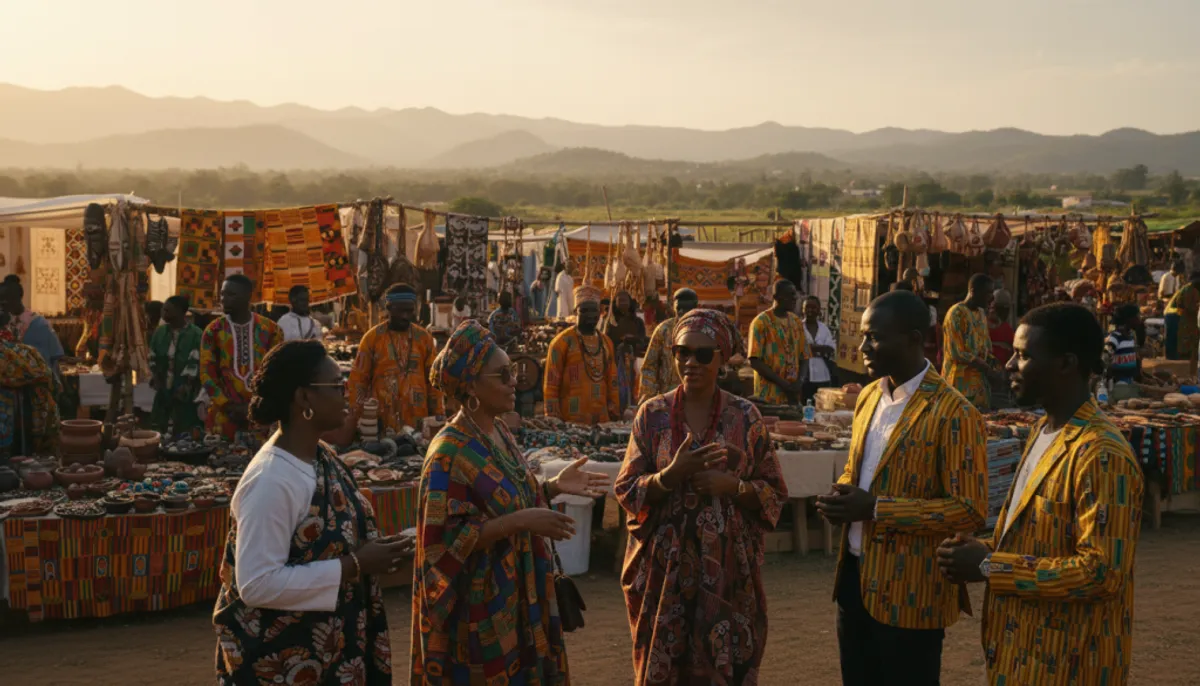
Long protected by the forest, it has opened up to movements of internal and external migration. Several groups have thus settled, enriching local diversity.
These include:
- Baoulé communities from central Côte d'Ivoire for agriculture.
- Burkinabé workers in cocoa and coffee plantations.
- Anglophone refugees fleeing crises in Liberia and Sierra Leone.
- Fanti fishermen from Ghana along the coasts.
In some villages, this mix creates a true cultural melting pot. Linguistic and family exchanges occur.
This dynamic has sometimes raised challenges, such as land tensions. However, society is learning to manage this diversity.
Meanwhile, a Krou diaspora has developed in major cities. These populations maintain strong ties with their western origins.
Challenges and Future Perspectives
The future of the Krou territory rests on a delicate balance between modernization and preservation of ancestral heritage. The challenges to be addressed are both cultural, economic, and social.
Cultural, Economic, and Social Challenges
The protection of sacred masks and ritual knowledge appears as a priority. Cultural erosion threatens these traditions.
Economically, development must reconcile growth and environmental protection. Poaching and intensive agriculture threaten unique natural spaces.
The Krou land has long suffered from its isolation. Its opening up through better roads is crucial for the interior.
Securing the border with Liberia is necessary for the southeast of the country. This would ensure stability and attract investments.
Heritage Preservation Initiatives
Many projects document and teach the functions of masks. They aim to pass this knowledge on to the young through a cultural program for young people.In the Bété land and in the north, artisan craftsmanship is revitalized. Opportunities are created for wood sculptors.
Community tourism appears as a solution. It allows villages to promote their traditions respectfully.
Civil society is organizing to influence decisions. Indeed, it is becoming aware of its strengths.
The fact that masks have early on fascinated the West offers an opportunity. They could become a vector for sustainable tourism development.
| Type of Challenge | Main Challenge | Response Initiative |
|---|---|---|
| Cultural | Erosion of traditions and know-how | Documentation programs and school transmission |
| Economic | Development without destroying nature | Promotion of community and eco-responsible tourism |
| Social | Isolation and lack of opportunities | Improvement of road and educational infrastructures |
| Environmental | Deforestation and poaching | Regulation of wood exploitation and park protection |
Conclusion
The journey through the Krou universe reveals a civilization whose foundations have withstood the test of time. This unique society has been built on the absence of central power, prioritizing the authority of lineages and consensus.
Living traditions, from sacred masks to dances, hold a central place. The role of elders and alliances ensure the cohesion of a significant number of distinct peoples.
The economy today blends ancestral fishing with modern crops. This people finds itself at a turning point, between heritage and development. The challenges are many, but a growing awareness offers hope for a balanced future.
Indeed, this contemporary hungarian culture continues to profoundly enrich regional identity. It is a heritage of admirable richness and resilience.FAQ
Who are the Krou peoples and where do they live?
The Krou form a major ethnic group historically established in the southwest of Côte d'Ivoire and part of Liberia. Their traditional land stretches from the coasts of San Pedro to the interior forests. This region has profoundly shaped their way of life and activities, such as fishing.
What is the traditional social organization?
Their society is structured around lineage. Kinship and marriage play a central role in weaving alliances and defining each person's place. This lineage organization governed land management and village cohesion.
What are the most well-known artistic elements?
Sculptural art, especially ritual wooden masks, is very renowned. These objects, often linked to ancestors and ceremonies, embody a powerful visual expression of beliefs. Their craftsmanship reflects a know-how passed down from generation to generation.
How do their spiritual traditions manifest?
Traditional religious practices honor secondary deities and nature spirits. Rituals, dances, including contemporary dance lyon, and ceremonies are key moments for communicating with the spiritual world, marking life stages, and strengthening community ties.