
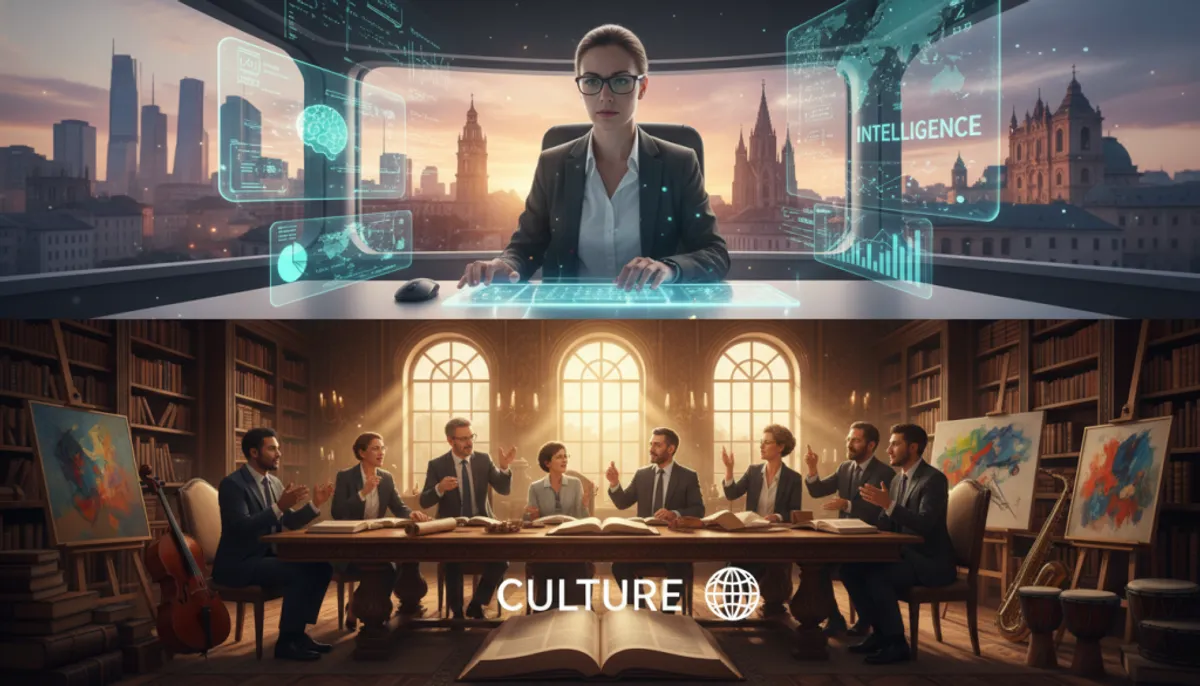
It is very common to mix up two concepts that are actually quite distinct. Many mistakenly believe that extensive book knowledge is the only mark of a brilliant mind. This confusion can create misunderstandings in our way of judging others and ourselves.
Some feel inferior if they are unaware of a historical detail. Others overestimate a person who recites classic works. These judgments are often based on inadequate criteria. It is essential to clarify these notions.
In a world that is changing rapidly, this question takes on particular importance. Understanding the difference helps us navigate the current society more effectively. It allows us to avoid prejudices and to value each person's true skills.
Our goal here is simple: to untangle these ideas clearly and accessibly. We will explore their definitions and their concrete impacts. Let's approach this topic without hesitation, as it concerns everyone.
Introduction: defining culture and intelligence
To untangle these notions, let’s start with their fundamental definitions. These two concepts, although often associated, respond to distinct logics in human development.
What do we mean by culture?
Culture represents the sum of knowledge accumulated by an individual, including kanak traditional art. This intellectual baggage includes literary, artistic, and historical references.
These knowledges are transferable between generations. They can be learned, memorized, and shared. A parrot can repeat a historical date without understanding its significance.
The notion of intelligence and its adaptation
Intelligence is defined as the ability to adapt. This central capacity allows for solving new problems.
A mathematician solves complex equations. A mediator calms conflicts. These actions demonstrate the same ability to adapt to different situations.
According to Pierre Soubiale, a philosophy professor, an intelligent being is characterized by what they do with their knowledge. The adaptation remains when all acquired knowledge is stripped away.
Impact of culture and intelligence on modern society
Our modern societies are the stage for a complex dance between acquired knowledge and the ability to adapt. This interaction, often seen as a fusion of cultures, determines how we interact and progress collectively.
Influence on social behavior and decision-making
The behavior of individuals in society often reflects their intellectual background. Some individuals use their common references to create connections.
Others adopt an elitist attitude that can create barriers. The true value lies in the ability to share with kindness.

Everyday decision-making clearly shows this distinction. When faced with a new problem, some people immediately seek their knowledge.
Others demonstrate remarkable flexibility. They analyze the situation with a critical mind and find innovative solutions.
Adaptation to changes in the current world
Our era is experiencing rapid technological transformations. This constant evolution demands a great capacity for adaptation.
Current environmental and social challenges require more than just simple knowledge. They necessitate practical intelligence to navigate complexity.
| Aspect of modern life | Influence of culture | Role of intelligence |
|---|---|---|
| Professional relationships | Provides common references | Allows adaptation to new colleagues |
| Complex decision-making | Offers historical precedents | Facilitates analysis of unprecedented situations |
| Technological adaptation | Helps understand evolution | Enables quick mastery of new tools |
Thanks to this balanced combination, individuals develop valuable autonomous thinking. They understand the issues of the past while adapting to today's challenges.
This complementarity shapes citizens capable of navigating the current world with discernment and open-mindedness.
In-depth comparison: culture or intelligence in our daily lives
In our daily lives, we constantly encounter people who illustrate this fundamental distinction. Some accumulate knowledge without knowing how to use it. Others solve complex problems with little information.
Key differences and points of convergence
Culture represents the accumulation of knowledge. Intelligence is the ability to use it effectively. A parrot can repeat historical dates without understanding their significance.
There are four types of individuals in society. Intelligent people without culture. Cultured individuals who are not very intelligent. Individuals possessing both qualities. And those who have neither.
Victor Hugo perfectly expressed this nuance: “He was, as we said, an ignorant man, but he was not a fool”. Ignorance does not equate to a lack of intelligence.
Misunderstandings and stereotypes surrounding these notions
Many believe that being cultured automatically guarantees intelligence. This idea is often far from reality. Some use their knowledge to look down on others.
Others develop an inferiority complex. They believe they are not intelligent simply because they are unaware of certain topics. Yet, saying “I don’t know” shows valuable intellectual honesty.
True intelligence lies in how one plays their cards. Not in the number of accumulated knowledge. Like in poker, what matters is how one uses their knowledge.
When these two faculties unite, they form a powerful combination. They allow navigation through the complexity of the modern world with agility and discernment.
Conclusion
The essential thing is not to choose between erudition and adaptation, but to grasp their complementarity. These two distinct things enrich each other in our current world, enhancing your culture.
Intelligence remains this precious capacity for adaptation. Culture represents the acquisition of knowledge. Neither should create a complex.
In every case, the real question is how we use our strengths. Let’s cultivate both with curiosity and humility. This approach helps us navigate our time better.
Ignorance about a subject does not define our overall intelligence. Let’s value shared culture with kindness and practical adaptation to contemporary challenges.
FAQ
Is it more advantageous to be cultured or intelligent?
One doesn’t really go without the other! A person can possess a great mental capacity, but without a background of knowledge, they may lack perspective. Conversely, someone who is very erudite must show sagacity to apply their knowledge meaningfully. These two aspects complement each other for better adaptation to the world.
How does modern society influence our way of thinking?
Our current environment, with its constant flow of information, greatly challenges our ability to sort and analyze. It values both mental agility and open-mindedness. This pushes individuals to develop a form of acuity that blends reasoning and sensitivity to different realities.
Can we really measure an individual's potential?
Traditional tests often assess a certain form of logic. However, true potential encompasses much more: creativity, empathy, resilience. These qualities, essential for navigating life, show that a person's value exceeds any simple definition or rating.
Is there a link between erudition and the ability to adapt?
Absolutely. Having references and knowledge allows for a better understanding of new situations. This understanding, coupled with a certain mental flexibility, is key to adjusting behavior and decisions in the face of the changing challenges of our time.