
Welcome to this fascinating exploration of a unique heritage. Mauritania stands out for its exceptional geographical position, at the crossroads of North and Sub-Saharan Africa.
This Sahelian territory has about 4 million inhabitants. Their cultural heritage represents a remarkable blend of Arab-Berber influence and black African traditions.
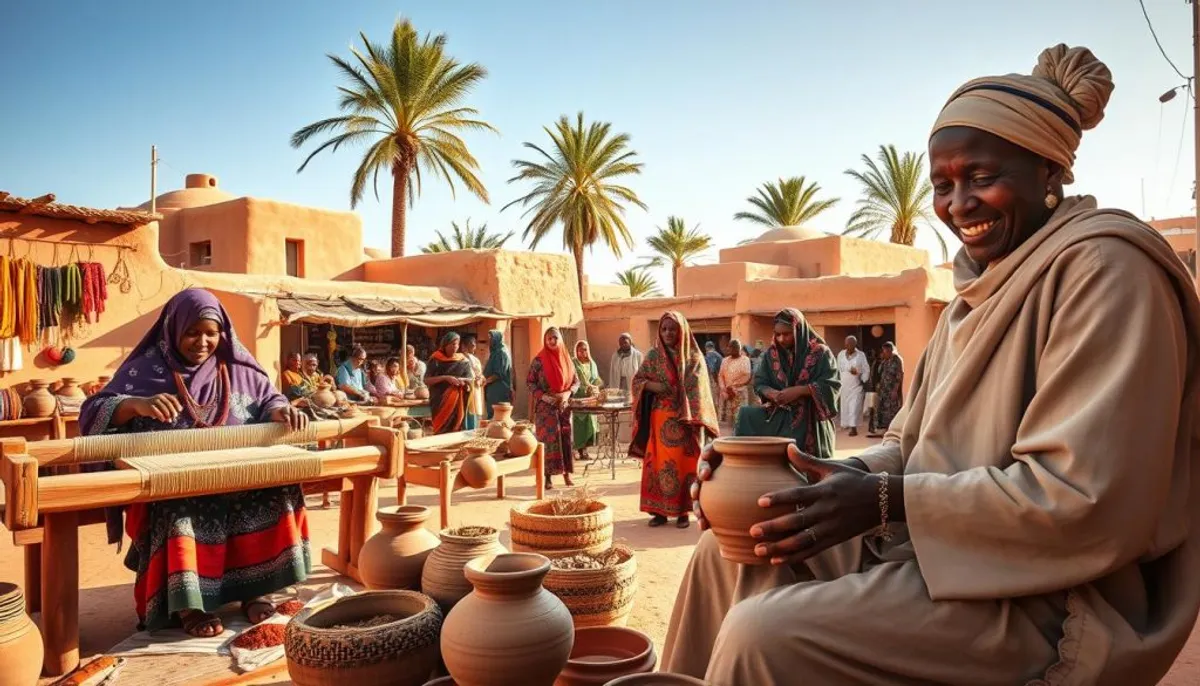
For centuries, this land has served as a crossroads of civilizations. Great empires such as those of Mali, Ghana, and Morocco have left their mark here.
This rich history has created a unique ethnic and cultural mix. Together, we will discover how these influences manifest in the daily lives of Mauritanians.
Key Points to Remember
- Mauritania is a country located at the border between North and Sub-Saharan Africa
- Its cultural heritage combines Moorish traditions and black African influences
- The territory has long been a crossroads for exchanges between different civilizations
- The great West African empires have marked its cultural development
- This diversity creates a rich and complex national identity
- The preservation of this heritage is essential for future generations
General Introduction
The demographics of this country in West Africa reveal a particular geographical distribution of its inhabitants. According to 2016 data, the population is about 4.3 million people.
A striking characteristic concerns the distribution of inhabitants. Nearly 85% of them live in the southern part, which accounts for only one-fifth of the territory.
This country presents two main demographic facets. In the north and desert areas, Arab communities dominate. The south is home to African-Mauritanian groups.
Sunnite Islam unites almost the entire population, with 99% being Muslims. This faith profoundly influences daily traditions.
The Saharan climate has shaped lifestyles. Different communities have developed practices adapted to their environment.
This ethnic diversity creates a rich heritage. Moors, Haratins, Peuls, and other groups coexist harmoniously.
Let us discover together how these demographic elements influence local customs. Each community contributes its unique input to the national identity.
Historical Overview of Mauritania
The historical journey of this West African region reveals a rich multicultural heritage, including significant aspects of swiss history. This land has witnessed numerous civilizations over time.
From Prehistoric Origins to Ancient Empires
Since the Paleolithic era, the Sahara has been inhabited by humans. Thousands of years later, during the Neolithic, various populations settled there.
The Berber tribes from the north coexisted with Negroid groups. In the 11th century, the Almoravid Empire unified a vast territory.
This power extended from southern Morocco to Senegal. The Bani Hassan arrived in the 14th century, leaving a deep mark on the country.
The Colonial Influence and the Paths to Independence
In 1904, France established a protectorate under Xavier Coppolani. The country officially became a colony sixteen years later.
After years of French domination, independence was achieved in 1960. The Islamic Republic of Mauritania was then born.
These different periods have shaped the current identity, including the history of slovakia. Berber, Arab, and colonial influences blend harmoniously.
The Characteristics of Contemporary Mauritanian Culture
Current customs testify to a remarkable adaptation to modern developments. This transformation is particularly observed in the organization of society and living arrangements.
Over time, ancestral practices have changed significantly. In the past, Arab communities primarily practiced nomadism while African groups were sedentary.
The Historical Legacy in Current Lifestyles
Today, these distinctions are gradually fading. Residential areas and professional activities blend harmoniously.
Nomadism now concerns only 5% of the inhabitants. This evolution marks a significant turning point in the country's history.
Despite these changes, community traditions remain vibrant. They still structure daily life and social relationships.
Visitors marvel at the legendary hospitality of this people. This way of welcoming strangers endures across generations.
The nomadic heritage still influences the fundamental values of generosity and sharing.
These contemporary adaptations allow for the preservation of identity while integrating modernity. A subtle balance between tradition and innovation characterizes this unique society.
Ethnic and Linguistic Diversity
The ethnic and linguistic mosaic of the country reveals an exceptional cultural richness. Several distinct groups coexist harmoniously, each bringing its unique traditions, including the local flavors belfort that enhance the culinary diversity of the region.
This diversity is particularly manifested in the languages spoken by the population. Hassaniya, an Arabic dialect, serves as a common link between the different communities.
The Moors, Haratins, and Their Traditions
The Moors represent the main ethnic group. They consist of white Moors (beidanes) and Haratins (black Moors).
All share the same language of Hassaniya despite their different origins. This linguistic unity facilitates exchanges between these groups.
Peuls, Soninkés, Wolofs, and Other Communities
The Peuls constitute the second most important group. Their language of Pulaar is the second language of communication in the cities.
The Soninkés and Wolofs complete this rich diversity. The Wolofs represent about 9% of the inhabitants and primarily live in the south of the country.
| Ethnic Group | Main Language | Main Region | Characteristics |
|---|---|---|---|
| Moors | Hassaniya | Nationwide | Majority group, divided into beidanes and haratins |
| Peuls | Pulaar | South and urban centers | Second most important group |
| Soninkés | Soninké | Senegal River region | Community with ancestral traditions |
| Wolofs | Wolof | South of the country | About 9% of the population |
| Bambaras | Bambara | South | Minority community |
French complements this linguistic landscape as an administrative and educational language. This diversity represents an essential part of the national heritage.
Ancestral Traditions and Customs
The rhythm of daily life is marked by immutable rituals passed down from generation to generation. These practices occupy a central place in social interactions.
Traditional Rituals and Ceremonies
Important moments in life are celebrated according to well-established codes. Births, weddings, and other community events follow ancestral protocols.
These ceremonies strengthen bonds between people and preserve the collective heritage. Every gesture carries profound meaning in tradition.
The Warm Welcome and the Tea Ceremony
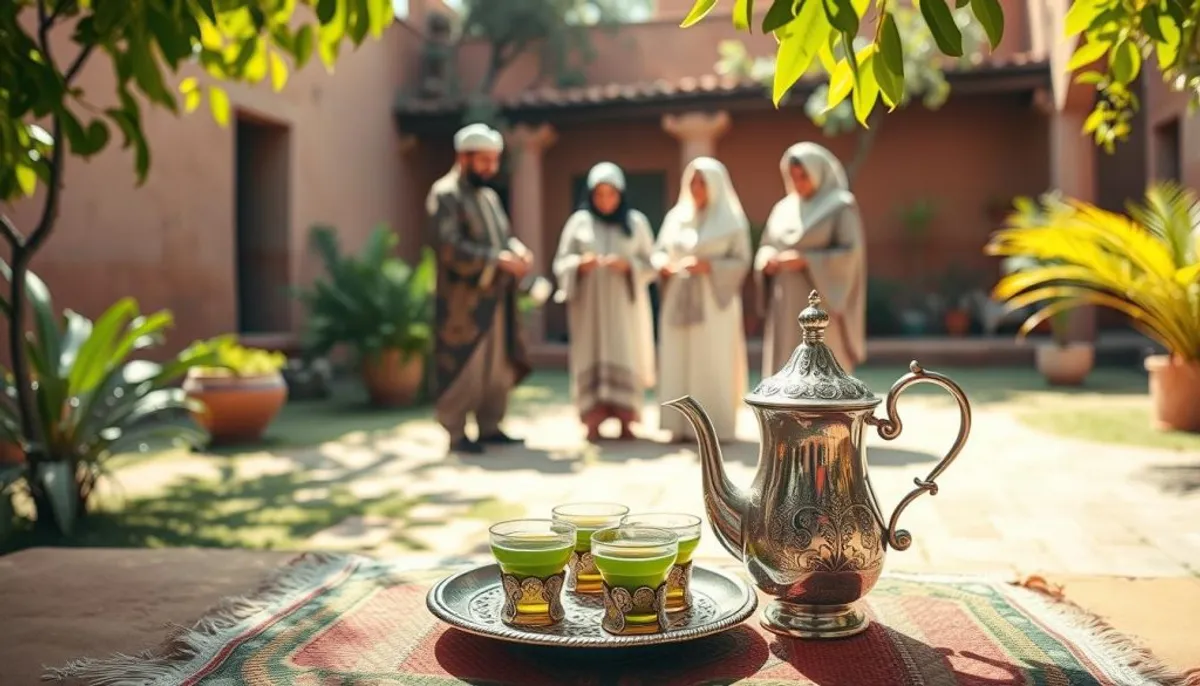
Hospitality is emblematic in the tea ritual. This practice is repeated several times a day on various occasions.
The ceremony includes three successive servings. The first tea is the strongest, the second is sweeter, and the third is the lightest.
Accepting the first glass commits one to taking the following ones. This politeness rule structures the time of the meeting.
Even before the tea, visitors are often offered whipped fresh milk (Zrig). This offering symbolizes the first sign of welcome.
These traditions continue to transmit fundamental values to new generations.
The Influence of Islam on Society
In this West African nation, the Islamic religion deeply permeates every aspect of collective life. The Islamic Republic of Mauritania bases its national identity on the principles of Mauritanian Islam.
Religious Practices and Daily Rituals
The five daily prayers structure each day for believers. This spiritual discipline organizes time and strengthens community cohesion.
Ramadan represents a month of fasting and purification. This period intensifies religious practice and social ties.
| Religious Practice | Frequency | Social Impact | Significance |
|---|---|---|---|
| Daily Prayers | 5 times a day | Collective rhythm | Spiritual connection |
| Ramadan Fasting | Annual month | Community solidarity | Personal purification |
| Aïd el-Fitr | Annual celebration | Family celebration | End of fasting |
| Aïd el-Adha | Annual celebration | Community sharing | Sacrifice and generosity |
The Impact of Sharia on Local Culture
The Islamic law directly influences the legal system of the Islamic Republic. This law also guides behaviors in society.
Mauritanian Islam manifests in family values and traditions. The Islamic Republic of Mauritania integrates these principles into its state functioning.
This religion unites the population around common values. The Quranic law remains an essential reference for the Islamic Republic.
Architectural Heritage and Historical Sites
Four ancestral cities emerge from the sand like jewels preserved by time. Chinguetti, Ouadane, Tichitt, and Oualata shine today in the world thanks to their UNESCO classification.
The Iconic Cities: Chinguetti, Ouadane, Tichitt, and Oualata
Chinguetti holds a unique spiritual place. Considered the seventh holy city of Islam, it attracted scholars and pilgrims for years.
The desert universities preserve invaluable intellectual treasures. Their libraries house thousands of ancient manuscripts, witnesses to a rich scholarly tradition.
| City | Foundation | Specialty | UNESCO Status |
|---|---|---|---|
| Chinguetti | 13th century | Spiritual center and libraries | World Heritage since 1996 |
| Ouadane | 12th century | Trans-Saharan trade crossroads | World Heritage since 1996 |
| Tichitt | 12th century | Dry stone architecture | World Heritage since 1996 |
| Oualata | 12th century | Wall decorations and calligraphy | World Heritage since 1996 |
These cities embody the living memory of an exceptional desert civilization.
The architecture adapted to the desert climate shows remarkable ingenuity. These sites today attract visitors eager to discover this unique heritage of the country.
Mauritanian Art and Craftsmanship
The artistic creativity in Mauritania reflects a unique synthesis of cultural influences, including moroccan music and dance. This country has a dynamic artistic scene where tradition and modernity coexist.
Visual Arts, from Sculpture to Painting
Several contemporary artists contribute to the radiance of this culture. Ould Meyne, Béchir Malum, and Oumar Ball represent the new generation, showcasing the richness of comorian culture.
Amy Sow and Zeinebou Mint Chiaa bring a remarkable feminine perspective. Their work explores identity and heritage themes.
Traditional Music and Local Instruments
Mauritanian or Hassani music fuses Arab and Sub-Saharan sounds. It often evokes the exploits of historical warrior princes.
Traditional instruments include the Tidinit, the Ardîn, and the Tbol. Modern instruments like the Kora and the Djembé today enrich this heritage.
Artists like Maalouma Mint Mokhtar and Dimi Mint Abba carry this musical tradition. Their songs transcend languages and community borders.
Musical diversity is also expressed through Peul and Soninke communities. Saidou Guédda and Touré Kunda illustrate this richness.
Craftsmanship is passed down through the different languages spoken in the country. This ancestral know-how unites generations.
Cuisine and Cultural Influences
Mauritanian gastronomy reveals a symphony of flavors where nomadic traditions meet African influences. This culinary diversity occupies a central place in social and family life.
Traditional Dishes and Regional Specialties
The thieboudienne, the national dish, combines fish, rice, and vegetables in perfect harmony. It illustrates Senegalese influence, particularly present in the south of the country.
Couscous (Kuskus) and Al-keçra (flatbread) recall the nomadic heritage. Al mechwi, meat cooked in the sand, testifies to adaptation to the desert environment.
In the Senegal River valley, the cuisine is very rich. Lathiri, fine couscous served with fresh or curdled milk, and Fondé, porridge made with milk, are integral parts of local traditions.
The Central Place of Tea and Its Traditions
Known as "Mauritanian whisky," tea marks each day and accompanies all moments of conviviality. Its preparation follows an immutable ceremonial passed down from generation to generation.
Cattle and dates form the basis of the food economy. Milk is consumed in various forms, fresh, curdled, or processed, depending on the regions and occasions.
Literature and Cinema in Mauritania
Artistic creation through writing and cinema reveals the multiple facets of this country. These forms of expression use different languages to share universal stories.
Influential Writers and Poets
Batta Mint El Bara represents a pioneer in women's poetry. Her work paves the way for other female voices.
Ousmane Moussa Diagana marked the 1980s and 1990s with his plays. His works explore local traditions and history.
The Rise of Cinema and Notable Directors
Med Hondo began in the 1970s with engaged films. Soleil Ô and Bicots-Nègres address important social themes.
Abderrahmane Sissako has gained remarkable international recognition. His film Timbuktu traveled the world in 2014.
| Artist | Field | Major Work | Period |
|---|---|---|---|
| Batta Mint El Bara | Poetry | Women's Poetry | 1990s |
| Ousmane Moussa Diagana | Theater | The Legend of Wagadu | 1988 |
| Med Hondo | Film | Sarraounia | 1987 |
| Abderrahmane Sissako | Film | Timbuktu | 2014 |
Mauritanian cinema carries a unique voice that resonates far beyond national borders.
These creators use various languages to enrich the narrative culture. Their contributions transcend the borders of the country.
Education and Media
The evolution of the educational and media system reflects profound social transformations. These two areas play a crucial role in preserving national heritage, including the cultural heritage nevers.
The Educational System and the Promotion of Culture
The ARPRIM organization, created in 1974, marked a decisive turning point. This association fought against illiteracy among children.
In 1979, 19 years after independence, a significant reform was adopted. The National Institute of Languages allowed for the teaching of Pulaar, Sooninke, and Wolof.
This innovation facilitated access to education throughout the country. Children can now learn in their mother tongue.
The Press, Digital Media, and Freedom of Expression
In 2016, the global ranking on freedom of the press placed this country at 66th. This position illustrates a contrasting but encouraging situation.
However, some recent measures worry journalists. The cybercrime law passed in 2014 poses challenges for freedom of expression.
Digital media are evolving to better serve linguistic diversity. They contribute to promoting the different languages spoken in the country.
Traditional Sports and Recreation
Traditional recreational activities offer a fascinating window into human adaptation to Saharan conditions. These recreational practices arise directly from the necessities of life in the desert.
Traditional Games and Recreational Activities
The Dhamet represents an emblematic strategy game. This intellectual entertainment developed the skills necessary for survival in arid environments.
Equestrian and camel activities combined practical utility with sporting pleasure. Mastering these animals was essential for transport and trade.
These pastimes strengthened community bonds while transmitting ancestral knowledge. They held an important place in the social organization of the country.
Over time, modern sports have emerged while retaining certain traditions. This evolution shows a harmonious integration between old and new.
These games testify to remarkable creativity in transforming the challenges of the desert into sources of entertainment. They remain a living heritage today.
Usage and Behavior Tips for Visitors
To ensure your trip is an enriching experience, here are some practical tips on local customs. These recommendations will help you interact harmoniously with the people you meet.
Dress Code and Respect for Local Traditions
The dress code requires particular attention. In urban areas, women and men should cover their shoulders and avoid shorts.
Bermudas are tolerated in the desert but not in town. This way of dressing shows respect for religious sensitivities.
Social Practices to Adopt for a Successful Stay
Greetings follow precise rules. In some cases, a man and a woman do not shake hands.
During meals, use only your right hand. The left is considered impure according to tradition.
Before sitting on a couch, remove your shoes. This simple gesture demonstrates great respect.
Avoid consuming alcohol in public. Adopt discreet behavior near places of worship.
These customs are not constraints but opportunities for cultural immersion. They will allow you to create authentic connections with the population.
The Impact of Nomadism on Culture and Economy
For millennia, the nomadic lifestyle has defined the social and economic organization of this Saharan land. This tradition has profoundly marked daily values and practices, including the historical context of slavery in africa.
The Legacies of Nomadic Lifestyles
Historically, a large part of the population practiced nomadism. This adaptation allowed survival in the harsh conditions of the desert.
The domestication of the dromedary as early as the 2nd or 3rd century was decisive. This animal revolutionized work and movement in the Saharan desert.
Nomadism has been gradually declining since the 1960s. Today, only 5 to 8% of the inhabitants maintain this lifestyle.
Despite this evolution, the nomadic heritage still influences traditional economy. Livestock and date palms remain important pillars.
The values of hospitality and solidarity reflect this heritage. These principles structure social relationships throughout the country.
Collective work and mutual assistance remain essential in communities. This part of national identity endures despite changes.
Adaptation to the desert environment has forged remarkable resilience. This quality continues to enrich contemporary life and the local economy.
Societal Analysis and Contemporary Challenges
The current social realities of the country present a delicate balance between heritage and modernity. Mauritanian society retains a traditional organization while adapting to contemporary issues.
Demographic Evolutions and Social Organization
The distribution of the population shows significant geographical imbalances. About 85% of people live in the south, which covers only one-fifth of the territory.
This concentration creates challenges in accessing public services. Children and women in rural northern areas have fewer opportunities.
Identity and Intercultural Challenges
The linguistic law of 1966 marked an important turning point. It imposed Arabic as the mandatory language in education.
This measure created tensions between Arabic-speaking and French-speaking communities. Ethnic groups today seek a fair place in the nation.
Freedom of expression is gradually evolving. Mauritanians are working to build inclusive citizenship throughout the country.
Conclusion
At the crossroads of North and Sub-Saharan Africa, this country cultivates a unique identity. Its heritage results from centuries of exchanges between peoples of the north and south.
The Islamic Republic of Mauritania has preserved its traditions despite the transformations of modern life. The multiple languages spoken testify to this cultural richness.
The social system remains marked by traditions and Islamic law. Mauritanians perpetuate their heritage around the world.
The legendary hospitality and sharing are worth more than money. These values transcend divisions between communities.
The desert has forged a unique character. It inspires traditions that enrich contemporary life.
We encourage visitors to discover this fascinating country. Respect the customs and open yourself to authentic encounters.
FAQ
What is the composition of the population in the Islamic Republic of Mauritania?
The Mauritanian society is composed of several ethnic groups, primarily the Moors (of Arab and Berber descent) and the Haratins, as well as communities like the Peuls, Soninkés, and Wolofs in the south of the country. This diversity is also reflected in the traditional guinean culture that intertwines with local practices and identities.
How is daily life influenced by the desert?
The desert shapes life in many ways, notably through pastoral nomadism, the importance of hospitality, and traditions like the tea ceremony, which rhythm the time and social relationships.
What is the role of religion in Mauritanian society?
Islam is central to the lives of the inhabitants. It influences law, customs, the organization of society, and the rhythm of days, with religious practices observed by the vast majority of the population.
What are the main languages spoken in this West African country?
Hassaniya Arabic is the most widely spoken language, followed by French, used in administration and education. The languages of various communities, such as Pulaar, Soninké, or Wolof, are also spoken.
What is the place of women in life and work today?
Women play an essential role in the economy, particularly in rural areas, and their position is evolving in cities with increased access to education and certain services, although challenges remain.
How does the heritage of tribes and ancient empires manifest today?
It is found in social organization, solidarity ties, the arts, craftsmanship, and the rich oral tradition, which continues to transmit values and stories through the years.