
In today's economic landscape, differentiation is crucial. The work environment is becoming a powerful strategic lever to ensure the sustainability of an organization.

This fundamental pillar goes well beyond simple administrative processes. It represents an invisible foundation that influences behaviors and decisions on a daily basis.
A strong and coherent approach allows organizations to attract and retain the best talents. It creates an environment conducive to the professional and personal growth of each employee.
We will explore how the dimensions of this approach directly contribute to overall performance. The link between shared values, the heritage of ancient Rome, competitive advantage, and sustainable success will be established.
The most successful organizations make it a true engine of innovation and agility. This article will rely on concrete examples to illustrate its impact on growth.
Key Points to Remember
- The work environment is a major strategic lever for differentiation.
- It profoundly influences daily behaviors and decisions.
- A solid approach is essential to attract and retain talent.
- It creates a favorable framework for employee development.
- It is directly linked to the performance and competitive advantage of the organization.
- High-performing companies use it as a driver of innovation and growth.
Origins and Issues of HR Culture in Companies
At the heart of every successful company lies a well-defined human management. This strategic approach goes beyond simple administrative processes to touch the very essence of organizational functioning.
Defining HR Culture and Distinguishing It from Corporate Culture
The corporate culture primarily emanates from the founders and leaders. It establishes the common values and behaviors that guide the entire organization.
The culture of human resources represents a specific component of this whole. It focuses on the concrete application of principles through daily HR policies.
The Impact on Employee Experience and Team Cohesion
This approach directly influences the experiences of the organization's members. It manifests through key stages such as integration, training, and internal mobility.
A clear definition fosters team cohesion by creating a common framework. Shared values enhance relationships among colleagues and the overall atmosphere.
Alignment around the same principles facilitates the management of collective projects. This harmony significantly contributes to the engagement and performance of all employees.
The Pillars of a Successful HR Strategy
Organizations that excel in talent management share common principles. Four key elements form the foundation of a successful human approach.
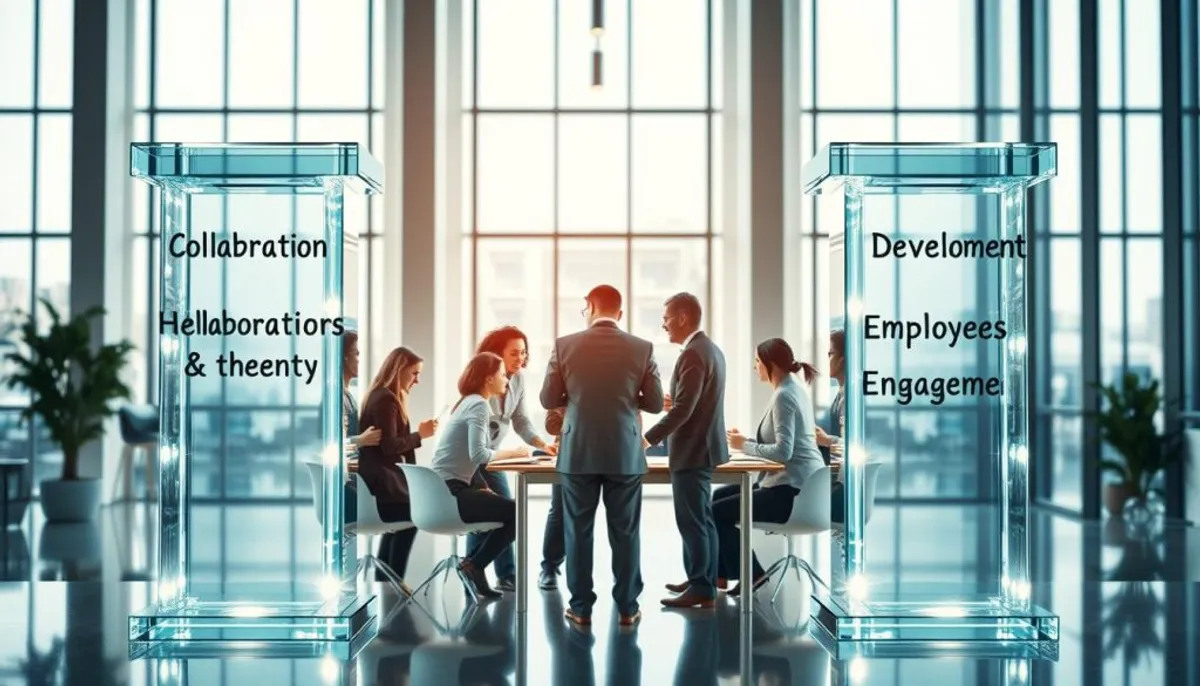
Transparency, Autonomy, and Continuous Learning
Transparency in communications creates an essential climate of trust. Employees better understand decisions and feel valued.
Autonomy empowers teams while stimulating their creativity. Continuous learning allows skills to evolve with the objectives of the company.
These pillars function as an interdependent ecosystem. The weakness of one element affects the entire professional experience.
Performance Indicators and Measuring Results
Measuring the effectiveness of human practices is crucial for any company. Without reliable data, it is impossible to evaluate concrete results.
Key indicators must be monitored regularly. They help to capture the real situation and identify gaps.
| Indicator | Measurement Objective | Recommended Frequency |
|---|---|---|
| Engagement Rate | Assess team motivation | Quarterly |
| Perceived Transparency Level | Measure the quality of communications | Biannual |
| Skills Progression | Track professional development | Annual |
| Alignment with Objectives | Check strategic coherence | Quarterly |
Digital tools provide precise visibility into team dynamics. They transform culture into a tangible and manageable element through data.
This approach measures real performance and guides necessary improvements. It ensures alignment between vision and on-the-ground reality.
The Role of HR Culture in Company Performance
The contribution of human resources far exceeds their traditional image. This department plays a crucial strategic role in the development of modern companies, while integrating the Lyonnaise culture that enriches diversity and innovation within teams.
Differentiating HR Contribution to Overall Development
HR professionals are strategists who mobilize human capital. They create favorable conditions for growth and innovation.
Their impact is measured across several key dimensions. The dissemination of good managerial practices is an integral part.
| Strategic Aspect | Specific Contribution | Observable Result |
|---|---|---|
| Talent Mobilization | Optimization of human potential | Increased innovation |
| Skills Development | Tailored continuous training | Improved productivity |
| Change Management | Supporting transitions | Facilitated adaptation |
Enhancing Employee Experience and Engagement
The employee experience directly influences organizational performance. Highly engaged employees generate exceptional results.
According to Gallup, their performance exceeds that of less involved peers by 147%. This engagement transforms human energy into a sustainable competitive advantage.
Investing in professional well-being produces measurable returns. Talent retention and innovation are strengthened.
Processes and Tools for Optimized HR Management
To transform an HR vision into operational reality, concrete processes are needed. These structured methods allow values to be embodied in the daily lives of teams.
Alignment between strategy and implementation is essential. It ensures coherence at every stage of the employee journey.
Recruitment, Training, and Internal Mobility
Recruitment is the first cornerstone. It must identify talents that naturally share the company's DNA.
Continuous training develops the necessary skills for evolution. It adapts to individual and collective needs.
Internal mobility offers coherent evolution perspectives. It values existing potential while retaining talent.
These three processes must be regularly revised. Their optimization ensures smooth and aligned management.
Digitalization and HRIS Tools for Performance
Digital tools modernize the management of human resources. Cloud HRIS suites centralize all information.
They automate repetitive administrative tasks. This efficiency frees up time for higher value-added activities.
Analysis platforms process data in real-time. They provide precise visibility into available skills and future needs.
To establish a true culture of feedback, these tools facilitate transparent communication. They transform information into a sustainable competitive advantage.
Communication, Feedback, and Employee Engagement
Internal communication and feedback mechanisms are powerful levers to enhance team engagement. These tools transform values into concrete actions in daily life.
360° Feedback Mechanisms and Evaluation Interviews
Well-structured evaluation interviews create a calm framework for employees. They strengthen ties with managers and prepare for future challenges.
A study by Elevo reveals that 86% of employees find the annual interview unhelpful. This highlights the importance of organizing them in a qualitative manner.
360° feedback offers a comprehensive view of performance. It includes soft skills and the quality of interactions.
At Proprioo, this process conducted every 6 months achieves 100% participation. It improves managerial practices and well-being while facilitating access to cultural jobs in Paris.
| Type of Interview | Ideal Frequency | Main Impact |
|---|---|---|
| Annual Evaluation | Once a year | Objective Alignment |
| 360° Feedback | Twice a year | Multi-Angle Vision |
| Professional Interview | As needed | Career Evolution |
Internal Communication Strategies and Recognition
Regular communication maintains engagement among employees. Newsletters and team meetings disseminate the values of the company.
Recognition actions acknowledge good behaviors. They unite teams around a common vision.
These strategies must be tailored to each context. Their regularity ensures a sustainable implementation of organizational culture, while considering aspects of leadership and culture.
Current Trends and Future Perspectives of HR Culture
Digital transformations and new team aspirations are profoundly changing managerial approaches. Organizations must quickly adapt to these changes to remain competitive.
The evolution of employee expectations and technological advancements create a constantly changing environment. This dynamic directly influences the way companies conceive the professional experience.
“Skills-First” Management and Personalization of Employee Journeys
“Skills-first” management represents an innovative approach centered on actual skills. Recruitment and promotion decisions are now based on concrete talents rather than degrees.
This vision allows for better valuation of available human resources. Career paths become more personalized and tailored to individual aspirations.

Skills management platforms facilitate this personalization in real time. They identify hidden talents and offer tailored training.
The Impact of Technologies and HR Data Analysis
Analytical technologies transform human management into predictive science. The collected data provide precise visibility into team dynamics.
These tools allow for anticipating future skills needs and adjusting strategies. The organization becomes more agile in the face of market changes.
Data-driven initiatives create a more efficient work environment. Positive behaviors are reinforced through this factual approach.
This evolution positions leaders as true architects of talent. They now drive human strategy with unprecedented precision.
Conclusion
Organizations that succeed sustainably place humans at the heart of their development. This strategic approach goes beyond simple processes to become a true lever of performance and innovation.
The alignment between the company's vision and daily practices creates an environment conducive to engagement. Employees thus find meaning in their work and actively contribute to common goals.
This final step underscores the importance of measuring results to adjust actions. Proactive management of human resources ensures the collective and sustainable success of the organization.
FAQ
How to Distinguish HR Culture from Corporate Culture?
Corporate culture represents the set of values and behaviors that define the identity of the organization. HR culture, on the other hand, focuses on the concrete practices and processes that human resources implement to manage employees. It is how the overall vision is applied daily, particularly through recruitment, training, or talent management.
What Are the Key Indicators to Measure the Impact of an HR Strategy?
Several points are essential for evaluating performance. One can look at the employee engagement rate, retention rate, or satisfaction measured through interviews and surveys. Internal mobility and skills development are also very good tools to see if the actions taken are bearing fruit.
How Does Digitalization Improve Human Resource Management?
Modern HRIS tools help automate repetitive tasks, freeing up time for more strategic initiatives. They also allow for better analysis of data on employees, providing a clearer vision for making informed decisions and personalizing the work experience.
How to Implement an Effective Feedback System?
Transparency is key! It involves establishing a culture of constructive and regular feedback, not just during annual reviews. 360° feedback mechanisms, where everyone can express themselves, and informal exchange moments foster continuous dialogue and improve team cohesion.
What Is the Next Major Trend in Talent Management?
There is a shift towards a “skills-first” approach. The idea is to focus on the actual skills of individuals rather than their current position. This allows for better anticipation of needs, offering personalized paths, and promoting internal mobility, which is a real lever for success for companies.