
Welcome to a universe of colors and symbols. This people from Southern Africa, originally from KwaZulu-Natal, has an extraordinarily rich heritage. Their history is marked by migrations and remarkable resilience.
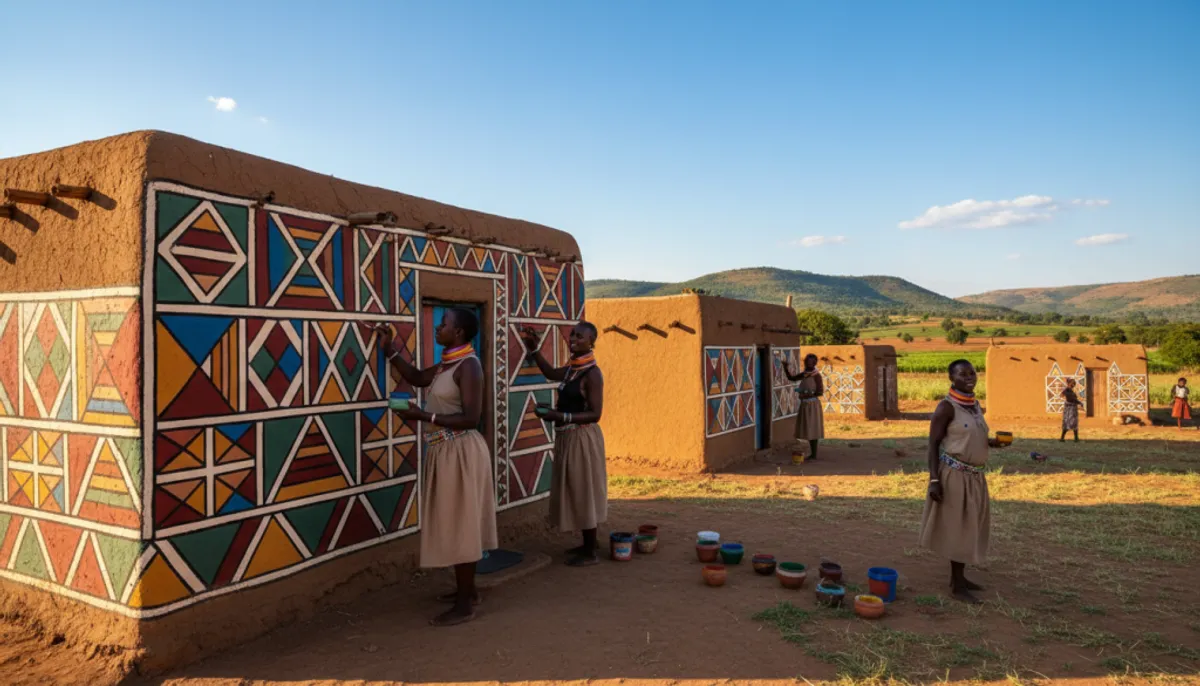
This article is an invitation to travel. We will explore the living traditions of the Ndebele, spread between South Africa and Zimbabwe. Their population exceeds four million individuals.
Their unique artistic expression, recognizable among all, fascinates the entire world. It manifests through bold geometric patterns that adorn houses and traditional attire.
This article will help you understand the essential role of women. They are the guardians of this heritage, particularly through mural painting and beadwork. Let’s discover how this identity brilliantly adapts to modernity.
Key Points to Remember
- The Ndebele are a people of Southern Africa, present in South Africa and Zimbabwe.
- Their cultural heritage is famous for its geometric art and bright colors.
- Women play a central role in the transmission of traditions.
- Their history is characterized by resilience in the face of challenges.
- This unique culture continues to evolve and adapt to the contemporary world.
- Ndebele art, particularly mural painting, is a strong visual signature.
Introduction to Ndebele Culture
At the heart of Southern Africa emerges an artistic expression that captivates with its uniqueness. This people belongs to the larger Nguni family, sharing linguistic roots with the Zulus.
Their language, isiNdebele, carries an evocative name. “Ndebele” means “those who disappear under their long shields.” This community practices both traditional African religions and Christianity.
The art of this group has gained spectacular worldwide recognition. In 1989, the exhibition “Magicians of the Earth” at the Centre Pompidou in Paris revealed their creativity to the international public.
Geographically, they are spread between South Africa and Zimbabwe. Their villages in the Limpopo and Mpumalanga provinces testify to living traditions.
This introduction allows us to grasp how centuries of history have forged a resilient identity. Their unique visual heritage continues to evolve in the face of contemporary challenges.
Origins and History of the Ndebele
The epic begins in the 16th century with historical movements to the north. This period marks the beginning of a fascinating history that shaped the identity of the people.
The Migrations and the Epic of King Mzilikazi
Around 1600, a Nguni group led by chief Musi leaves KwaZulu-Natal. They establish the foundations of the Ndzundza nation near Pretoria.
In the 19th century, Mzilikazi, a former lieutenant of King Shaka, leads a memorable rebellion. With his warriors, he founds a powerful kingdom north of the Drakensberg.
The Evolution of Ndebele Nations and Early Encounters
The successive migrations of different groups transform the region. These movements create exchanges with local populations.
In 1837, crossing the Limpopo, Mzilikazi settles permanently in Zimbabwe. This period forges a modern identity characterized by remarkable resilience.
These events over several years have profoundly influenced the development of the community. The legacy of this rich history endures today.
Ndebele Culture: Traditions and Customs
Ndebele traditional practices reveal a deep symbolism where every gesture and ornament carries a specific message. This symbolic richness permeates the daily life of the members of this community.
Daily Practices and Their Symbolism
The complex social system is based on the extended family. Celebrations and collective responsibilities strengthen community ties. This organization promotes social harmony.
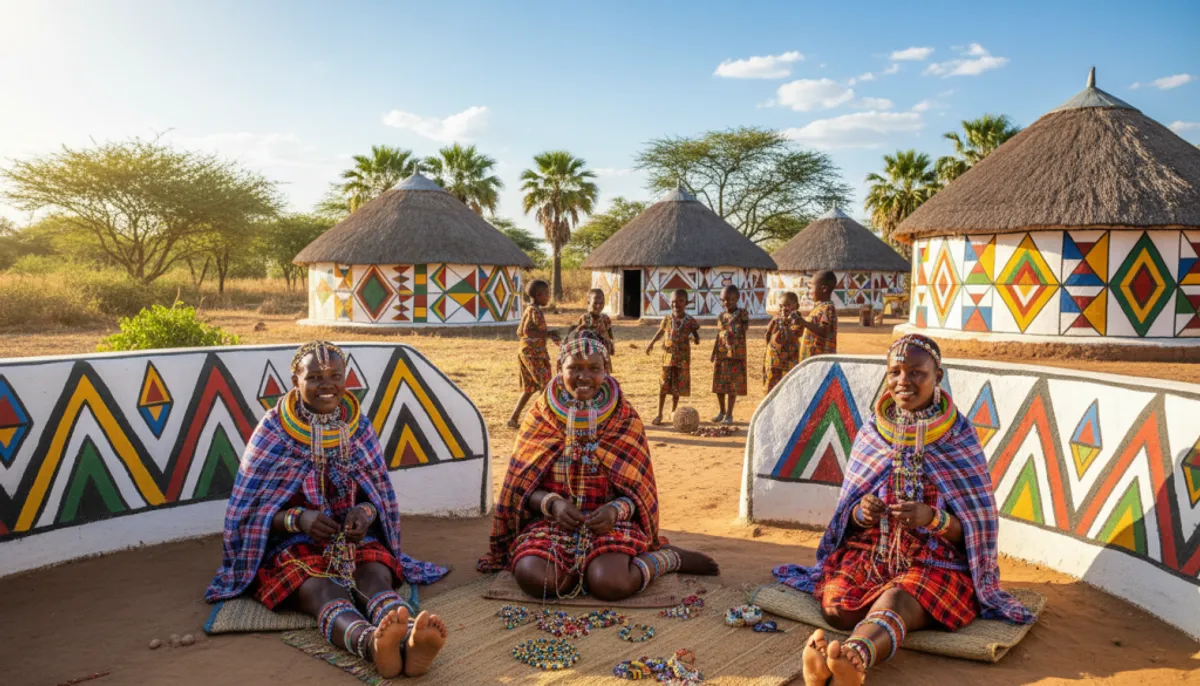
Traditional clothing adornments testify to an elaborate symbolic language. Married women wear copper rings that can weigh up to 25 kilograms. The number of rings indicates family social status.
| Traditional Element | Meaning | Context of Use | Main Bearer |
|---|---|---|---|
| Copper adornments | Marital status and prestige | Important ceremonies | Married women |
| Geometric patterns | Family events | Decoration of houses | Female artists |
| Bright colors | Emotions and messages | Clothing and artifacts | Entire community |
| Agricultural rituals | Cycle of life | Seasonal work | Community groups |
The oral tradition ensures the transmission of ancestral knowledge. Elders share stories and values with younger generations. This transmission keeps the cultural identity alive in the face of modernity.
Family ceremonies punctuate the year and mark important milestones. These moments of social cohesion reaffirm community values. They collectively celebrate the heritage passed down.
Visual Art and Architecture in Ndebele Villages
The villages transform into true open-air galleries thanks to a unique artistic tradition. Each dwelling becomes a living work of art, reflecting an exceptional visual heritage.
Mural Paintings and Decorative Patterns
Women hold the exclusive responsibility for decorating the facades. They create geometric patterns in vibrant colors that completely cover the walls.
Historically, they used natural materials like crushed stones and colored earth. Egg yolk served as a binder for certain specific shades.
Traditional Architecture and Materials Used
Men build the structures with an ingenious mix of manure and grass. This material dries and hardens in the sun, forming solid walls covered with thatch.
Each house follows an ancestral process preserved through generations. The arrangement of houses in the village reflects a precise social organization.
| Element | Traditional Technique | Modern Technique | Advantages |
|---|---|---|---|
| Painting materials | Crushed stones, colored earth | Acrylic paints | Superior durability |
| Color palette | Limited (white, brown, red, yellow) | Extensive and varied | More creative possibilities |
| Tools | Feathers | Modern brushes | Increased precision |
| Application | Ancestral techniques | Contemporary methods | Preservation of patterns |
This technical evolution allows artists to preserve traditional patterns while exploring new expressions. Mural art continues to resonate in every village, celebrating a unique identity.
The Role of Women in Artistic Expression
In this society, visual expression finds its source in the patient and meticulous work of artisans. Women hold an exclusive position in the creation and preservation of this heritage.
Transmission of Craft Skills
Learning begins at a young age. Girls attentively observe their mothers and grandmothers. This matrilineal transmission ensures the continuity of techniques.
Every gesture, every pattern carries a deep meaning. Elders patiently teach the secrets of their art. This tradition forges an unbreakable bond between generations.
The Impact of Beadwork and Adornments on Identity
Beadwork represents much more than mere decoration. Each bead attached one by one creates a unique visual language. These works communicate marital status and community belonging.
The lipotho apron, worn by married women, immediately symbolizes their condition. Beaded dolls offer protection during important events.
| Beaded Object | Shape | Meaning | Occasion |
|---|---|---|---|
| lipotho apron | Two strips with fringes | Marital status | Marriage |
| Ornamental dolls | Decorative figurines | Protection and blessings | Birth, puberty |
| Traditional jewelry | Necklaces and bracelets | Community belonging | Ceremonies |
| Ceremonial clothing | Elaborate outfits | Family events | Rites of passage |
This precious craftsmanship embodies familial love and cultural continuity. The creations become gifts filled with emotion and meaning.
Geometric Patterns and Bright Colors: Symbolism and Meaning
The visual universe of this people stands out with a grammar of shapes and hues with deep meanings. This unique artistic expression rests on a balance between tradition and personal creativity.
The Meaning of Shapes and Hues
The geometric patterns constitute an immediately identifiable visual language. Triangles, rectangles, and diamonds assemble into rigorous compositions. Each element once held a precise social meaning.
The bright colors – vibrant blues, intense reds, luminous yellows – are delineated by thick black lines. This contrast creates an extraordinary visual force. Historically, these colors communicated family status and recent events.
The Influence of Emotions on the Choice of Patterns
Today, the symbolic function has evolved. Artists draw from the traditional repertoire while expressing their sensitivity. The choice of patterns now reflects the mood and inspiration of the moment.
This creative freedom developed from the 1950s. Tourist interest transformed mural painting into a more personal artistic expression. The characteristic geometric style remains preserved.
The deep meaning today lies in the affirmation of a strong identity. These geometric patterns proclaim ancestral pride to the entire world.
Historical Context and the Impact of Apartheid on the Community
The 20th century marked a turning point in the history of this community, confronted with racial segregation policies. This political context profoundly disrupted traditional social organization.
As early as 1882, a conflict broke out between supporters of Nyabela and Boer settlers. After nine months of heroic resistance, the defeat led to the confiscation of ancestral lands. The community was dispersed and forced into five years of forced labor.
The Repercussions on the Lives of the Ndebele
During the apartheid period, the government created bantustans like KwaNdebele in the Southern Transvaal. These impoverished territories geographically fragmented the people. Freedoms and economic opportunities were drastically reduced.
This period of oppression caused immense suffering. Paradoxically, it strengthened unity around ancestral traditions. Artistic expression became an act of cultural resistance.
The Post-Apartheid Identity and Cultural Reclamation
Since 1994, the reclamation of identity has accelerated in South Africa. The former KwaNdebele was dissolved, and populations now live in different provinces. The artistic richness is celebrated as national heritage.
This cultural renaissance testifies to remarkable resilience. The unique identity today contributes to the rich fabric of the rainbow nation. The people continue to honor their heritage while adapting to the contemporary world.
Rituals, Ceremonies, and Cultural Heritage
Rituals and ceremonies represent the heartbeat of Ndebele social life. These ancestral practices create strong moments that reinforce community ties.
Initiation Rituals and Traditional Commemorations
Initiation rites occupy a central place in the life cycle. While young men isolate themselves in the hills after circumcision, their mothers repaint the facades of the houses.
This special occasion unites artistic expression with personal transitions. On December 19, the community gathers at KoNomtjharhelo to honor the ancestors.
The Transmission of Oral Traditions
The elders then share heroic tales with younger generations. This oral transmission preserves a precious heritage.
Family celebrations – births, weddings – strengthen unity. Each important moment is accompanied by traditional gifts and specific rituals.
These traditions ensure the continuity of a rich heritage in the face of modern challenges. The family and the community remain at the center of this transmission.
Traditional Craftsmanship and Modernity in Ndebele Expression
Esther Mahlangu embodies this successful fusion between ancestral heritage and contemporary creation. Born in 1935, this artist has brought the characteristic geometric style to the international stage.
Tourist Valorization and Economic Impact
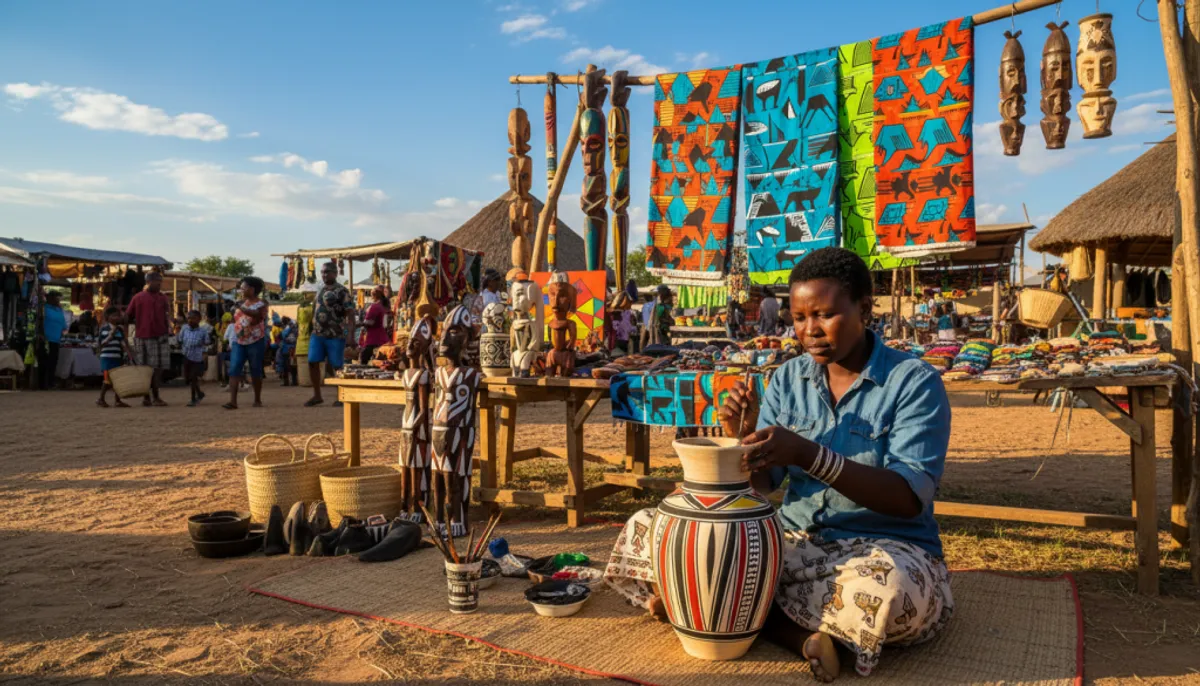
Since the 1950s, visitors have discovered this unique craftsmanship with fascination. They purchase painted house models and traditional objects. This demand creates significant income for communities.
| Type of Craft | Economic Impact | Evolution Since 1950 | Current Reach |
|---|---|---|---|
| House models | Direct family income | Small-scale artisanal production | International sales |
| Beaded dolls | Creation of local jobs | Traditional ritual objects | Tourist souvenirs |
| Traditional jewelry | Enhancement of craftsmanship | Community use | Global market |
| Contemporary works | Artistic recognition | Domestic mural paintings | Museum exhibitions |
Contemporary Adaptation of Ancestral Techniques
Esther Mahlangu and Francina Ndimande now use acrylic paints on canvas. They meticulously preserve traditional geometric patterns. Their work gains recognition worldwide.
These artists collaborate with prestigious brands like BMW. Their ancestral craftsmanship thus finds new vitality. This adaptation ensures the longevity of a precious heritage.
Conclusion
The journey of this people from South Africa illustrates remarkable cultural resilience. Despite historical challenges, their unique artistic expression continues to shine.
The murals and beadwork have transcended their traditional function. These practices are now celebrated in museums around the world.
This international recognition values a precious heritage. Communities preserve their traditions while adapting to contemporary realities.
Ndebele art remains a source of national pride. It embodies the strength of a people who transform adversity into beauty.
FAQ
Who is Esther Mahlangu and why is she important?
Esther Mahlangu is a globally recognized South African artist. She has played a key role in bringing Ndebele art to the world. Her bold work and vibrant colors have given international recognition to this heritage.
What is the meaning of the geometric patterns on the houses?
These shapes and hues are not just decorative. They tell a story and express emotions. Each pattern can symbolize life events, a family's status, or convey a message within the community.
How are craft skills transmitted from generation to generation?
Transmission primarily occurs through women. Mothers teach their daughters the techniques of mural painting and beadwork. This oral and practical tradition ensures that this unique craftsmanship endures through the years.
What has been the impact of apartheid on this community?
This period had severe repercussions on the lives of the people. Despite this, the community managed to cope and has engaged in a strong reclamation of its identity post-apartheid, revitalizing its traditions with great pride.
Has Ndebele art evolved with modernity?
Absolutely! While retaining its roots, artistic expression has adapted. Today, we see these geometric patterns and bright colors on various media, benefiting from tourist valorization that brings positive economic returns.