

The collective identity of a nation reveals itself far beyond tourist clichés. According to experts, this living mosaic combines ancestral traditions, artistic creations, and shared ways of thinking. It shapes our way of living together, celebrating, and even resolving conflicts.
Indeed, international institutions emphasize its central role in human development. This common wealth includes both local festivals and political institutions, artisanal know-how and technological innovations. A true mirror of a people's soul!
Paradoxically, this notion is constantly evolving. Younger generations reinvent practices while preserving the inherited legacy. Migrations and international exchanges add additional layers to this ever-changing picture.
In this guide, we will decipher together the mechanisms of transmission and adaptation. You will discover how shared values influence education, the economy, and urban planning. An exciting adventure at the crossroads of history and the present!
Get ready to explore a subject far more concrete than it seems. From family rituals to national laws, every detail tells a part of our shared history. Let’s begin this journey…
General Introduction to the Culture of a Country
It is impossible to understand a population without deciphering the invisible thread that connects its members. This powerful bond, studied in sociology, is nourished by collective practices that are constantly transmitted and reinvented. Specialists describe it as a dynamic reservoir shaping behaviors and mindsets.
This living system transcends individual boundaries. It unites people through common references: language, arts, values, or traditions. Exchanges between generations and communities constantly enrich this shared heritage.
| Traditional Elements | Modern Contributions | Social Impact |
|---|---|---|
| Folklore | New Technologies | Knowledge Transmission |
| Local Festivals | International Exchanges | Community Cohesion |
| Ancestral Craftsmanship | Artistic Innovations | Collective Identity |
Each nation thus develops a unique signature. This process creates stable reference points while integrating external influences. Citizens find both an anchor and an openness to the world.
The study of these mechanisms reveals why certain customs persist despite historical upheavals. It also sheds light on contemporary challenges related to diversity and global uniformity.
What is the Culture of a Country: Definition and Perspectives
Defining what unites a society is akin to exploring a kaleidoscope of meanings. As early as 1952, Alfred Kroeber and Clyde Kluckhohn listed 150 distinct interpretations of the term, revealing its fascinating complexity. This multiplicity of approaches forms an essential key today for deciphering national realities.

The humanities offer various lenses to observe this phenomenon. Anthropology studies rituals and beliefs, while sociology analyzes collective structures. Economics focuses on symbolic exchanges, and philosophy questions underlying values.
This diversity reflects a fundamental characteristic: human practices blend tangible and intangible dimensions. A historical monument coexists with oral traditions, social laws with artistic creations. Each element enriches the others.
The evolution of interpretations primarily shows our capacity to reinvent common reference points. Technological mutations and migrations constantly transform symbolic boundaries. A unique definition would quickly become obsolete in the face of this ongoing movement.
Adopting a multidisciplinary perspective allows us to grasp the richness of national identities. This living synthesis illuminates both the legacies of the past and contemporary challenges, offering a valuable guide to navigate our interconnected world, while highlighting the knowledge that arises from it.
History and Evolution of the Concept of Culture
The journey of the word “culture” resembles a seed that has become a millennial tree. Originating from the cultivated fields of antiquity, this term has germinated in all areas of human knowledge. Its evolution reflects our changing perspectives on the development of societies.
Historical and Influential Origins
The history begins with the Latin verb colere, related to agriculture. Cicero makes a brilliant turn by comparing human education to the work of the land: “The mind is cultivated like a fertile field”. This metaphor plants the roots of a revolutionary idea.
For centuries, the concept remains tied to individual scholarship. The Enlightenment in the 18th century broadens this vision. Philosophers and scientists add the collective dimension, paving the way for modern studies.
Transformations and Key Periods
The 20th century accelerates this maturation. The world conference in Mexico in July-August 1982 marks a crucial milestone. For the first time, 126 states define cultural heritage as encompassing living traditions and contemporary creations.
This historic meeting illustrates how international exchanges shape our conceptions. Each era contributes its fertilizer to this ongoing growth. Today, the term transcends borders to embrace global interactions.
From an agricultural tool to a conceptual tool, this evolution reveals our constant need to make sense of the world. The heritage of ideas thus enriches from generation to generation, like a garden without a fence.
Plurality of Definitions of Culture
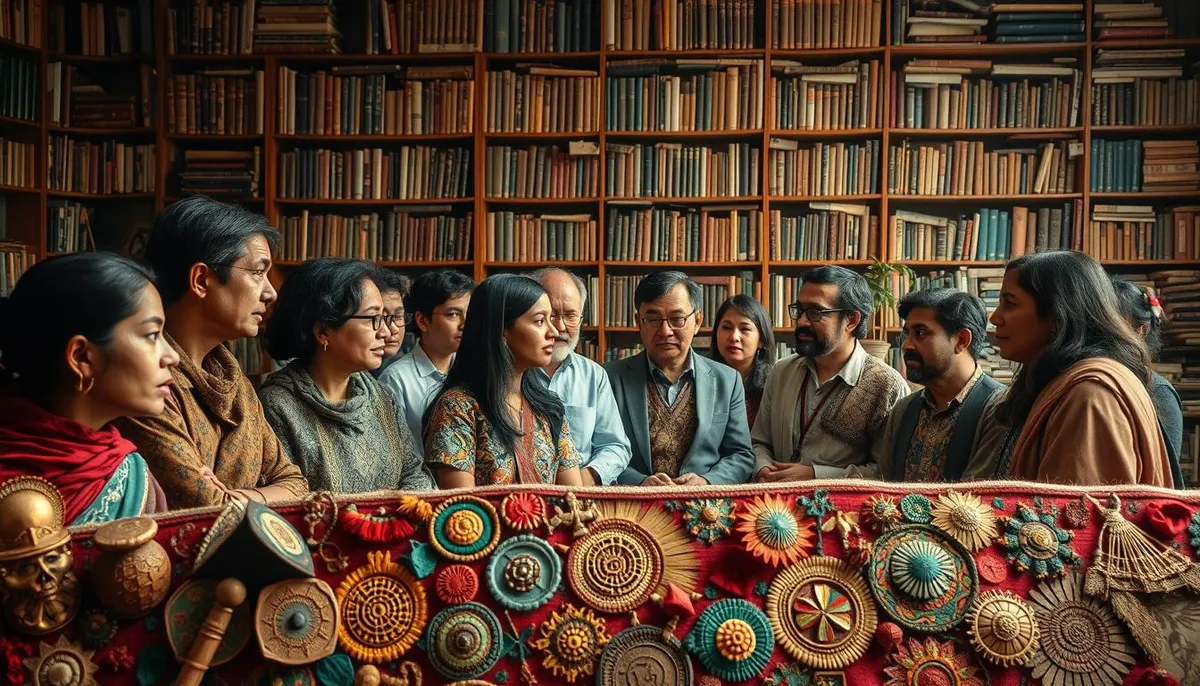
Deciphering the multiple facets of a society requires varied conceptual lenses. Researchers use complementary analytical frameworks to grasp this shifting reality, each revealing distinct aspects of our collective mental programming.
Sociological and Anthropological Approaches
Geert Hofstede compares societies to social computers operating with invisible software. His theory of collective mental programming shows how shared norms guide the behaviors of a group. This systemic vision sheds light on the mechanisms of social cohesion.
Cultural anthropology adopts a tangible perspective. It studies everyday objects, artisanal techniques, or rituals that mark geographical space. A traditional potter and his foot-operated wheel tell as much as a law text on national identity.
These methodologies diverge but mutually enrich each other:
- Sociology analyzes the systems of values and their impacts on collective organization
- Ethno-archaeology tracks the material traces left by human groups
- Both disciplines intersect historical data and contemporary information
This complementarity allows us to transcend theoretical divisions. It offers a dynamic mapping where traditions and innovations constantly interact, redrawing the symbolic boundaries of nations, including those of Quebec heritage and Quebec elements. By integrating Quebec perspectives, this dynamic enriches cultural dialogue, especially regarding Quebec contributions and heritage. This approach also highlights the importance of Quebec heritage in the global cultural landscape, while emphasizing the influence of Quebec heritage. Furthermore, the diversity of cultural expressions from Quebec, including Quebec traditions, contributes to this richness.
Individual Culture versus Collective Culture
Did you know that the same word can describe both your latest reading and the DNA of a civilization? This semantic duality of the term culture reveals two complementary realities. On one side, personal knowledge shaped by education and experiences. On the other, the invisible cement that unites millions of people.
The first meaning refers to an intimate treasure: technical skills, artistic references, or accumulated historical knowledge. Each individual develops this mental library unique to their choices and encounters.
The second meaning, which emerged after 1950, encompasses shared social structures. Collective rituals, educational systems, and symbolic creations form this common heritage. These two dimensions constantly feed into each other:
| Individual Aspect | Collective Aspect | Interaction Zone |
|---|---|---|
| Language Learning | National Language | Schools and Media |
| Musical Tastes | Folklore Heritage | Local Festivals |
| Religious Practices | Institutionalized Worship | Places of Worship |
Museums perfectly illustrate this dynamic. They preserve works from individual creators while transforming them into common goods. By exploring these places, one can also discover Moroccan historical sites that enrich our understanding of heritage. Visitors draw inspiration for their own productions from them.
This ongoing interaction explains why national identities evolve without dissolving. New generations reinterpret traditions while adding their personal touch. A delicate balance between heritage and innovation, which can be analyzed through the lens of cultural anthropology.
The Essential Components of Culture
Deciphering the invisible foundations of a society involves exploring a puzzle with interdependent pieces. Four key elements articulate to form this symbolic framework: values, norms, institutions, and artifacts. Their constant interaction outlines the contours of a collective identity in perpetual motion.
Values, Norms, and Belief Systems
Values act as a moral compass. They define common priorities and guide daily decisions. An example? The importance placed on family or work varies radically depending on geographical contexts.
Around this core gravitate belief systems. Whether religious or secular, they respond to major existential questions. These interpretive frameworks shape individual and collective behaviors.
Institutions and Cultural Artifacts
Museums, schools, or courts embody formal institutions. But informal structures – like family circles – play an equally crucial role. Together, they ensure the transmission of symbolic systems.
Material artifacts (monuments, works of art) and immaterial ones (tales, music) serve as a bridge between generations. Their study reveals the evolution of traditions and their adaptation to contemporary realities.
| Component | Function | Concrete Example |
|---|---|---|
| Values | Moral Guidance | Importance of Equality |
| Norms | Social Regulation | Rules of Politeness |
| Institutions | Transmission | Educational System |
| Artifacts | Identification | Traditional Costumes |
This complex network explains why certain practices resist historical upheavals. Each element reinforces the others, creating a dynamic balance between permanence and change.
The Artistic and Heritage Dimension
Stones and musical notes sometimes speak louder than speeches. The architectural heritage reveals much more than styles: it exposes the technical ingenuity and aesthetic dreams of an era. Gothic cathedrals or Renaissance castles, each building tells of a human conquest over matter.
But the soul of a nation also vibrates in its traditional melodies and folk tales. The orally transmitted stories preserve forgotten values, while musical scores capture shared emotions. These intangible treasures traverse the centuries without losing their evocative power.
Artistic creation acts as a distorting mirror. It magnifies everyday realities while projecting universal aspirations. A medieval stained glass window and a contemporary urban mural thus dialogue across ages, revealing cultural constants.
Protecting these heritages does not mean freezing them. Modern artisans reinterpret ancestral techniques with digital tools. Writers blend regional languages and urban slang. This ongoing alchemy breathes life into cultural heritage, transforming relics of the past into resources for tomorrow. The definition of a cultural object is therefore essential to understand how these elements interact and evolve in our society.