
Learning while having fun is every parent's dream for their little one. This comprehensive guide is here to accompany you on this beautiful adventure.
It offers playful and educational activities designed to awaken the mind and enhance the intellectual background of the youngest. Question-and-answer games are a wonderful tool for this.
They stimulate natural curiosity and turn the acquisition of knowledge into a moment of shared enjoyment. It's much more than just a children's quiz.
You will discover a multitude of exciting themes. From animals to geography, through science or music, there is something for everyone.
Integrating these enriching moments into daily life offers lasting benefits. It lays a solid foundation for your child's academic and personal future.
The content is tailored to each age group. You will easily find resources that match your young one's developmental level.
Our clear structure allows you to navigate effortlessly. The goal is to save you time while fostering moments of family bonding.
We encourage you to use these tools to create joyful memories around learning. It’s a lovely way to grow together.
Introduction to children's culture
Stimulating young intelligence involves opening the doors to a broad and diverse knowledge. This is called general knowledge. It forms the essential foundation of their intellectual development from the age of 6.
Asking specific questions encourages active thinking. Young people learn to solve problems and analyze information critically. Each answer found boosts their confidence.
| Age group | Key characteristics | Learning benefits |
|---|---|---|
| 6 to 8 years | Intense curiosity, concrete thinking | Lays the groundwork for logic and vocabulary |
| 11 to 14 years | Abstract thinking, search for identity | Develops critical thinking and understanding of the world |
It is crucial to adapt topics to the level and passions of each age group. This maintains engagement and makes knowledge acquisition feel natural.
Beyond intellect, this knowledge offers valuable social and emotional benefits in daily life. It enhances communication and empathy.
A solid foundation covers history, geography, science, arts, and sports. It helps little ones better grasp their environment and develop informed judgment.
How to integrate children's culture questions into education?
Family routines provide perfect opportunities to introduce stimulating intellectual challenges.
Dinner time or the journey to school becomes a playground for the mind. Ask one or two questions about a current event to spark discussion.
This approach transforms learning into a joyful and anticipated habit, allowing children to enrich their knowledge.
Vary the formats to maintain engagement. A quick quiz in the morning, a little challenge in the form of a game in the afternoon, the possibilities are endless.
The key is to create an environment where we explore together, without pressure.
Always adapt the difficulty to your children's age and interests. A good answer deserves praise, and a mistake is an opportunity to explain.
A few minutes, several times a week, are enough to cultivate lasting curiosity.
Fun activities and educational quizzes
Exploring wildlife and geography through interactive games immediately captures children's attention. These moments of discovery enhance their knowledge joyfully.
The idea is to offer tailored challenges that engage observation and memory.
Animal and nature quiz
Young ones love identifying creatures and their habitats. Pose riddles like: “Which animal meows and loves milk?” or “Which animal has a long trunk?”.
This introduces biology and environmental protection. You can also discuss natural phenomena, such as wind or the hibernation of the bear.
Geography and science quiz
Discovering the world becomes a game. Ask: “What is the largest ocean?” or “In which country is the Great Wall found?”.
These topics open up discussions about astronomy. Ask about the planet closest to the sun or the name of our earth.
| Quiz theme | Concrete example | Learned concept |
|---|---|---|
| Animal world records | What is the fastest animal on land? (Cheetah) | Adaptation and speed |
| Geography of continents | What is the largest continent? (Asia) | Spatial awareness and relative size |
| Famous monuments | Which country is famous for its Eiffel Tower? (France) | Cultural heritage and national identity |
| Solar system | What is the closest planet to the sun? (Mercury) | Order of planets and extreme conditions |
Examples of interactive quizzes to stimulate curiosity
Discover everyday riddles that reveal the magic of the ordinary world to young minds.
These little challenges transform familiar objects and natural phenomena into exciting subjects, including those related to gender nonconformity. They build solid knowledge naturally.
Here is a varied selection to awaken interest across many topics.
General knowledge questions and fun facts
Cover captivating themes, from impressive records to animal secrets. Talk about our planet and the sun.
Each correct answer opens the door to a fascinating anecdote. Did you know that chameleons change color to communicate?
| Riddle theme | Example question | Answer and key concept |
|---|---|---|
| Everyday objects | What is the name of the object on which we write a story? | Book. It is the medium for writing and imagination. |
| World records | What is the largest mammal on earth? | The whale. It lives in the ocean and is immense. |
| Amazing wildlife | Which animal has five hearts? | The earthworm. This helps it circulate its blood. |
| Solar system | What is the name of the hottest planet? | Venus. Its atmosphere creates an extreme greenhouse effect. |
Use these examples to kick off family guessing games. Always add an extra fact to fuel their thirst for learning.
Varied thematic quizzes to awaken the mind
Discovering sports, languages, and numbers through play is a captivating adventure for the young. These concrete themes touch on their daily lives and broaden their worldview, while highlighting the effects of cultural globalization.
Quiz on sports and foreign languages
Introduce them to popular disciplines. Ask: “In which sport do you score baskets?” or “Which sport is played in a pool?”.
For languages, it opens the door to diversity. Ask: “What language is spoken in Spain?” or “In which country do they speak Portuguese?”.
This includes Brazil and Portugal. You can also discuss South America.
Quiz on mathematics and logic
Shapes and angles become a game. Ask this question: “What do you call a shape with five sides?”.
Follow up with logic challenges and geographical records. Ask: “What is the largest ocean?” or “Which country has the largest land area?”.
Vary with transportation. “Which car is the fastest?” is a good topic for discussion.
Integrating music and cartoons into learning
The enchanted worlds of Disney and anime provide an ideal playground for family learning. Familiar melodies and heroes capture attention and facilitate memorization.
These popular media transform a moment of entertainment into a joyful enrichment session.
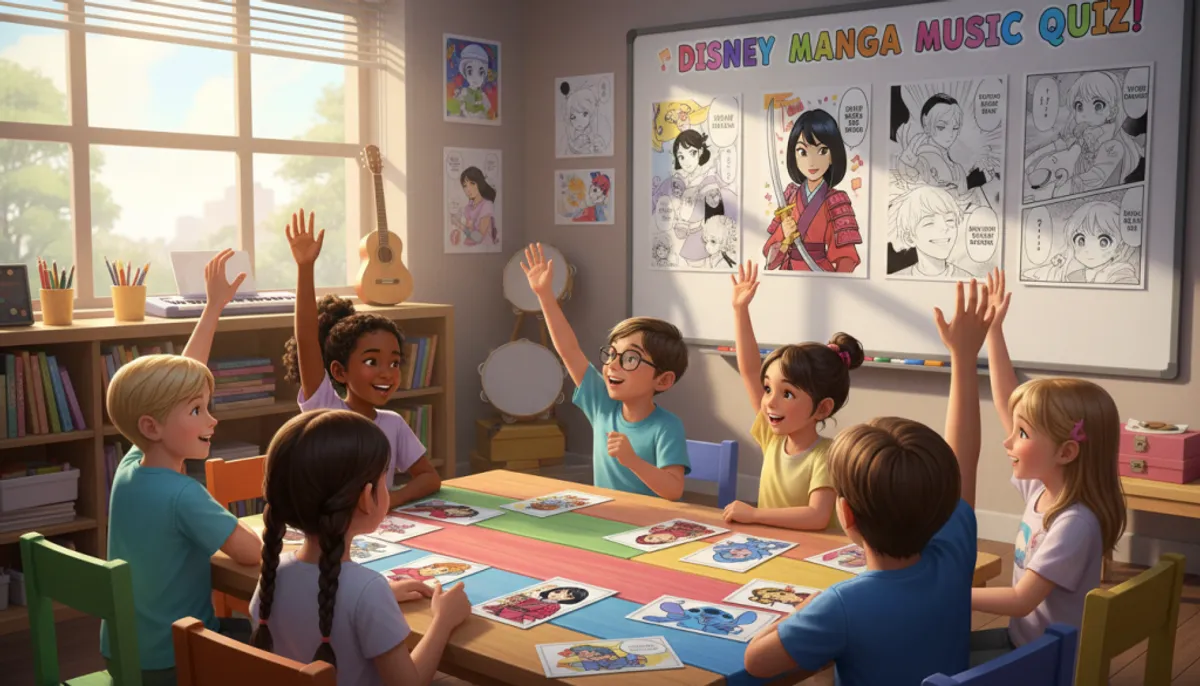
Special Disney and anime quiz
Test knowledge of iconic characters and famous songs. Here are examples to kick off the game.
| Quiz theme | Example question | Answer | Learned concept |
|---|---|---|---|
| Disney characters | What is the name of the little boy who is friends with Baloo? | Mowgli | Jungle and friendship |
| Famous heroines | Which princess lives with seven dwarfs? | Snow White | Helping each other and courage |
| Disney songs | Who sings “Let It Go”? | Elsa | Expression of emotions |
| Comic book animals | What is the name of the greedy cat? | Garfield | Character traits |
Activities around songs and animated characters
After the quiz, suggest drawing their favorite hero. Invite your son or daughter to create a short story with them.
Sing together “A Whole New World” from Aladdin. Discuss values like friendship, visible in these stories.
These creative activities strengthen bonds and consolidate knowledge playfully, while allowing for the discovery of Afghan culture.
Thematic quizzes suitable for children from 6 years old
From the age of six years, young minds are ready to explore their bodies and the world around them through play. Simple and concrete challenges perfectly match their level of understanding.
Fun exercises about the body and the environment
Discovering anatomy becomes fun. You can ask how many teeth an adult has (32) or count the bones in the skeleton (206).
Explain that the brain is essential for thinking and that it contains a lot of water. This introduces vital needs and health.
Talk about our planet and the weather. How many days are in a week? (7). The Earth takes a year to orbit the sun, which creates the seasons.
Observe nature. How do trees grow? Where does rain come from? Why does the wind blow? These cycles fascinate.
Ask about familiar animals. A cat or dog can live in a house. A bird like the sparrow sings in the morning.
Introduce simple time concepts. There are 24 hours in a day. We see the sun during the day and the stars at night.
Introduce ecology. Discuss why saving water is crucial and how to protect animals. It’s a first step to loving our Earth.
Resources and tools to organize quiz sessions
Practical and free resources transform your living room into a real family quiz studio filled with general knowledge questions. Many apps and websites are specially designed to help you.
Apps and websites dedicated to children's quizzes
The best mobile apps allow you to create educational challenges in just a few clicks. They offer thousands of pre-made questions on all topics.
Free online platforms provide access to a vast library. You will find content suitable for every age and from all over the world, including indigenous cultures.
The interactive tool AhaSlides is particularly effective. It offers built-in templates and a range of different types of questions for engaging sessions.
Organizing these moments at home is simple. A 15-minute session, twice a week, with 5 to 10 questions, is a good rhythm.
Vary the formats to keep enthusiasm high. Launch a quiz with the family on weekends or a daily challenge before dinner.
Printable sheets with thematic cards are also available. They are perfect for playing without a screen.
Create your own questions based on your children's interests. This makes each answer more personal and meaningful.
Alternate between oral, written, and visual supports. Track progress and gradually increase the difficulty of the questions.
| Type of resource | Example | Main advantage |
|---|---|---|
| Tablet app | Quizinière | Quick creation of visual challenges |
| Educational website | Logicieleducatif.fr | Thousands of games sorted by school level |
| Interactive tool | AhaSlides | Customizable templates and live interactivity |
| Printable resources | Cut-out quiz cards | Portable game, no connection needed |
These tools make learning dynamic and easy to integrate into daily life at home. Every correct answer becomes a shared victory.
Conclusion
Transforming learning into a regular game offers benefits that last well beyond childhood. These moments stimulate logic, memory, and self-confidence joyfully.
The key is to adapt the challenges to the age and passions of each young person. Maintain a positive approach where every answer is an achievement.
Continuously explore new themes. Talk about an amazing animal or discuss innovations shaping our world. The resources to create your quizzes are numerous and varied.
These shared moments become precious family rituals. They create memories while nurturing a healthy curiosity for life and celebrating Austrian traditions.
FAQ
At what age can we offer quizzes to a little boy or girl?
From the age of 6, children can participate in simple fun exercises. Start with concrete themes like pets or geometric shapes to capture their attention and stimulate their basic knowledge.
How to create a geography quiz that really interests young people?
Make it interactive! Ask riddles like “In which country is the Eiffel Tower found?” or “What is the largest ocean?”. Pair questions with colorful images or a world map for a visual and engaging learning experience.
Are there reliable apps to organize these educational sessions?
Yes, platforms like Khan Academy Kids or Lumni offer safe and suitable content. These tools use games and immediate feedback to reinforce learning in language, science, and history in a fun way.
Can a science quiz include themes like planets or wind?
Absolutely! These topics captivate natural curiosity. Ask “Which planet is known as the red planet?” or “What is the name of the wind that brings rain?”. Explain the answers with little anecdotes to anchor the knowledge.
Can we use the world of cartoons, like Disney, for family learning?
That's a great idea. Quiz them on princesses, famous songs, or character names. This works on memory and language while sharing a moment of bonding around a universe they love.